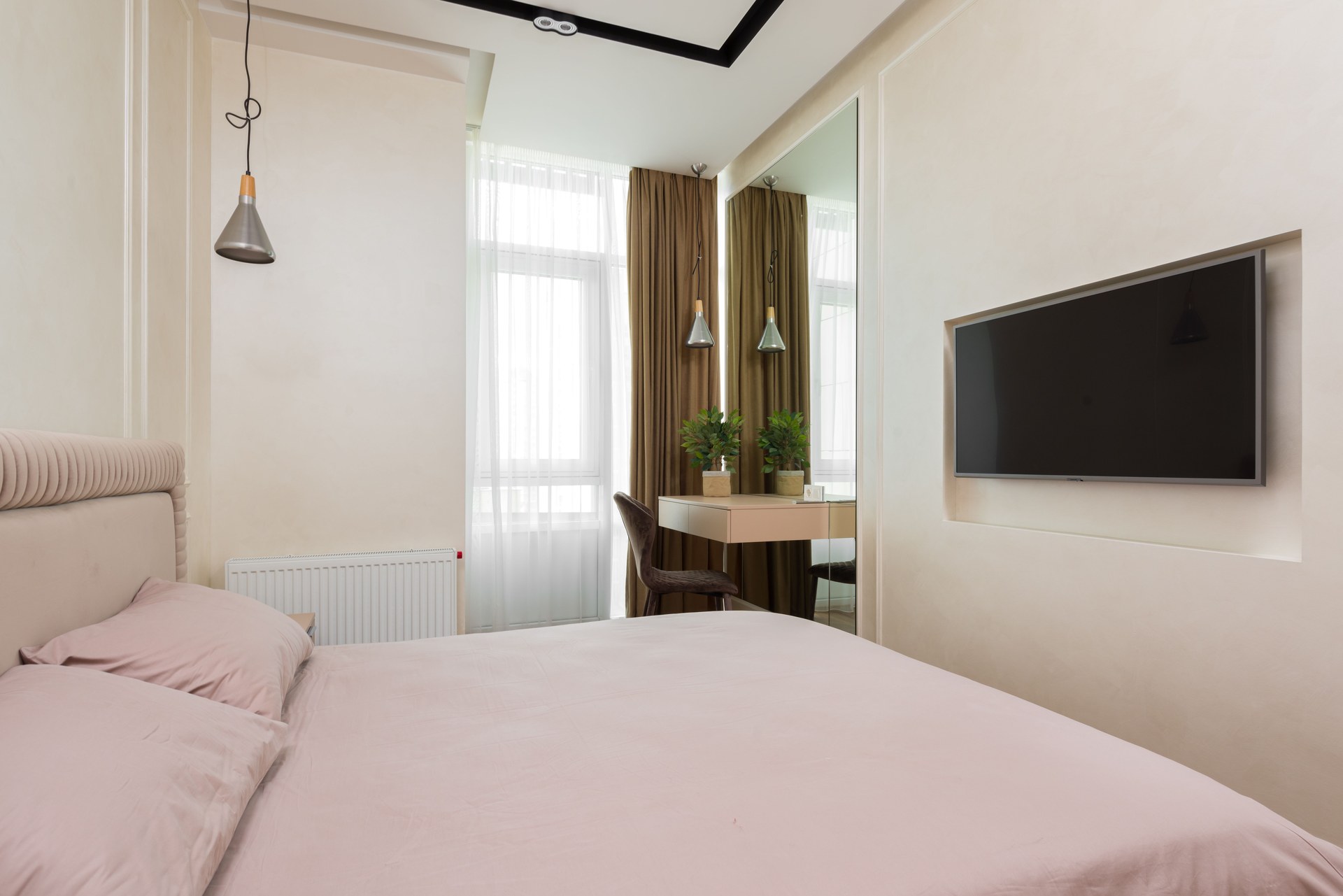
In a small room, the commanding position means placing the bed, desk or sofa so its user can see the door from where they sit or lie, without being directly in line with it — even if that means the piece sits diagonally across a corner, a few inches from a wall, or facing a window instead of the ideal compass direction. The room’s size limits the options; it does not remove the principle.
What Is the Commanding Position, Exactly?
The commanding position is the placement of the main piece of furniture in a room — usually a bed, desk or sofa — so the person using it faces the door but is not directly in line with it, and ideally has a solid wall behind them rather than open space or a window. It comes from Form School (Xingshi) reasoning about sightlines and vantage: a person who can see who enters a room, without sitting exposed in the doorway’s direct path, is in a stronger position within the space. A longer explanation of the rule itself, including where it came from, is covered separately on what the commanding position actually means in feng shui.
The rule is sometimes stated as if it were universal across the tradition. It is closer to a shared instinct across schools than a single fixed rule — the BTB (Black Sect) adaptation and Form School both value it, but they reach it by different reasoning, and Compass School practitioners weigh it against a person’s personal directions calculated from their birth data, which the other two do not use at all.
Why Is This Harder in a Small Room?
A small room usually has one door, one or two walls interrupted by windows, and not enough floor area to place a bed or desk on the wall directly facing the door without also blocking it or crowding the exit path. In a larger room, there are normally two or three walls that would satisfy the commanding position; in a small one, there may be only a single workable wall, and it may not be the “correct” one by any school’s compass calculation.
This is the recurring problem covered across the site’s Small Spaces section: the commanding position, clutter reduction and a workable circulation path all compete for the same limited floor. Something has to be prioritised, and the tradition itself gives some guidance on which.
Where Should the Bed Go If the Room Is Small?
Priority goes first to seeing the door from the bed, second to not being directly in line with it, and third to having a solid wall behind the headboard. Where all three cannot be satisfied, most guidance treats the first two as the ones worth keeping.
In practice, this often means the bed is placed on a diagonal into a corner, rather than centred on a wall — a solution frequently suggested in small-room guidance precisely because it opens up a sightline to the door that a straight, wall-flush placement would not. Details on this specific arrangement are set out in the site’s guide to where the bed should go in a bedroom, and the trade-offs of a bed placed under a window — sometimes unavoidable in a small room — are addressed in the piece on a bed positioned under a window.
What If the Door and Only Wall Line Up Against Each Other?
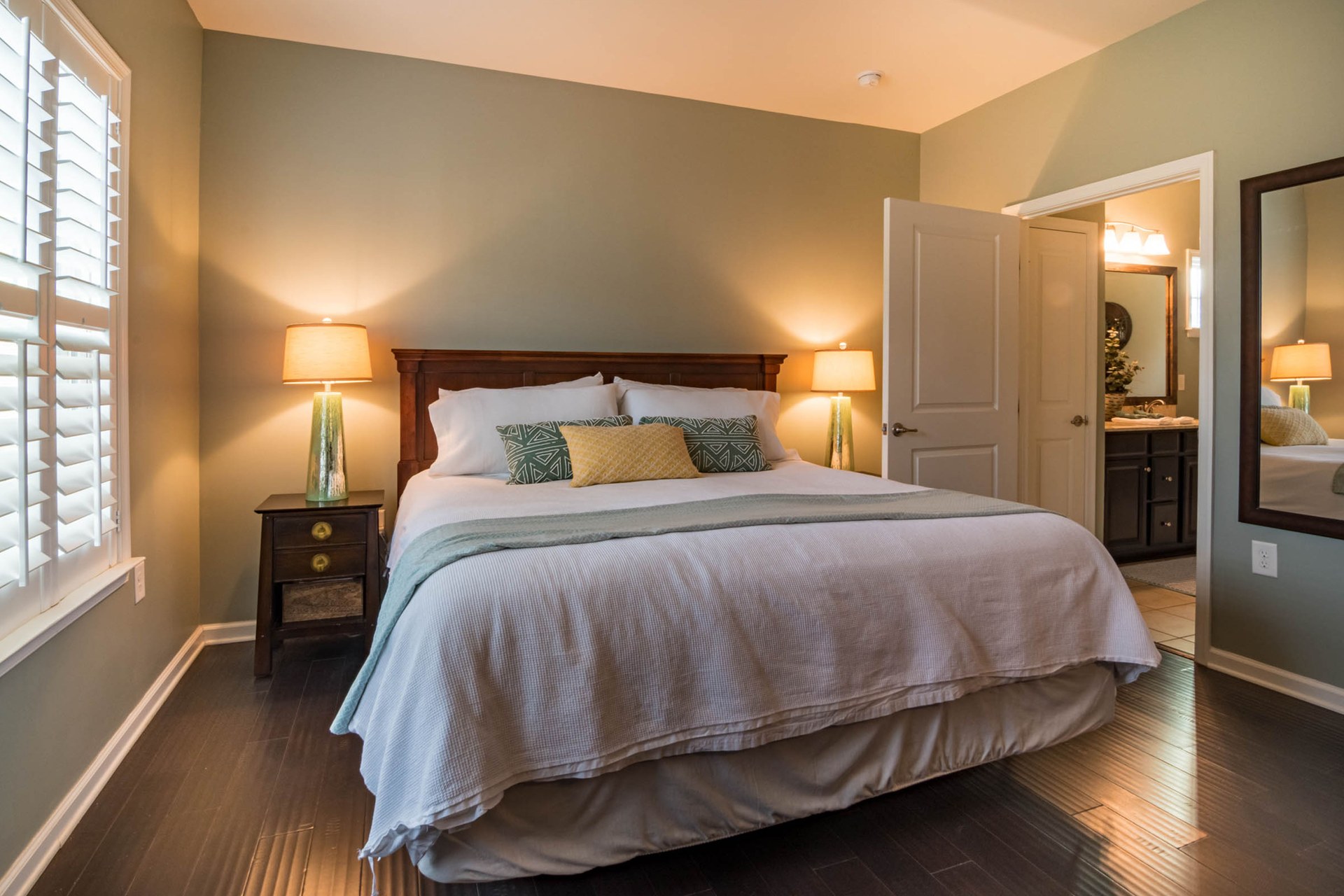
Some small rooms genuinely have no wall that both faces the door and sits out of its direct line — the door opens onto the only usable wall, or the room is narrow enough that every placement is in the doorway’s path. In this situation, the tradition offers workarounds rather than a solution: angling the piece away from a straight line to the door even by a small degree, using a furniture placement that leaves a visual buffer such as a low shelf or plant between the foot of the bed and the door, or accepting the compromise and addressing it with a mirror (discussed below).
This exact scenario — a bed that cannot physically be moved to a commanding position — is covered in more depth in what feng shui actually suggests when the bed can’t be moved, including why practitioners generally treat this as a matter of degree rather than pass or fail.
Can a Mirror Substitute for a Direct View of the Door?
A mirror positioned to reflect the doorway is a commonly suggested workaround when a bed or desk cannot physically be turned to face the door directly. The reasoning given is that the sleeper or worker can still see who enters, even indirectly, which restores part of the original purpose of the rule.
This comes with a separate caution, though: a mirror facing the bed directly is treated in Form School guidance as its own problem, unrelated to the door issue, because of the disturbed reflection it creates over a sleeping body. The two concerns — mirror-as-fix and mirror-as-problem — are easy to conflate, and are separated out properly in whether a mirror facing the bed is actually a problem and in the general reference on mirrors in the bedroom.
What About the Desk in a Small Room?
The same logic applies to a desk as to a bed: face the door, avoid sitting with your back to it, and avoid a straight line from the door to the chair where possible. In a small room used for both sleeping and working, this becomes a placement puzzle with two commanding positions competing for the same limited wall space, which is covered directly in the guide to arranging a work corner and, for direction-specific reasoning some Compass School practitioners apply to desks, in desk direction.
Where the desk sits inside a bedroom rather than a separate room, there is an additional set of considerations — about rest and work occupying the same visual field — addressed in the piece on a home office in a bedroom.
Does the Commanding Position Apply to Sofas Too?
Yes — the same three priorities (sightline to the door, not directly in line with it, solid support behind) are applied to a sofa in a small living space, though with less consequence attached, since a living room is occupied while awake and alert rather than asleep. In a studio or one-room home where the sofa also functions as the main seat for the household, this sits alongside decisions about zoning the room at all, which is covered in the guide to separating sleeping and living areas in one room and the broader studio apartment guide.
What Feng Shui School Is This Rule From?
The commanding position, as commonly taught in English-language sources, is largely a Form School concept adopted and simplified by the BTB adaptation, which places less weight on compass direction than classical Compass School (Liqi) does. A Compass School reading would also factor in the occupant’s personal auspicious directions, calculated from birth data, before deciding where a bed or desk should sit — something the door-and-wall version of the rule does not consider at all.
This is a useful example of a broader pattern on this site: most single-sentence “rules” circulating online are one school’s position, stated as if it were shared by all of them. The reasons different consultants give conflicting advice on the same room are explored in why feng shui consultants disagree with each other, and general caution about unattributed advice is covered in what to ignore in most online feng shui advice.
When It’s Genuinely Impossible to Get a Command View
Some rooms cannot accommodate the commanding position under any arrangement — a single door, a single usable wall, and a floor plan that leaves no diagonal option. In this case, the tradition does not offer a guaranteed fix; it offers partial mitigations, and it is honest to say so rather than claim a workaround solves the problem completely.
For renters in particular, structural limits often overlap with what a lease permits changing at all — fixtures, wall-mounted items, sometimes even furniture layout in shared accommodation. That overlap is addressed directly in what feng shui says about renting and things you can’t change. This article is a guide to a traditional design framework, not building, tenancy or safety advice; where a layout change affects fire egress, a landlord’s fixtures, or a shared space, that is a matter for the tenancy agreement or a qualified professional, not for feng shui guidance.
None of this is a claim that furniture placement produces a measurable outcome. What Form School and BTB both describe is a preference for sightlines and a sense of vantage within a room — a design logic with an ordinary, checkable rationale behind it, even where the room itself won’t fully allow it. Related layout constraints — beams, long narrow rooms, rooms with two doors — are covered across the site’s Layout & Furniture section for readers dealing with a similar mismatch between the room they have and the rule as usually stated.
Related reading
What Does Feng Shui Say About Storage in a Small Home?, How Do You Handle a Home With No Hallway?, What Does Feng Shui Say About a Small Bedroom?, The Basics, Flow, Light and Small Spaces
About this site. Feng Shui Pack explains what the feng shui tradition holds and which school holds it, from published sources. Feng shui is a tradition of placement and orientation, not a science: nothing here will bring you wealth, health, luck or a relationship, and we never claim otherwise. Where a suggestion has an ordinary practical reason — daylight, airflow, sightlines, less clutter — we say so; where it does not, we say that too. This is not medical, financial, legal or tenancy advice. If a decision matters, talk to a professional in that field.