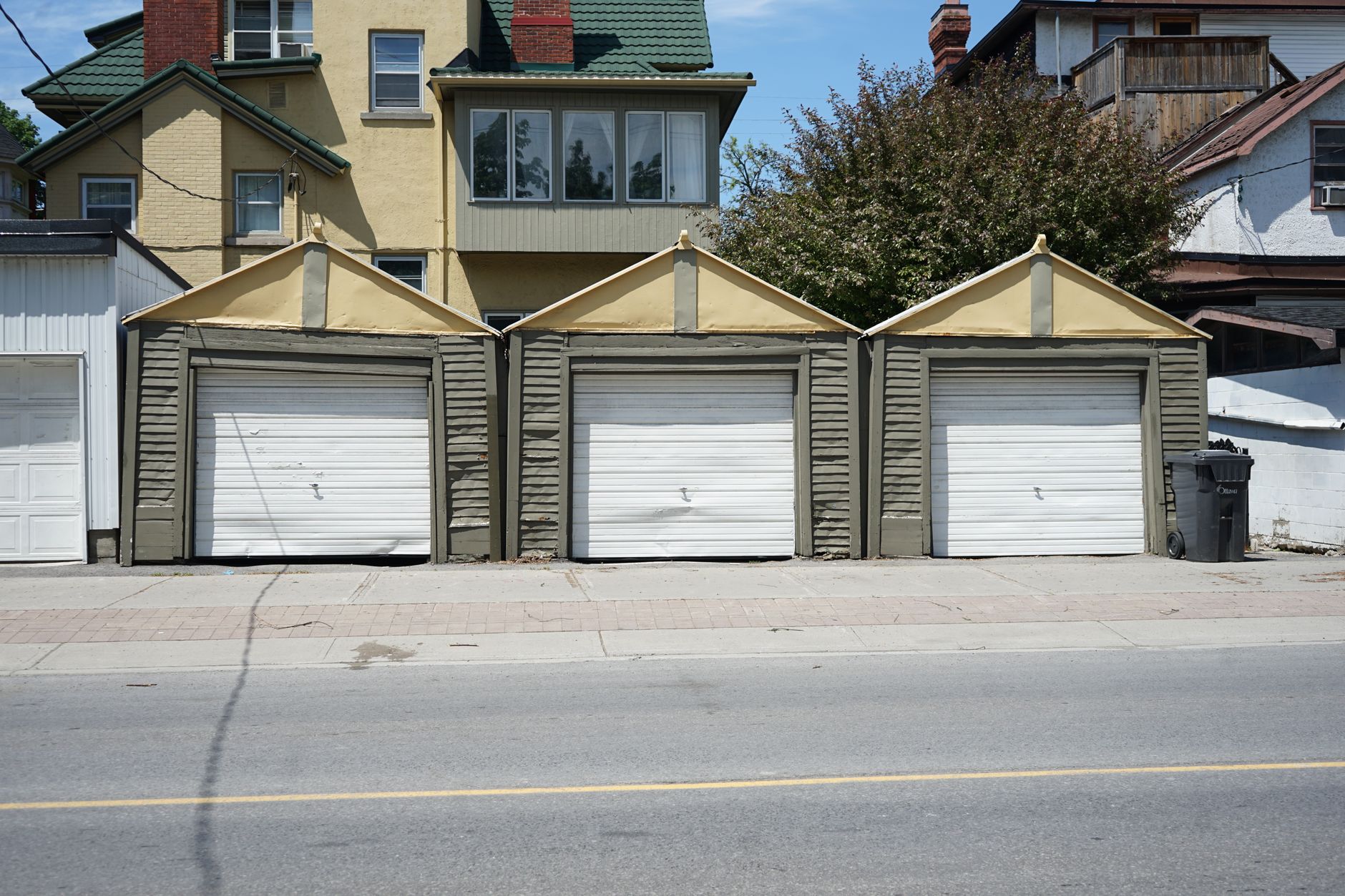
Feng shui traditions generally treat a garage facing the street as a secondary entrance that competes with the front door for the house’s chi (qi), the flow of energy the tradition treats as entering a home through its openings. The concern is usually about which door dominates, not the garage itself.
This is not one uniform rule. Form School, Compass School and the Western Black Sect (BTB) adaptation approach the garage question differently, and most of what circulates online is BTB material presented as if it were the whole tradition. Below is what each actually says, and where there is no practical reasoning behind a claim, that is stated plainly rather than dressed up.
Why does a garage door draw attention in Form School?
Form School reasoning centres on the shape and scale of what faces the street. A garage door is typically larger than a front door, and in Form School terms a larger opening is read as a stronger, more dominant point of entry for chi than the door beside it.
The practical observation underneath this is straightforward: on many house fronts, the garage door is visually the biggest feature, and the front door can look secondary by comparison. Form School texts describe this as the house “receiving” more through the garage than through its formal entrance, which is treated as an imbalance rather than a fixed misfortune.
This overlaps with a broader concern about entrances covered on the site’s Entrances & Flow pages — a home is expected to have one clear, legible point of arrival, and competing openings are read as diluting that.
Does the garage count as the main entrance to a house?
Functionally, in many houses, yes — the garage is the door used daily, while the front door is opened for visitors only. Feng shui traditions generally hold that whichever door is used most is the one that actually matters for the flow of chi, regardless of which one is architecturally “the front door.”
This is a claim, not a settled fact: it appears consistently across Form School and BTB writing, but there is no way to verify it as anything other than a traditional premise. Practitioners in both schools suggest that if a household enters through the garage most days, that door should be treated — swept, lit, kept clear — with the same attention usually reserved for the front door. The reasoning given is that a door used constantly has more practical bearing on the household’s daily experience of the house than one rarely opened, which is also simply true as a matter of habit and light.
What is said about a garage facing a T-junction or a straight road?
Where a garage (or the house generally) faces directly down a straight road, or sits at the end of a T-junction, classical Form School describes this as a “secret arrow” — a straight line of oncoming traffic and headlights aimed at the building. This is a site-level concern about the house’s position, not specifically about the garage.
The site’s separate articles on a house at a T-junction and on what a secret arrow is cover this in more depth. A garage door at such a position adds a straightforward practical layer to the traditional one: headlights shining directly into a garage or a window at night are a genuine daily nuisance, independent of any school of feng shui.
Does the direction the garage faces matter?
Under classical Compass School (Liqi), yes — direction is central, and it is calculated using the compass bearing of the house and the occupants’ personal kua numbers, not from the front door the way BTB does it. Compass School does not treat “facing the street” alone as meaningful; what matters is which compass sector the garage sits in relative to the whole property.
This is one of the clearest points of disagreement in the field, and it is worth naming directly: a rule that is true under Compass School calculation may be irrelevant under BTB, and vice versa. The site’s piece on why feng shui consultants disagree with each other goes into why two practitioners can give a household opposite advice about the same garage and both be working within a real tradition.
What does the BTB adaptation say, and how does it differ?
The BTB adaptation, which is the source of most English-language feng shui content, lays the bagua (pa kua) map across the building starting from whichever door is used as the main entrance — which, as above, is sometimes the garage in practice. Under BTB, a garage that overshadows the front door is described as pulling attention and chi toward itself, away from the door the house was designed to be entered through.
Classical Compass School has no equivalent concept of anchoring the bagua to an entrance at all; the bagua there is fixed to compass direction, independent of which door anyone actually uses. This is exactly the kind of distinction the site’s guide to online feng shui advice flags — BTB material is very often presented as universal “feng shui” without saying so, and a reader comparing two sources should expect them to disagree because they are, in effect, two different systems.
What about a bedroom above or behind the garage?
This is a related but distinct question, covered in more detail on the site’s separate article on a bedroom above a garage. In brief: practitioners commonly raise concerns about the lack of solid ground or “support” beneath a bedroom that sits over an open garage space, and separately, about noise and exhaust fumes from vehicles below — the latter being an ordinary ventilation and air-quality issue rather than a feng shui-specific one, and one worth raising with a builder or surveyor if it involves shared walls or ducting, not a feng shui practitioner.
Can anything be done if the garage genuinely dominates the front?
Feng shui traditions offer a handful of adjustments here, and none of them require buying anything to “cure” the situation:
- Keeping the front door and its immediate path well lit and clear, so it reads as an intentional entrance rather than an afterthought — see the site’s guide to the path to the front door.
- Using colour or lighting to give the front door more visual weight relative to the garage door, a point covered in the piece on front door colour.
- Treating the garage door itself — keeping it closed when not in use, and the interior tidy — since BTB and Form School both link an open, cluttered garage to unsettled chi at that entrance, in the same way clutter is treated as a first problem everywhere else in the house.
For a household that rents, or that cannot alter the exterior of a property at all, the site’s article on what feng shui says about renting and things you can’t change covers the more realistic set of adjustments — almost all interior, almost all about attention and order rather than construction.
What’s the practical takeaway?
None of this is a claim that a street-facing garage causes any measurable outcome for a household, and no school of feng shui frames it that way in its own terms — the language is about balance and attention, not cause and effect. What is checkable is that Form School, Compass School and BTB genuinely disagree on why a garage might matter and what to do about it, and a reader is better served knowing which one a piece of advice is drawing from.
For the wider approach to a house’s exterior — paths, gates, gradients and what a facade communicates before anyone reaches the door — the site’s Outdoors & Approach category and the Feng Shui Basics hub set out what the tradition holds more broadly, and where its schools part company.
About this site. Feng Shui Pack explains what the feng shui tradition holds and which school holds it, from published sources. Feng shui is a tradition of placement and orientation, not a science: nothing here will bring you wealth, health, luck or a relationship, and we never claim otherwise. Where a suggestion has an ordinary practical reason — daylight, airflow, sightlines, less clutter — we say so; where it does not, we say that too. This is not medical, financial, legal or tenancy advice. If a decision matters, talk to a professional in that field.