
Feng shui is a Chinese system for judging how a building or a room’s layout, orientation and surroundings affect the people living in it. It began as a practice for siting graves and houses using landscape and compass readings, and later split into rule-based schools that sometimes disagree with each other outright.
What does “feng shui” literally mean?
The two characters mean “wind” (feng) and “water” (shui). The phrase is shorthand for a longer classical idea: that chi (qi), a term usually translated as “vital energy” or “breath”, moves through landscape and buildings the way wind and water move — and that a site’s shape, elevation and orientation either gather that movement or scatter it.
The term appears in Chinese texts on siting and burial going back roughly two thousand years, though the practices it describes are older than the label. It is sometimes called Chinese geomancy in English, a translation that captures the land-reading part of the tradition but misses the later, more abstract compass calculations.

Where does feng shui actually come from?
It developed in China as a practical craft tied to two separate concerns: choosing auspicious burial sites (a discipline sometimes called kanyu) and orienting houses, palaces and cities. Early practitioners worked from direct observation — which slope drained well, which valley trapped cold air, which orientation caught winter sun — combined with cosmological ideas drawn from Chinese astronomy, the five phases (wu xing) and yin-yang theory.
By the Song dynasty (960–1279 CE), the practice had split into recognisably different approaches, and compass-based calculation using the luopan — a specialised magnetic compass ringed with cosmological data — had become a distinct professional skill alongside landscape reading. Feng shui texts and practitioners moved between imperial court use, elite domestic architecture and rural burial practice, which is one reason the tradition contains genuinely contradictory advice: it was never produced by a single school with a single rulebook.
The Metropolitan Museum of Art’s essays on Chinese cosmology and geomancy and general reference works such as Encyclopaedia Britannica’s entry on feng shui are reasonable starting points for the history in more depth than a single article can cover.
What is the difference between Form School and Compass School?
Form School (Xingshi) reads the physical landscape — hills, water, roads, the shape of a plot — and judges a site by what surrounds it. Compass School (Liqi) calculates direction, using the luopan and a person’s or building’s specific orientation and construction date to assign readings the landscape alone cannot give.
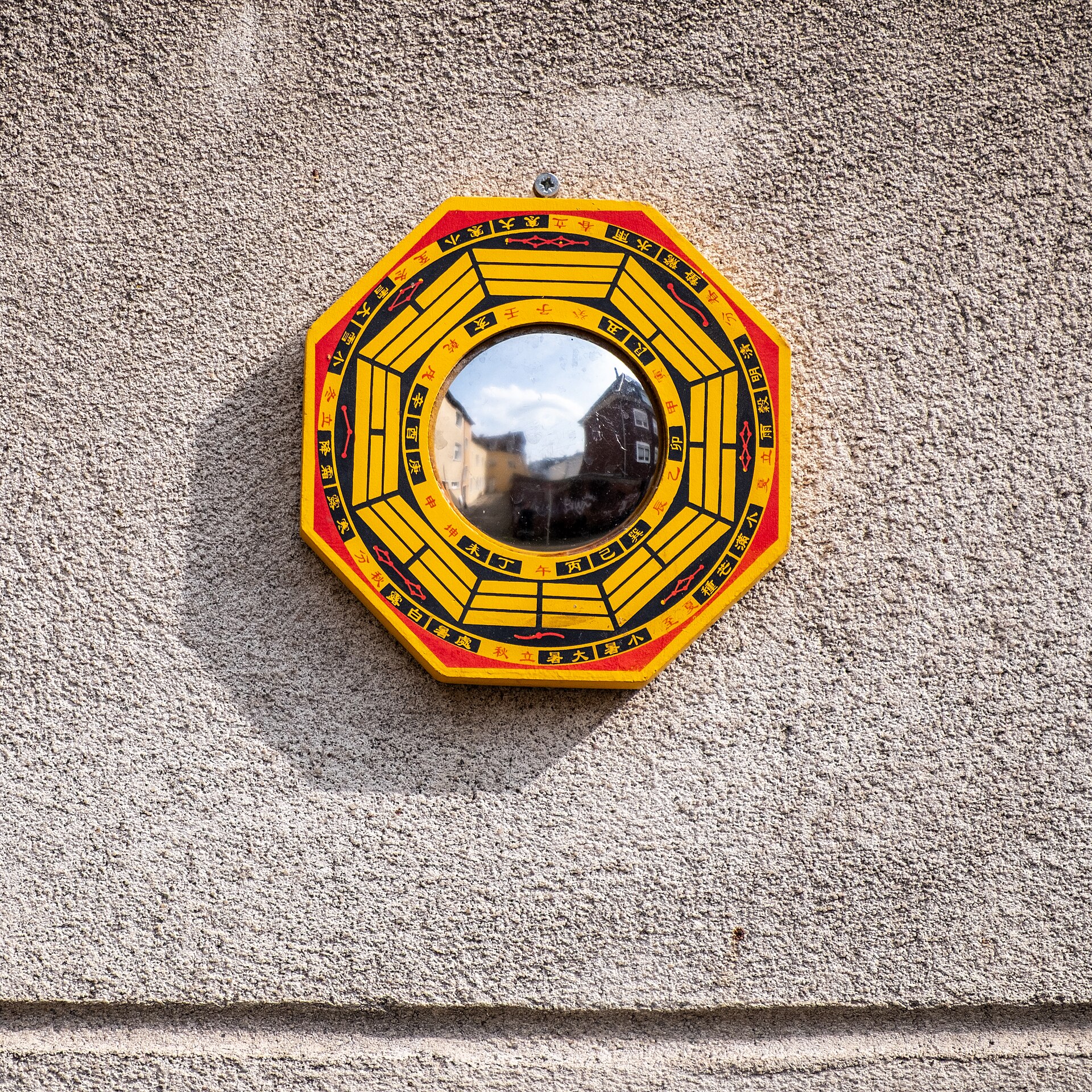
Form School is older and more closely tied to observable terrain: a house with high ground behind it and open, unobstructed land in front is read as protected and receiving, an idea with an obvious echo in ordinary siting sense — shelter from behind, light and visibility ahead. Compass School developed the mathematical side of the tradition, assigning directions, dates and structures to categories from the five phases and the classical bagua (pa kua), the eight-sided diagram of trigrams used to map a site’s zones.
The two schools do not always reach the same conclusion about the same building, and classical Chinese feng shui manuals argue between them at length. Any article, including this site’s, that gives a single rule as though the whole tradition agrees on it is oversimplifying — which is why practitioner-facing sources normally name which school a rule comes from.
What is BTB, and why does most English-language advice use it without saying so?
BTB stands for Black Sect Tantric Buddhist feng shui, sometimes called Western or Black Hat feng shui. It was developed and popularised in the United States from the 1980s onward by Professor Thomas Lin Yun, and it departs from classical Chinese feng shui in one significant, checkable way: it places the bagua map from the front door of a room or building, regardless of compass direction.
Classical Compass School feng shui places the bagua according to magnetic orientation, calculated with a luopan. BTB replaces that calculation with the door as the fixed reference point, which makes it far simpler to apply — no compass, no calculation — and this simplicity is a large part of why it dominates English-language books, blogs and consultancy in a way that is rarely labelled as a distinct, twentieth-century adaptation rather than an ancient rule.
Neither approach is “the real one” in a way that erases the other; they are different systems with different histories, and a reader is better served knowing which one a piece of advice belongs to than being told it is simply “feng shui.”
What are chi (qi) and the bagua (pa kua)?
Chi (qi) is the tradition’s term for a flow or vital energy said to move through a space, land or body. Practitioners describe it as something that can move too fast (through a long straight corridor, for instance) or stagnate (in clutter or a dead-end layout), though this is a description within the tradition rather than a measurable physical quantity, and this site does not claim otherwise.
The bagua (pa kua) is an eight-sided diagram, each side associated with a trigram from the I Ching, a direction, and — in later practical use — a life area such as career, health or relationships. Classical Compass School feng shui anchors the bagua to compass direction. The BTB adaptation anchors it to the entrance of the space instead. Practitioners of either school use the bagua as a map to assign meaning to different zones of a room or building; it is a diagnostic tool within the tradition, not a physical measurement.
Does feng shui have a practical, non-mystical logic anywhere in it?
Some feng shui guidance overlaps with ordinary, checkable reasoning about how buildings function, and some does not — the tradition itself is a mixture of both, and it is worth being clear about which is which rather than treating every rule the same way.
- Sitting with a view of the door in a room is often recommended in the tradition; it also happens to reduce being startled by unseen movement, which is a plain, ordinary reason independent of feng shui.
- Clear, unobstructed hallways are read as allowing chi to flow; they also happen to be easier and safer to walk through, particularly at night.
- Good daylight and airflow are treated favourably in most schools; both have straightforward practical value for a home regardless of any cosmological reading.
- Some rules — the specific compass degree ranges assigned to trigrams, or certain BTB colour-to-life-area assignments — have no stated practical rationale outside the tradition itself, and this site says so plainly wherever that is the case rather than inventing one.
Is feng shui officially recognised or regulated anywhere?
Feng shui is not a licensed profession with a single governing body anywhere, and there is no international standard that certifies a practitioner. It is, however, taken seriously as a factor in property markets in parts of Greater China, Hong Kong and Taiwan in particular, where developers, architects and buyers commonly commission consultations, and this is documented in real estate and architecture reporting rather than being a fringe curiosity.
Academically, feng shui is studied within Chinese history, architecture and religious studies departments as a historical practice and belief system, distinct from claims about its effectiveness. This site treats it the same way: as a tradition worth describing accurately, attributing correctly to its schools, and separating from any promise about outcomes such as wealth, health or relationships, which the tradition itself frames as reasoning and suggestion rather than guarantee.
How should a reader actually use feng shui advice?
Treat any single rule as belonging to a specific school — Form, Compass or BTB — rather than to “feng shui” as a whole, and expect that a classical Compass School reading and a BTB reading of the same room can disagree. Where a rule has an ordinary practical reason behind it (light, safety, ease of movement), that reason stands on its own regardless of the tradition.
This site’s other sections work through specific rooms and situations in that spirit: layout questions for individual rooms, the underlying principles and terminology, how chi is said to move through a home in the flow section, the objects and symbols the tradition uses in the objects section, and common errors covered in the mistakes section. None of it is medical, financial or legal advice, and none of it promises an outcome — only what a given school claims, and why.
About this site. Feng Shui Pack explains what the feng shui tradition holds and which school holds it, from published sources. Feng shui is a tradition of placement and orientation, not a science: nothing here will bring you wealth, health, luck or a relationship, and we never claim otherwise. Where a suggestion has an ordinary practical reason — daylight, airflow, sightlines, less clutter — we say so; where it does not, we say that too. This is not medical, financial, legal or tenancy advice. If a decision matters, talk to a professional in that field.
Related reading
The Basics, Flow, Light and Small Spaces, What Questions Should You Ask a Feng Shui Consultant?, Is It Worth Paying a Feng Shui Consultant? What They Do, What Feng Shui Says About a House That Has Stood Empty.