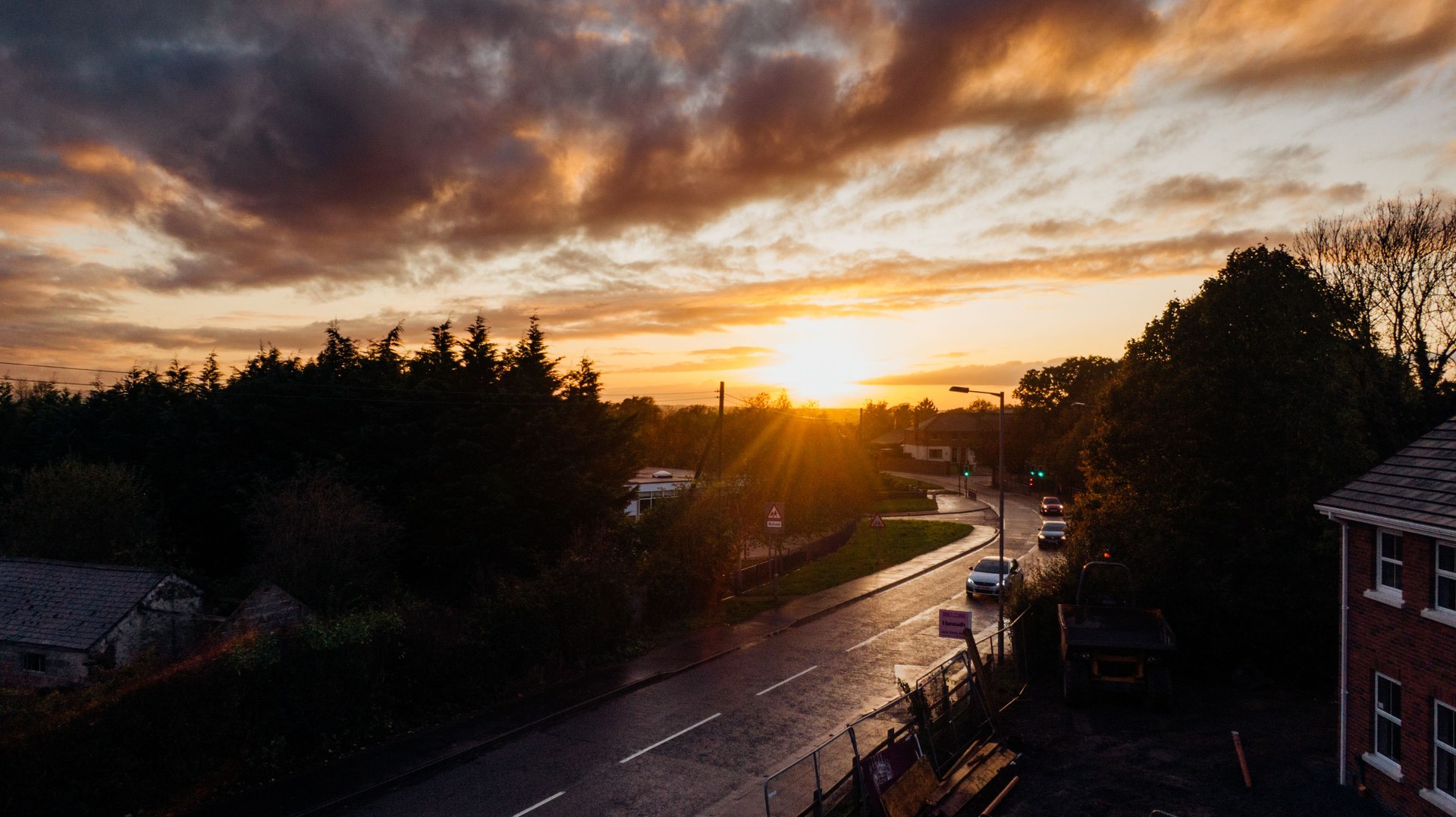
Feng shui, in its Form School tradition, treats a house sitting at the closed end of a T-junction — facing straight down the incoming road — as a poor position. The road is read as a channel that sends fast-moving chi directly at the building’s front door, an arrangement classical texts describe as a “secret arrow.” No single school treats this as fatal, but almost none treats it as neutral.
Why is a T-junction house treated as a problem?
The concern comes from how Form School reads landscape and streets: as channels that move chi, the way a river moves water. A straight road pointed at a building is thought to accelerate that flow rather than let it disperse, and a front door facing the oncoming lane takes the full force of it rather than the side of it.
Practitioners working in this tradition describe the effect as chi that arrives too fast and too directly, rather than settling and circulating around the building the way it does on a curved street or a road that runs past rather than into a plot. This is a claim from the tradition, not a measurable property of traffic or air movement, and it should be presented that way rather than as established fact.
Is this the same thing as a “secret arrow”?
Yes — a T-junction is one of the most commonly cited examples of a secret arrow, alongside things like a straight staircase pointed at a front door or a large structure’s edge aimed at a building. The term covers any straight line — road, corridor, ridge, another building’s corner — read as directing chi at a specific point rather than letting it move around it. The full explanation of what a secret arrow is covers the range of things the term is applied to beyond roads, and how seriously different practitioners take each one.
A T-junction differs from an ordinary busy road in one respect that matters to this reading: it is not just traffic passing the house, it is the road’s own geometry pointed at it, day and night, whether or not a car is on it at the time.
Does Compass School treat this differently?
Compass School (Liqi) uses the compass directions and a person’s or building’s specific chart to assess a site, rather than reading the shape of the street as the primary factor. It has its own literature on roads and water as conduits of chi, but the emphasis sits on direction and timing calculations more than on the visual geometry that Form School reacts to first.
In practice, most English-language advice on this subject — including advice that never names its source — is closer to Form School reasoning dressed in general language, or is the Western Black Sect (BTB) adaptation, which tends to translate “arrow” concerns into simpler visual and remedial terms without engaging the compass calculations at all. Where an article does not say which school it is drawing from, that is worth noticing; the schools genuinely disagree, and why feng shui consultants disagree with each other is a useful primer on how much of that disagreement is structural rather than sloppy.
What design logic exists behind the concern, if any?
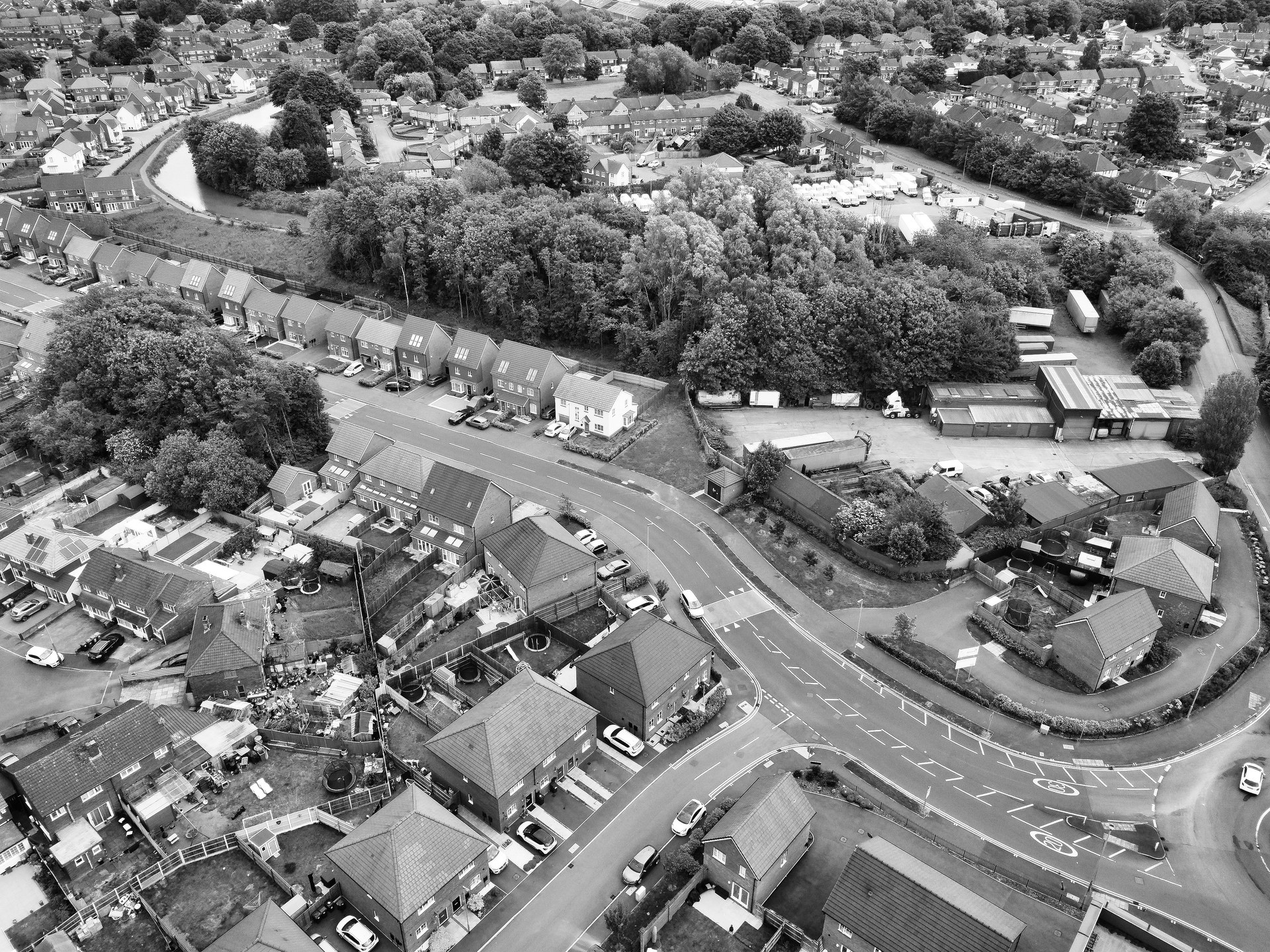
Separate from the chi reading, there is an ordinary and checkable reason a T-junction house draws attention: it sits directly in the sightline of every vehicle coming down that road, and in some places, in the path of a vehicle that fails to stop or turn. This is a road-safety and site-planning issue that has nothing to do with feng shui and is assessed by traffic engineers and local planning authorities, not by a bagua reading.
Beyond that, headlights swinging into a front-facing window at night, and a facade that reads as the visual “stop” for a whole street, are ordinary observations about a building’s exposure — worth noting to a surveyor or the local council if genuinely concerned about safety or noise, and not something this site advises on. The approach to a house in feng shui terms covers the broader question of how a front door reads from the street, of which the T-junction case is one example.
What does the tradition suggest doing about it?
Suggestions vary by school and by consultant, and none of them are presented here as something that changes an outcome — only as what is commonly recommended and why.
- Screening the direct line to the door. Hedging, a wall, a change in level, or landscaping between the road and the entrance is the most consistently cited suggestion, on the reasoning that anything breaking the straight line softens the arrow. This overlaps entirely with ordinary front-garden design.
- Adjusting the entrance itself. Some Form School practitioners suggest angling or relocating a front door slightly off the direct line of the road where renovation allows it, rather than facing the junction squarely. Related reading on the front door as the “mouth of chi” covers why the door specifically carries this weight in the tradition.
- Objects placed at the threshold. Some BTB-influenced advice recommends mirrors, guardian figures, or other objects facing outward at the door. This site does not recommend buying anything to address it — see why “buy this lucky object” is weak feng shui advice for the reasoning — and a mirror facing a street raises its own practical and neighbourly questions that have nothing to do with chi.
- Wind chimes. Sometimes suggested at an exposed entrance in the tradition; what they are said to do, and the range of opinion on them, is covered in what wind chimes do in feng shui tradition.
None of these are claimed by this site to change a household’s health, finances, or safety. They are recorded here as what the tradition suggests and the reasoning it gives for suggesting them.
What if you already live in a house like this and can’t change the building?
This is the more common real-world question, and the honest answer from within the tradition itself is that screening and softening the sightline — hedges, a low wall, planting, a change of paving pattern — accounts for most of what is suggested, and none of it requires structural work. A tenant has even less scope to act than an owner, and what feng shui says about renting and things you can’t change covers the general position the tradition takes when the building itself is fixed: attention shifts to what is inside the door, since the layout of the street is not something a resident controls.
Inside the home, the more actionable version of this concern is usually about the entry sequence rather than the street: whether the front door lines up with a back door, whether the hallway is cluttered, and how the entrance reads once someone is through it. The Entrances & Flow section and Outdoors & Approach section both cover this from different angles — one from inside the threshold, one from the street.
Does this matter when buying or renting a property?
Some buyers, particularly in markets with a strong feng shui-conscious buyer base, do factor a T-junction position into their decision, and estate agents in those markets are often aware of the reluctance. That is a market fact worth knowing, not a verdict on the house. Whether it should influence a purchase decision is a personal one, and this article is not financial or property advice — a structural survey, a conveyancer, and independent research into the specific street and planning history of a property are the right sources for anything that actually affects value or safety. The Buying & Renting section covers related feng shui questions that come up during a property search, without pretending to replace that professional advice.
What should be ignored in the more dramatic claims made about this?
Claims that a T-junction house causes specific accidents, illness, or financial loss go well beyond anything the tradition itself argues carefully, and beyond anything checkable. The consistent, defensible version of this rule is narrow: Form School treats a straight road aimed at a front door as an unfavourable line of chi, and offers screening as the standard response. Anything sold as a guaranteed fix, or stated as established danger rather than a traditional reading, is worth treating with the same skepticism recommended in what to ignore in most online feng shui advice. For a broader look at how much of feng shui claims to be evidence-based versus traditional and interpretive, see is there evidence for feng shui.
About this site. Feng Shui Pack explains what the feng shui tradition holds and which school holds it, from published sources. Feng shui is a tradition of placement and orientation, not a science: nothing here will bring you wealth, health, luck or a relationship, and we never claim otherwise. Where a suggestion has an ordinary practical reason — daylight, airflow, sightlines, less clutter — we say so; where it does not, we say that too. This is not medical, financial, legal or tenancy advice. If a decision matters, talk to a professional in that field.