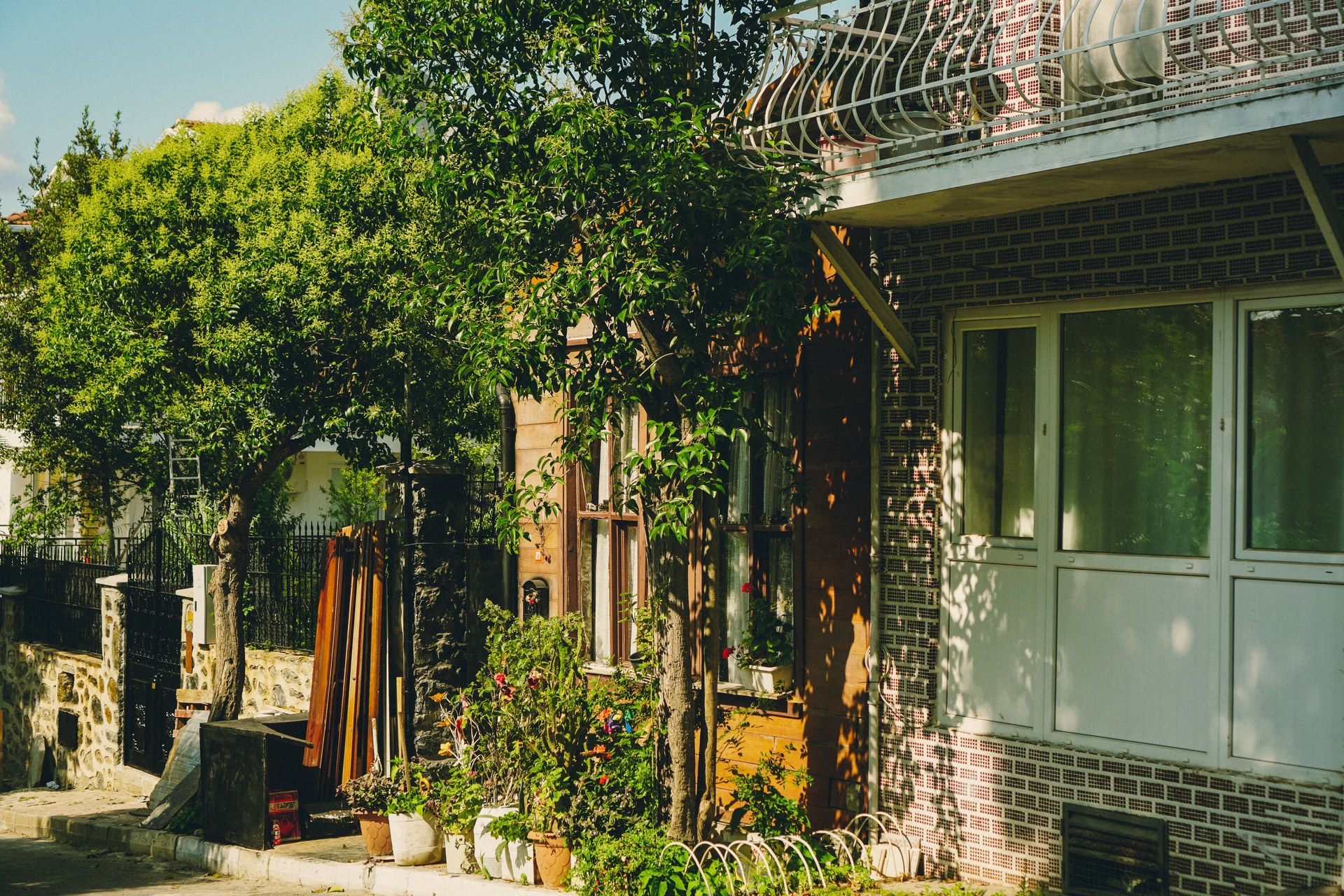
Feng shui traditions generally treat a large tree very close to a house as a problem, though the reasoning differs by school. Form School focuses on whether the tree blocks the view, light or approach to the door. Compass School considers its direction from the house. Neither school treats all trees as bad — a tree at a distance is usually read as protective, not obstructive.
What does Form School say about trees near a house?
Form School (Xingshi) reads a site by its physical shape — hills, water, roads, and anything solid enough to block or channel movement. In this tradition, a tree functions the way a wall, pole or neighbouring building does: it is assessed by what it blocks, not by any symbolic meaning attached to trees as a category.
A tree set back from a house, visible from a window but not looming over it, is commonly described in Form School writing as beneficial — comparable to the “armchair” formation of hills said to shelter a site from behind and the sides. A tree planted directly against a wall, or one whose canopy overhangs the roof, is treated differently: it is read as crowding the building, cutting light, and interrupting the clear approach that Form School generally wants at a front elevation. The practical logic and the traditional one line up here, which is unusual and worth noting plainly.
Does a tree blocking the front door matter in feng shui?
Yes, in most schools — a large trunk, hedge or dense canopy directly in front of the entrance is treated as an obstruction to chi (qi), the flow of energy the tradition associates with movement, light and air reaching the door.
This overlaps with concerns covered in more detail in the site’s piece on the path to the front door and in the broader discussion of the approach to a house. The practical version of the claim is straightforward: a tree trunk close to a doorway restricts sightlines, blocks natural light into the hall, and can hold damp against a wall. The tradition adds a layer on top of that — that a blocked entrance restricts the chi entering the home — but the underlying physical observation is one most people would make without any reference to feng shui at all.
Is a tree that looks like it’s pointing at the house a problem?
A single bare branch, or a tree trunk, aligned directly at a door or window is sometimes described using the same language as a “secret arrow” — a straight, hard line pointed at a building, more commonly discussed in relation to roads, roof edges and corners.
The site’s article on the secret arrow outside a home covers this concept in more detail. Applied to trees, the claim is usually about a single dead branch or an unusually straight trunk in direct line with a door, rather than a tree in general. No structural or scientific rationale is offered for this specific reading beyond the tradition itself — it is a visual and symbolic association, and readers should treat it as such.
What does feng shui say about a dead or dying tree near a house?
Most schools, including BTB, describe a dead, dying or heavily diseased tree close to a house unfavourably — the reasoning given is usually about stagnant or “dying” energy rather than anything to do with the tree’s condition as a hazard.
Separately, and more importantly for anyone actually living with one: a dead or structurally compromised tree near a building is a genuine safety and property concern, independent of feng shui. This is not something this site can assess remotely, and it is not offering safety, structural or arboricultural advice here. Anyone concerned about a tree’s condition, its proximity to a foundation, or the risk of falling limbs should contact a qualified arborist or, where applicable, their local planning authority — many jurisdictions have separate rules for trees under preservation orders. The UK’s Arboricultural Association (trees.org.uk) publishes guidance and a directory of qualified professionals; readers elsewhere should look for the equivalent body in their own country.
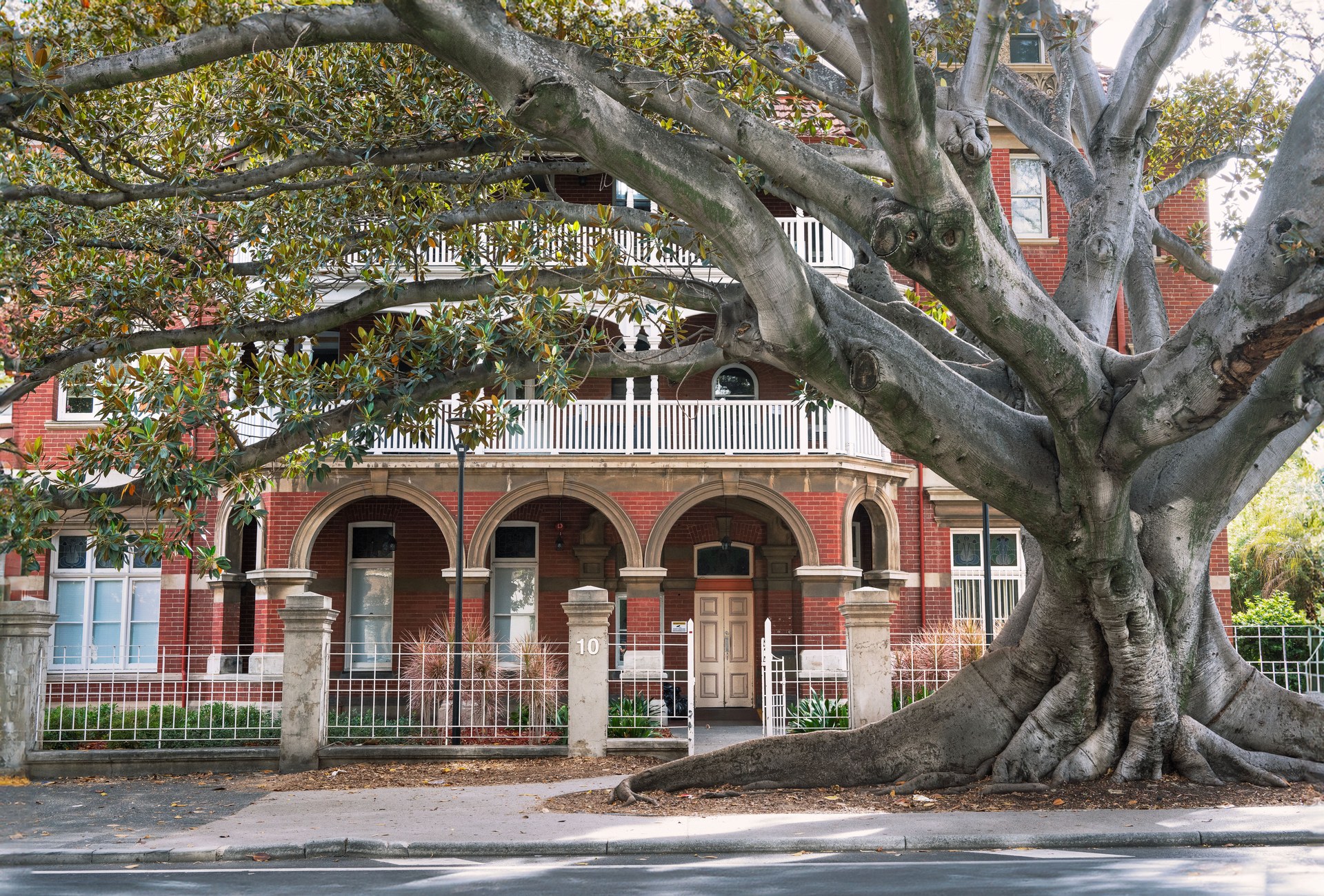
Does the direction of the tree from the house matter?
In classical Compass School (Liqi), placement is read against the compass and the specific facing of the building, using tools like the luopan. Directional readings assign different significance to a tree depending on which sector of the property it falls in, and these assessments vary by the specific method and lineage a practitioner follows.
This is one of the clearest points of disagreement across the field, discussed in general terms in why feng shui consultants disagree with each other. The BTB (Black Sect Tantric Buddhist) adaptation, which is what most English-language feng shui content actually draws from, generally does not use compass direction at all — it maps the bagua from the front door instead. A tree that one Compass School practitioner reads as sitting in a favourable sector might be assessed completely differently by another using a different formula, or ignored entirely in a BTB reading. Where a specific compass direction is claimed for tree placement, it is worth asking which school and which method produced it — the site’s overview of common mistakes applying the bagua covers a related version of this confusion.
What is the practical concern with trees very close to a house?
Independent of any feng shui reading, trees planted too close to a building can affect the structure itself — root systems can interact with foundations, particularly in clay soils prone to shrinkage, and overhanging branches can block guttering, damage roofing, and hold moisture against walls.
This is a structural and financial matter, not a feng shui one, and this site is not qualified to advise on it. Questions about root proximity to foundations, subsidence risk, or whether an existing tree needs management should go to a structural engineer, a chartered surveyor, or a qualified arborist — not to a feng shui text of any school. Where buying or renting a property with mature trees close to the building is a live concern, the site’s Buying & Renting section covers related questions, though again, structural assessment itself sits outside what any of these articles can responsibly answer.
Does a tree at the back of a house count differently from one at the front?
Yes, in most traditions — a tree behind a house is far more likely to be read as protective than one in front of it, echoing the same logic Form School applies to hills and rising ground behind a building.
A tree or line of planting at the rear is often described as giving a house a “backing” — something solid behind it, comparable to the protective role assigned to a rising slope in classical siting texts. A tree at the front, by contrast, is judged mainly by whether it blocks the door, the path, or the main view out, which is why the same species and size can be read as favourable at the back of a plot and unfavourable at the front. This asymmetry is consistent across most of the schools that discuss trees at all, even where they disagree on the underlying mechanism.
What about a house near a T-junction with a tree in the sightline?
A tree does not change the underlying concern raised about T-junction sites — the issue in that reading is the road aligned directly at the house, not the tree itself — though a tree in that sightline is sometimes described as softening the effect.
The site’s dedicated article on a house at a T-junction sets out that reasoning in full. Some practitioners describe planting or an existing tree as a way of breaking a direct line of sight or traffic movement toward a building, functioning as a buffer in the same way a wall or hedge would. This is presented as a mitigation within the tradition, not a claim that a tree changes traffic patterns or safety at the junction itself, which is a matter for the relevant road authority.
What can actually be done where a tree can’t be moved or removed?
Where a mature tree is protected, belongs to a neighbour, or is simply not something a resident can remove, feng shui traditions generally suggest working with lighting, planting, and the approach rather than treating the tree as fixable.
This mirrors the general approach the site takes toward rented homes and things that can’t be changed — the tradition consistently prioritises adjusting what is controllable (a porch light, a clear path, trimmed lower branches where that’s within a resident’s rights) over insisting on removing a tree, which is very often not the resident’s decision to make at all, particularly where a tree preservation order applies. For a broader look at how siting and approach are read together, the Outdoors & Approach section covers related ground, including paths, driveways, and what a front boundary is doing before a visitor even reaches the door.
A final note on what this article is, and isn’t
Nothing here is structural, arboricultural, safety or legal advice. Questions about root damage, subsidence, falling limbs, tree preservation orders or a landlord’s obligations regarding trees on a property should go to a qualified professional or the relevant local authority — not to a feng shui reading, however the tradition is applied.
About this site. Feng Shui Pack explains what the feng shui tradition holds and which school holds it, from published sources. Feng shui is a tradition of placement and orientation, not a science: nothing here will bring you wealth, health, luck or a relationship, and we never claim otherwise. Where a suggestion has an ordinary practical reason — daylight, airflow, sightlines, less clutter — we say so; where it does not, we say that too. This is not medical, financial, legal or tenancy advice. If a decision matters, talk to a professional in that field.