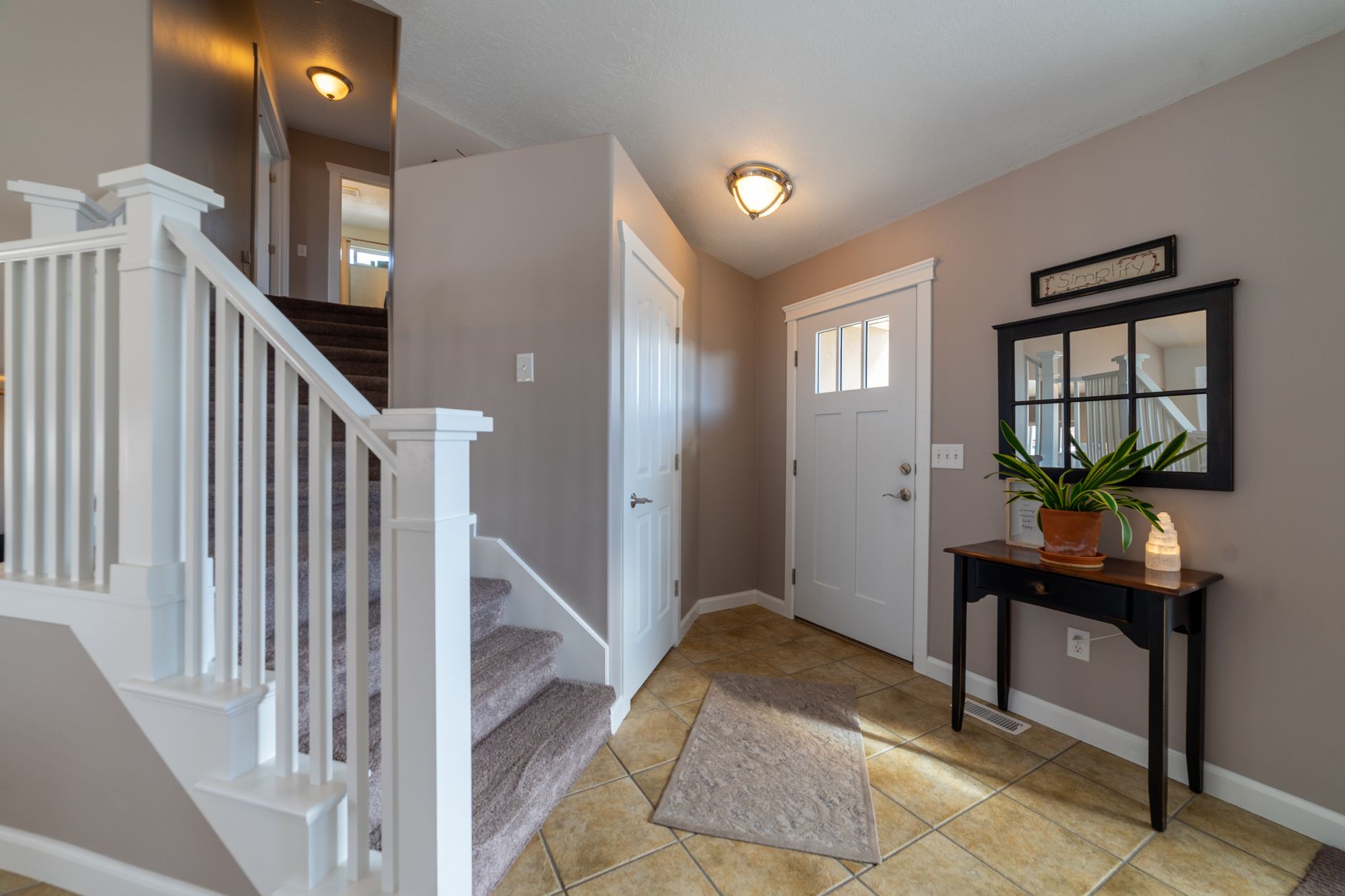
An entryway should hold what a person needs on the way in or out — a place to sit or set down bags, closed storage for shoes and coats, enough light to see clearly — and it should stay clear of clutter, stacked shoes, umbrellas leaning in the open, and furniture that blocks or narrows the path from the door. Beyond that, specific rules vary by school, and this article says which is which.
What is the entryway actually doing, in feng shui terms?
In the tradition, the front door is sometimes called the “mouth of chi” — the point through which chi (qi), the tradition’s term for circulating energy, is said to enter a home. Practitioners treat the entryway as the transition zone where that energy is supposed to slow down and spread through the house rather than stall or bounce straight back out. This is an interpretive framework, not a testable claim — see the site’s explainer on what evidence exists for feng shui before treating any of this as settled fact.
Separate from the metaphysics, there is an ordinary design logic that most schools agree on: an entryway that is dim, cramped, or blocked by furniture is harder to move through and harder to see clearly, whether or not chi is involved. That practical reasoning is worth taking seriously even where the symbolic reasoning is a matter of tradition rather than evidence.
What should be in an entryway?
Across Form School (Xingshi), Compass School (Liqi), and the Western Black Sect adaptation, there is broad agreement on the basic furnishing of an entry space, even though the three traditions justify it differently.
- A surface for landing items — a console table, bench, or shelf where keys, mail, and bags can be set down rather than dropped on the floor.
- Closed storage — a cabinet, closet, or shoe cupboard that keeps footwear and outerwear out of sight rather than accumulated in the open.
- Adequate lighting — enough to see the space clearly, especially where the entry has no window. Many entryways are interior and depend entirely on artificial light; the tradition treats a badly lit entry as sluggish, and the practical case for good lighting near a door needs no tradition at all.
- A clear, unobstructed path from the door to the rest of the home — no furniture placed so a person has to turn sideways or step around something immediately on entering.
- Something living, where there is light for it — a plant is a common suggestion in BTB writing specifically, on the reasoning that living things signal vitality at the point of entry. Where there is no natural light, this is more decorative than functional and the tradition does not require it.
None of this requires anything expensive or specific to “feng shui” as a product category — a bench and a cupboard do the job.
What should not be in an entryway?
The advice here is more consistent across schools than the “what to add” side, largely because it overlaps with plain household order.
- Stacked or scattered shoes. Left in the open, they are treated in the tradition as visual and energetic clutter at the exact point chi is said to enter; in practical terms they are also a trip hazard directly inside a door.
- Overflowing coat hooks or a hall full of umbrellas, boots, and outdoor gear with no cabinet to absorb them.
- Furniture that narrows or blocks the walking path, especially anything positioned so a person entering has to immediately navigate around it.
- Broken items — a cracked mirror, a lamp that doesn’t work, a chair that wobbles. Classical texts describe broken or non-functioning objects near the entry as symbolically stagnant; separately, a broken item anywhere in a home is simply something to repair or discard.
- Sharp-cornered furniture aimed at the direct entry path. This overlaps with the idea of a “poison arrow” — a straight, sharp line of energy said to run toward an opening — though the term and its use vary between schools.
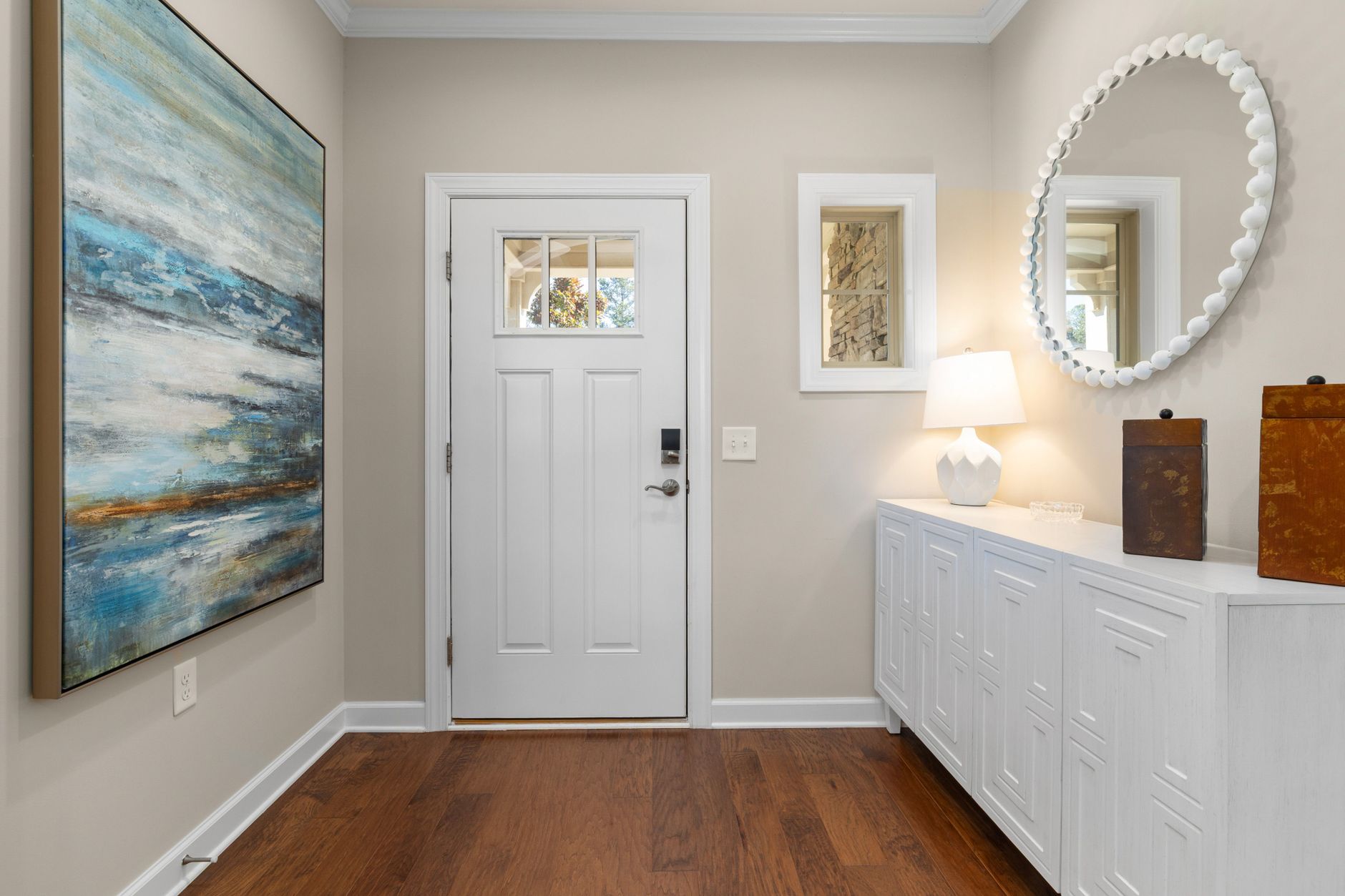
- A mirror positioned directly opposite the front door. This is one of the most argued-over rules in the entire tradition, covered in detail below.
Does a mirror facing the front door matter?
Some BTB writers hold that a mirror directly opposite the front door reflects incoming chi straight back out before it can circulate; other practitioners and some classical sources disagree, or qualify the rule heavily by distance and angle. There is no single answer given as final across the tradition. The full range of positions — and where each comes from — is set out in Mirror Facing the Front Door: What Feng Shui Actually Says.
Does the front door need to face a particular direction?
Classical Compass School (Liqi) ties auspicious directions to a home’s construction period and the compass reading taken at the front door, using tools like the luopan; this is a technical, calculation-based system, not a matter of personal preference. The BTB adaptation, by contrast, orients its bagua map from wherever the front door stands, regardless of compass direction — a method that classical Compass School practitioners do not recognise. Both approaches are explained, with the disagreement stated plainly, in What Is the Bagua, and How Is It Actually Used? and in How Do You Orient a Bagua Map to a Home?. Anyone wanting to apply compass-based rules with any rigor is dealing with a real measuring instrument, covered in What Is a Feng Shui Compass, and Do You Need One?, not a symbolic prop.
What about the door’s colour?
Front door colour recommendations differ by school and by which element or direction is assigned to the entry in a given system — red carries different associations than black or a natural wood tone, and the reasoning changes depending on whose framework is used. That variation, including where the popular “which colour is lucky” claims actually originate, is unpacked in What Colour Should a Front Door Be, and Who Says So?.
Does any of this apply to a small apartment entry with no separate hallway?
Most contemporary homes, especially apartments, do not have a distinct entryway room — the front door opens directly into a living space. The tradition still applies the same principles to whatever few feet of floor exist just inside the door: keep that immediate zone clear, add a small landing surface if the space allows one, and avoid piling shoes or bags in the direct sightline of the door. Where the entry opens straight onto a set of stairs, that specific configuration has its own set of concerns, addressed in Staircase Facing the Front Door: What Feng Shui Says. Where the entry leads into a long corridor before anything else, the relevant guide is How Should a Hallway Be Treated? A Feng Shui Guide.
Why do the schools disagree so much about entryways specifically?
The entryway is one of the most rule-dense parts of any feng shui guide because it sits at the intersection of every school’s core concerns — direction, symbolism, and the practical experience of a threshold — and because the BTB adaptation, which dominates English-language advice online, was developed independently of classical Compass School and doesn’t reconcile with it on several points, including this one. Anyone finding contradictory advice about a front door is not misreading anything; the sources genuinely disagree, and the reasons are set out in Why Do Feng Shui Rules Contradict Each Other So Often? and Black Sect (BTB) Feng Shui: What It Is, and Why It Spread.
What’s the practical takeaway for an entryway?
Strip the specific rules back and most schools converge on the same short list: keep the path from the door clear, store shoes and coats out of sight rather than piled up, light the space adequately, and don’t fill it with broken or unused furniture. Whether a mirror opposite the door or a door’s exact compass bearing matters beyond that is a question of which tradition is being followed, and this site names the tradition every time rather than presenting one school’s preference as settled fact. For the wider set of entry and flow topics — thresholds, hallways, staircases, and the front door itself — the Entrances & Flow archive and the Basics archive cover the underlying framework in more detail.
About this site. Feng Shui Pack explains what the feng shui tradition holds and which school holds it, from published sources. Feng shui is a tradition of placement and orientation, not a science: nothing here will bring you wealth, health, luck or a relationship, and we never claim otherwise. Where a suggestion has an ordinary practical reason — daylight, airflow, sightlines, less clutter — we say so; where it does not, we say that too. This is not medical, financial, legal or tenancy advice. If a decision matters, talk to a professional in that field.