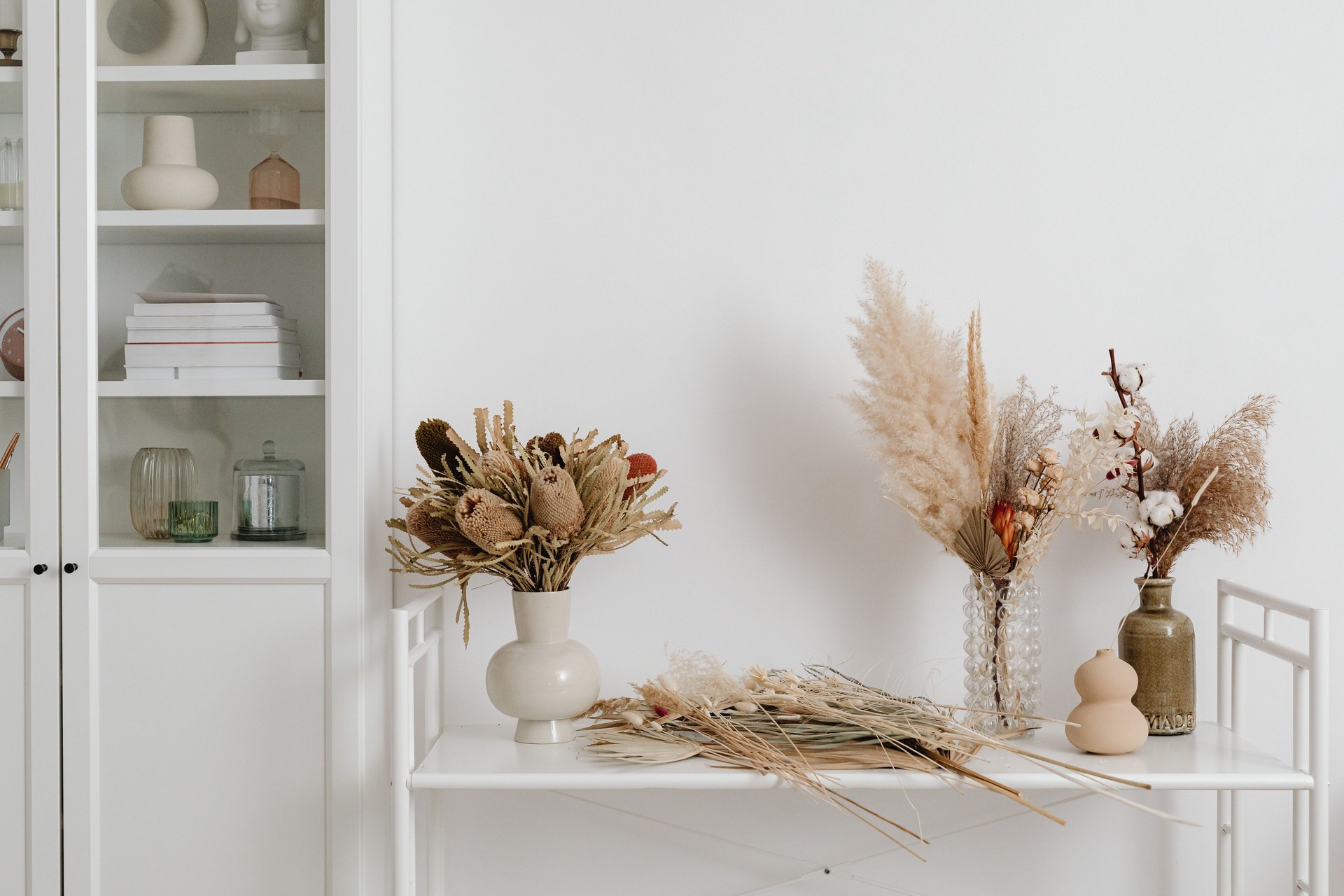
Most feng shui teaching treats dried plants as carrying “dead” or spent chi and generally advises against them, particularly in bedrooms. Artificial plants are viewed more mildly — acceptable as visual stand-ins for greenery where real plants cannot survive, provided they are clean, undamaged, and not mistaken for a substitute in a spot the tradition considers important.
These are not identical objects to the tradition, and treating them as one category misses the reasoning given for each. The distinction matters more than the verdict.
Why does feng shui object to dried plants specifically?
Dried flowers and dried grasses have completed their life cycle before they enter the home. In Form School reasoning, an object’s condition signals what kind of chi it carries into a space — and something desiccated, however attractive, is read as depleted rather than active.
This is consistent with a broader theme across the tradition: preference for objects that are whole, functioning, and current over ones that are worn, broken, or finished. It is the same logic applied to a mirror with a crack or a clock that has stopped — the object’s state is treated as information, not decoration.
No laboratory measurement underwrites this. It is a symbolic reading, and practitioners who hold it say so in those terms — a completed, drying plant stands in for stagnation, and a bedroom or a main living area is not where stagnation is wanted symbolically.
Is there a practical reason, or is it purely symbolic?
There is a genuine practical note worth separating from the symbolism. Dried arrangements collect dust, shed fine particulate matter, and in some cases (certain dried grasses, pampas, some preserved botanicals) are flagged by furnishing and fire-safety guidance as more combustible than fresh foliage. That is a household-safety matter, not a feng shui claim, and anyone concerned about fire risk from dried materials in the home should check guidance from a fire safety authority rather than relying on this article, which is not fire, safety or building advice.
Beyond that, the objection is symbolic. No practical reason is given for avoiding a dried arrangement that is dust-free and away from any flame — the tradition’s discomfort with it rests on what the object represents, not on what it does.
What does feng shui actually say about artificial plants?
Assessments vary here more than most single-answer articles suggest, and this is precisely where naming the school matters.
- Form School reasoning is generally more accepting of well-made artificial plants than of dried ones, because an artificial leaf is not read as a depleted living thing — it never lived, so it cannot be spent. The concern shifts instead to whether it collects dust and whether it looks convincing or obviously cheap, which some practitioners treat as a separate, aesthetic objection rather than a chi-based one.
- Classical Compass School texts, which are concerned with orientation, directional sectors and the compass reading of a building, do not address dried or artificial plants as a category at all. This is a modern household question layered onto an old system, not a rule with roots in the classical corpus.
- The BTB (Black Sect Tantric Buddhist) adaptation, which is the source of most English-language “plant” advice online, tends to treat any plant — living, dried or artificial — primarily through its bagua placement and its association with the Wood element, discussed further on the site’s five elements page. In this framing, an artificial plant can occupy a Wood-associated position and contribute the visual and colour cues of that element, even without being alive.
The takeaway is not that one school is correct. It is that “feng shui says artificial plants are fine” and “feng shui says artificial plants are hollow” are both true of different schools and false as universal statements. For a broader look at why the same object gets opposite verdicts depending on source, see why feng shui rules contradict each other.
Do artificial plants still “count” for the Wood element?
In BTB practice, colour and form generally do the work the tradition assigns to the Wood element — greens, upright growing shapes, vertical lines — and an artificial plant can supply those visual cues. The productive and destructive relationships between elements, covered on the site’s productive cycle and destructive cycle pages, are described in terms of what a material or colour represents, which an artificial object can represent as well as a living one.
Practitioners who hold a stricter Form School view are more likely to say that only a living plant carries active chi, because it is exchanging gases, responding to light, and changing — and an artificial one, however well made, is a static prop. There is no way to reconcile these two views into a single rule; the honest answer is that it depends which tradition is being applied.
Where do real houseplants fit into this comparison?
The reason most guidance defaults to real plants over dried or artificial ones is that a living plant is treated as doing something a static object cannot: it grows, it responds to its environment, and in Form School terms it is read as continuously producing rather than holding still. The site’s separate guide on which houseplants are suggested indoors covers the specific species named across different sources and why some are favoured over others.
Where a real plant genuinely cannot survive a given spot — a windowless interior room, low and inconsistent light, a spot in a rental with no reliable heating — an artificial plant is generally treated across most modern practice as an acceptable substitute for the visual and colour role, rather than a failure of the rule. Light conditions more broadly are covered in the site’s Light & Air section.
Where should dried or artificial plants not go?
Most caution across sources converges on the bedroom, for the same reason a bedroom gets specific treatment elsewhere on this site: it is where the tradition asks for the calmest, least ambiguous symbolism, discussed in the site’s guides to bedroom symmetry and mirrors in the bedroom. A dried arrangement in a bedroom is the specific combination most sources flag as worth avoiding, more than the same object in a hallway or living room.
An entryway is treated more mixed. Some sources place any plant near a front door as helpful, framing an entrance as the point where chi is said to enter, discussed on the site’s page about the “mouth of chi”; others simply require that whatever sits there is clean, whole, and not obstructing the path in, a concern shared with the site’s broader guide to what belongs in an entryway.
What maintenance actually matters here?
Across every school, upkeep is treated as doing more work than the material itself. A dusty artificial plant or a dried arrangement gone brittle and grey is read the same way a wilting real plant is: as neglect made visible, regardless of what the tradition says about the object’s category.
- Wipe artificial leaves periodically; dust dulls colour and is the most commonly cited complaint against them.
- Replace or remove a dried arrangement once it visibly fades or sheds, rather than leaving it as permanent decor.
- Keep either well clear of a stove, candles or any open flame — an ordinary household precaution as much as a feng shui one.
This general emphasis on clean, functioning, well-placed objects over any specific material is a theme that runs through the site’s Objects & Materials section and its Basics hub, which sets out what feng shui claims — and does not claim — before any single object is discussed.
Is any of this backed by evidence?
No controlled study demonstrates that a dried flower arrangement or a silk plant affects a resident’s fortune, mood or health. The site’s separate page on whether there is evidence for feng shui sets out what the tradition is and is not able to claim, and this article does not go further than that. This is not medical, financial or safety advice; where dust, allergens or fire risk are a genuine concern in a specific home, that is a matter for a household safety or health professional, not a feng shui guide.
Related reading
Which Houseplants Are Suggested Indoors, and Why?, What Feng Shui Says About Mirrors: A General Guide, The Basics, Flow, Light and Small Spaces, What Does Feng Shui Say About Scent in a Home?
About this site. Feng Shui Pack explains what the feng shui tradition holds and which school holds it, from published sources. Feng shui is a tradition of placement and orientation, not a science: nothing here will bring you wealth, health, luck or a relationship, and we never claim otherwise. Where a suggestion has an ordinary practical reason — daylight, airflow, sightlines, less clutter — we say so; where it does not, we say that too. This is not medical, financial, legal or tenancy advice. If a decision matters, talk to a professional in that field.