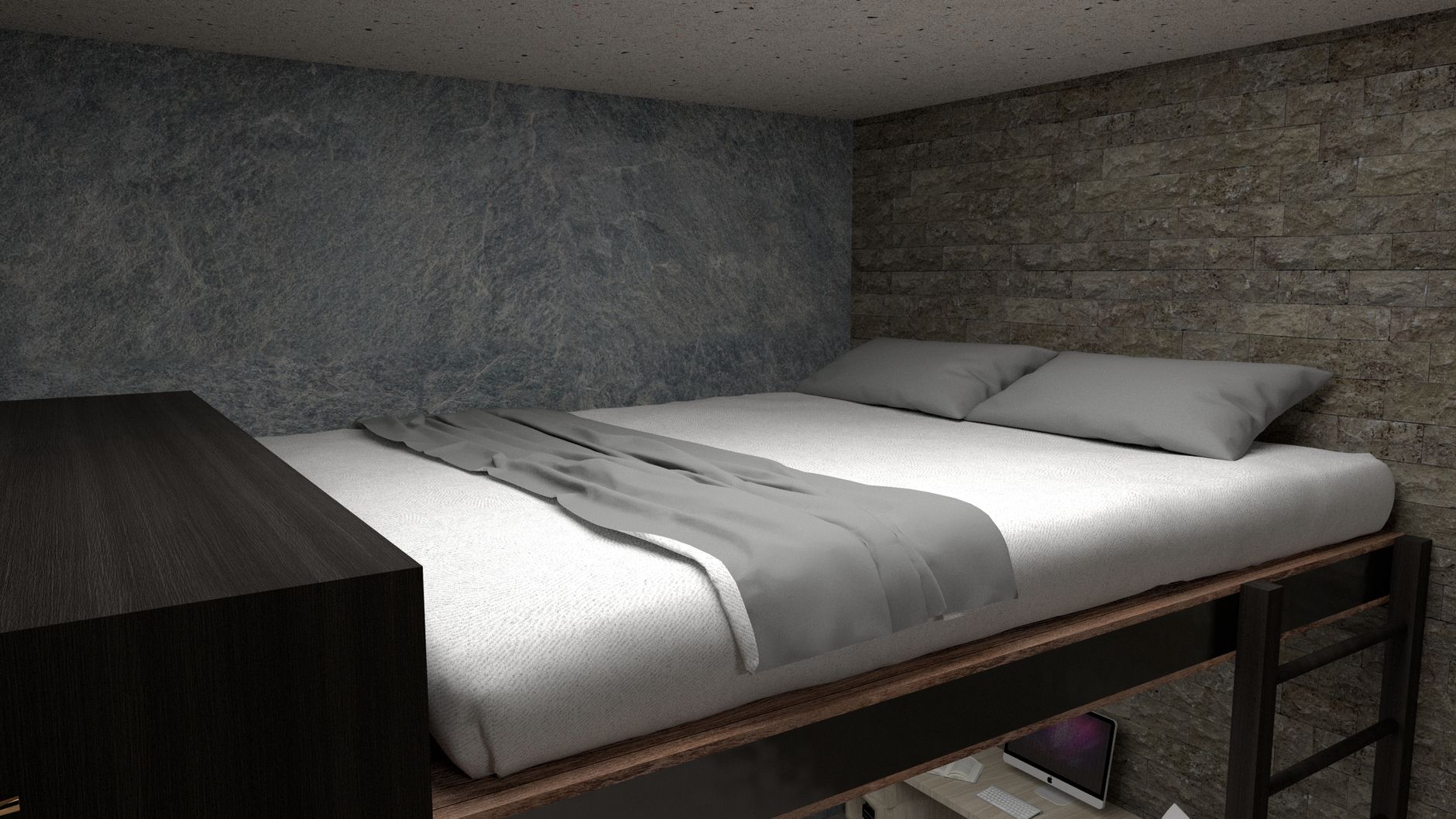
In the commanding position principle used in Form School and carried into the Western Black Sect (BTB) adaptation, a bed should be placed so the sleeper can see the bedroom door without lying directly in its path. “Facing the door” means having a clear diagonal view of it, not sleeping with the feet pointed straight at the opening.
What does “the bed must face the door” actually mean?
It means the sleeper’s line of sight, while lying down, reaches the doorway without a wall or piece of furniture blocking it. It does not mean the bed sits on the same axis as the door, headboard directly opposite it, feet pointed straight out. That second arrangement is treated as a separate and less favourable case in most of the tradition, discussed below.
The commanding position, as it is usually described, has three conditions: the bed is diagonally across from the door rather than in line with it, it is not positioned with the foot pointing directly at the door, and it has a solid wall behind the headboard rather than open space or a window. The door-facing part is one piece of a larger layout rule, not a standalone instruction.
Why does this rule exist — is there a practical reason?
Yes, and this is one of the clearer cases in the tradition. Being able to see the door from bed means seeing who or what enters a room before they are close to it. That is a straightforward, ordinary explanation, and it is the one most consultants give first, before any reference to chi (qi, the flow of energy through a space in feng shui terms).
A sleeper who cannot see the door — bed against the same wall as the entrance, or facing away from it entirely — is described in Form School reasoning as being in a “weak” position, historically framed around a person being caught unaware. Whatever the historical framing, the practical logic holds up on its own terms: a line of sight to the entrance is a small, checkable thing about how a room is used, and it is the same reasoning behind the broader commanding position principle applied to desks and seating, covered in more detail in the guide to what the commanding position actually means.
Is facing the door the same as being in line with it?
No, and this distinction is often lost in shorthand advice. A bed directly in line with the door — headboard against the far wall, feet pointing straight at the opening — is a different configuration, and several schools treat it separately, sometimes calling it the “coffin position” because of the resemblance to how a body is laid out for viewing in some traditions. No practical mechanism is offered for this association beyond the visual resemblance itself; it is a symbolic reading, not a structural one, and readers should treat it as such.
The two rules are frequently run together in generic online advice, producing the false impression that any bed with sightline to the door is a problem. It is the opposite arrangement — being in the direct line, not merely facing it — that draws the stronger objection. This kind of conflation is common enough that it has its own entry in the site’s guide to what to ignore in most online feng shui advice.
What do the different schools of feng shui say?
They do not agree in emphasis, though the general preference for a door-facing bed is shared. Form School (Xingshi), the older tradition built around landscape and the physical shape of a space, frames the rule in terms of visibility and vulnerability — the logic sketched above. Compass School (Liqi), which works from directional calculations tied to a person’s birth data and the compass orientation of the building, layers a further set of directional preferences on top of the same basic layout rule, and its recommendations can differ from Form School’s on which wall the bed should sit against.
The BTB adaptation, widely taught in English-language feng shui since the late twentieth century, keeps the commanding-position logic but drops the compass calculation, instead treating the position relative to the room’s own door as the fixed reference point. Most bedroom advice circulating online is BTB without saying so, which is one reason the same rule gets described with such different justifications from one source to the next — a pattern examined directly in why feng shui consultants disagree with each other.

What if the bed cannot be moved to face the door?
Most bedrooms, particularly small or oddly shaped ones, do not allow a bed to be placed in the ideal diagonal spot, and the tradition itself accounts for this rather than treating it as a dead end. Where the layout genuinely will not permit repositioning — a single door, a window bank, a fixed radiator or built-in wardrobe dictating the only viable wall — the commonly suggested workaround is a mirror angled to reflect the doorway into the sleeper’s line of sight, though a mirror facing the bed directly is treated as its own separate issue, addressed in the feng shui view on a mirror facing the bed.
Fuller options for genuinely fixed layouts are set out in what feng shui actually suggests when the bed can’t be moved, and the same constraint comes up constantly in smaller rooms, which is covered separately in what feng shui says about a small bedroom. Renters facing a layout they cannot alter structurally will find the wider reasoning in what feng shui says about renting and things you can’t change.
Does the door-facing rule change in a shared bedroom or shared house?
The underlying layout logic does not change with occupancy, but shared housing often removes the choice entirely — a bed may be fixed by a landlord’s furniture, a room shape dictated by a conversion, or a door position shared awkwardly with a housemate’s routine. Where control over layout is limited, the more useful question becomes what can realistically be adjusted rather than chasing an ideal placement. This is worked through at greater length in the guide to applying feng shui in a shared house.
Is there evidence this arrangement affects sleep?
There is no clinical evidence that a bed’s position relative to a door affects sleep quality, and this article is not sleep, health or safety advice. Readers with ongoing sleep difficulties should consult a doctor or a registered sleep specialist rather than treat furniture placement as a substitute for medical guidance. What can be said plainly is that a bed positioned with a clear sightline to the door, away from direct alignment with it, follows an ordinary and explainable piece of spatial reasoning — regardless of which school’s terminology is used to describe it.
Readers working through a full bedroom layout, rather than this one rule in isolation, will find the broader placement principles in where the bed should go in a bedroom, and the general logic of sightlines and command of a room in the Layout & Furniture section of the site.
Related reading
How Do You Apply Feng Shui in a Shared House?, What Feng Shui Says About Mirrors in Small Rooms, How to Apply the Commanding Position in a Small Room, What Does Feng Shui Say About Storage in a Small Home?, The Basics, Flow, Light and Small Spaces
About this site. Feng Shui Pack explains what the feng shui tradition holds and which school holds it, from published sources. Feng shui is a tradition of placement and orientation, not a science: nothing here will bring you wealth, health, luck or a relationship, and we never claim otherwise. Where a suggestion has an ordinary practical reason — daylight, airflow, sightlines, less clutter — we say so; where it does not, we say that too. This is not medical, financial, legal or tenancy advice. If a decision matters, talk to a professional in that field.