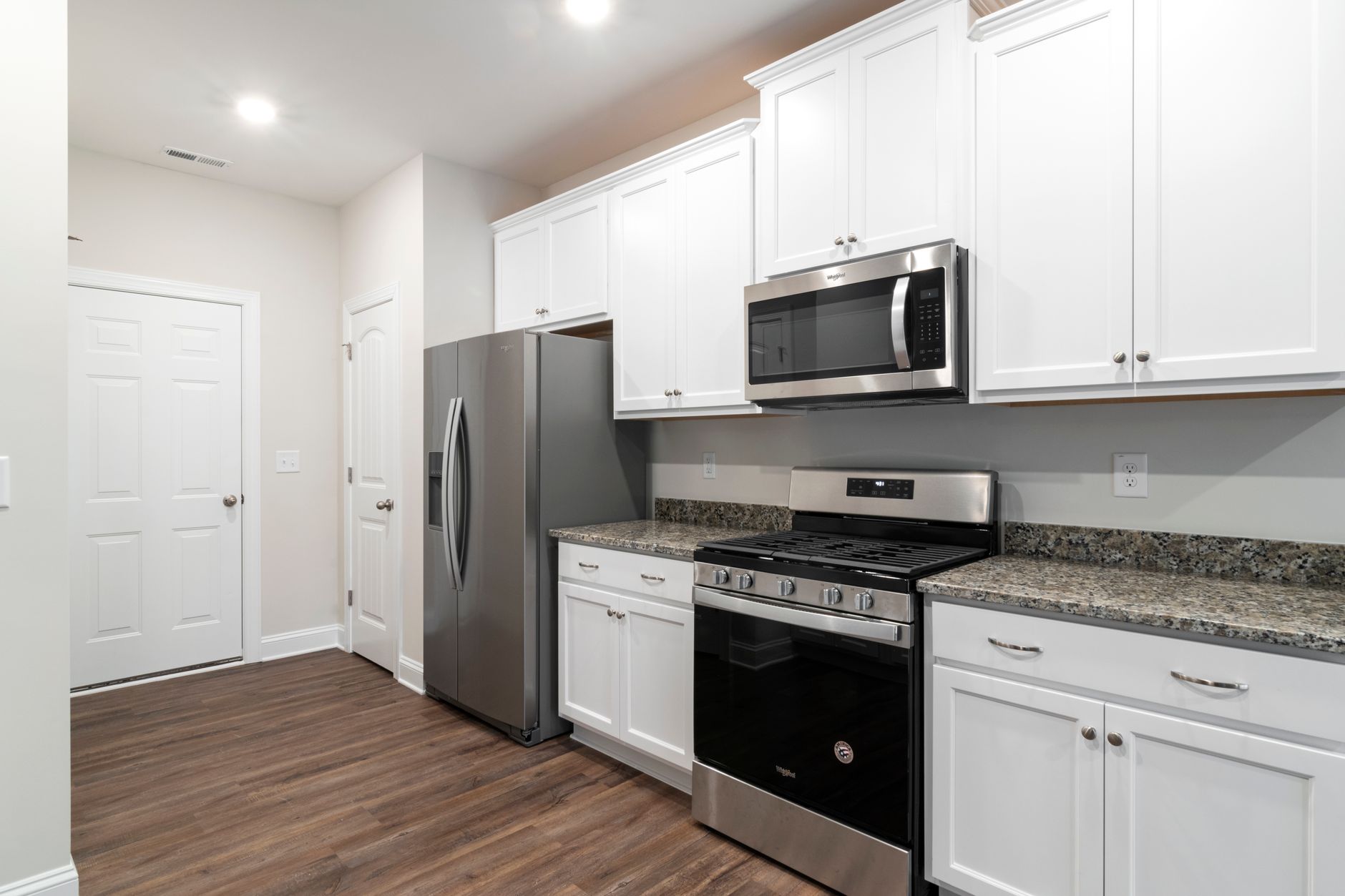
The kitchen work triangle is a mid-20th-century design rule stating that the stove, sink and refrigerator should form a triangle whose three sides add up to a moderate total distance — close enough to limit walking, far apart enough that people aren’t colliding. Feng shui does not use this concept at all, but some of its stove and sink rules produce similar layouts for entirely different reasons.
What is the kitchen work triangle, exactly?
The work triangle treats a kitchen as a small factory floor. The three points of activity — cold storage, water, and heat — are joined by imaginary lines, and the efficiency of the kitchen is judged by the shape and length of those lines.
The commonly cited guidance is that no single leg of the triangle should be too short (the cook has no room to work) or too long (the cook is walking back and forth unnecessarily), and that the total perimeter should stay within a moderate range. It is a rule about motion and workflow, developed for a very specific historical kitchen: a single cook, a fixed sequence of tasks, and a room designed around that one person.
Where does the work triangle idea come from?
The concept comes out of home-economics and industrial-efficiency research in the United States in the 1940s and 1950s, most notably studies associated with the University of Illinois School of Architecture’s kitchen research and the broader time-and-motion tradition pioneered by industrial engineers such as Lillian Gilbreth. It is a design-industry standard, not a scientific law, and later commentators — including kitchen designers writing for professional bodies such as the National Kitchen and Bath Association in the US — have qualified it heavily for modern, multi-cook, open-plan kitchens where a strict triangle often doesn’t fit.
None of this has anything to do with feng shui. The work triangle is a Western industrial-design concept with a traceable, documented origin, and it predates any meaningful contact between that research tradition and feng shui literature.
Does feng shui have its own version of kitchen layout?
Feng shui addresses the kitchen, but through a different lens: the relationship between fire and water, and the position of the cook relative to the room’s entrance. Classical Form School reasoning is concerned with sightlines and the practical experience of standing at the stove — being startled by someone entering from behind is treated as a real disruption, not a superstition, and this is discussed in detail on this site’s guide to where the kitchen stove should be placed.
Compass School readings go further, assigning the stove and the main door directional significance based on the home’s facing direction, using a Compass School reading — a method distinct from Form School and explained on this site’s page on Form School versus Compass School feng shui. The BTB (Black Sect Tantric Buddhist) adaptation, which is common in English-language feng shui writing without always being labelled as such, tends to fold both concerns into bagua-based advice about the kitchen’s position within the home overall — see the site’s explainer on Black Sect (BTB) feng shui for what distinguishes it.
None of these three schools describes anything resembling a “triangle.” There is no equivalent geometric rule in classical or Compass texts, and no historical borrowing in either direction.
What does feng shui say about the stove and sink being close together?
Where feng shui and the work triangle brush up against each other is on stove-and-sink proximity, and here the traditions actually disagree in outcome even though they sometimes share a layout.
In the five-element framework, fire and water are opposing forces — water extinguishes fire in the destructive cycle, a relationship explained on this site’s page on the destructive cycle of the five elements. Many feng shui sources therefore advise against placing the stove and sink directly adjacent, or facing each other across a narrow galley, on the reasoning that the two elements are in direct conflict. This is presented as a symbolic principle, not a physical hazard — no practical rationale is offered beyond the five-element logic itself, and that should be stated plainly rather than dressed up as engineering advice.
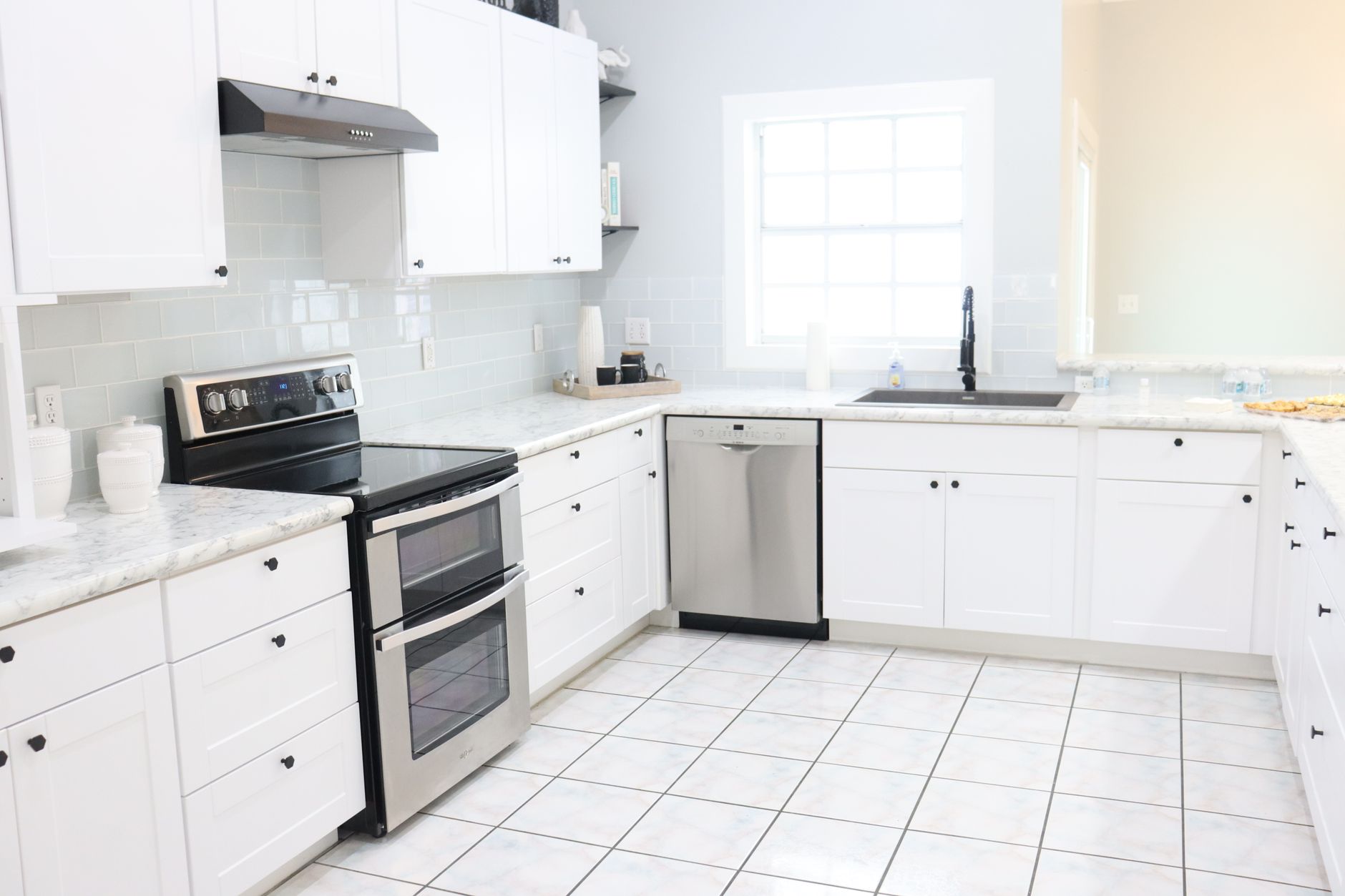
The work triangle, by contrast, is often satisfied by exactly this kind of close stove-sink pairing, because a short leg between the two most-used points reduces walking during meal preparation. A kitchen can therefore be “efficient” by work-triangle standards and “in conflict” by five-element standards at the same time. The two systems are not commenting on the same thing — one measures foot-traffic, the other measures elemental symbolism — and treating a五-element caution as if it were a workflow objection misrepresents both.
Does feng shui care about the refrigerator?
Not in the way the work triangle does. The refrigerator is a minor fixture in most feng shui writing, occasionally discussed in terms of clutter or what’s kept inside it in BTB-influenced consumer guides, but it does not carry anything like the weight given to the stove. The stove is treated, across Form School, Compass School and BTB alike, as the kitchen’s most consequential object, because it is symbolically tied to the household’s nourishment and, in Compass School terms, to the direction it faces. The refrigerator’s location relative to the sink and stove — central to the work triangle’s whole logic — is simply not a feng shui category.
Where they agree, and where they don’t
It’s worth separating the overlap from the coincidence.
- They agree, incidentally, on avoiding a cramped, single-file kitchen. The work triangle rejects layouts where the legs are too short to move between; Form School reasoning about the stove separately values enough space for the cook to see the room. Both conclusions favour an uncrowded kitchen, but they arrive there from workflow versus sightline reasoning, not a shared principle.
- They disagree on stove-sink adjacency. Work-triangle efficiency can favour it; five-element reasoning cautions against it.
- They disagree on what matters most. The work triangle is indifferent to which direction the stove faces or where the door is. Feng shui, particularly Compass School and the commanding-position reasoning discussed on this site’s page on the commanding position, treats the stove’s orientation and the cook’s sightline as central.
- Neither is a safety standard. Gas connections, electrical clearances, ventilation and fire code requirements are governed by building regulations, not by either the work triangle or feng shui, and questions about kitchen safety should go to a qualified contractor, electrician or the relevant local building authority — this article is not that advice.
Is one of these “supported by evidence” and the other not?
The work triangle has an empirical basis, even if a contested one: it comes from observed time-and-motion studies of cooks in specific kitchen types, and later research has revised or qualified it rather than discarded it outright. Feng shui’s stove and sink guidance is a symbolic and cultural framework, not a body of measured outcomes, and this site’s separate page on what evidence exists for feng shui goes into that distinction in more depth. The two shouldn’t be graded on the same scale — one is a design-research heuristic with a paper trail, the other is a tradition with its own internal logic, attributed to specific schools rather than treated as a single settled rulebook.
Practical takeaway for a real kitchen
A reader designing or renovating a kitchen can use the work triangle as a genuinely practical starting point for the physical layout — how far the cook walks, whether two people can work at once — while treating feng shui guidance on the stove separately, as a distinct and clearly labelled tradition rather than a competing engineering claim.
Where the stove sits relative to the kitchen door, and whether the cook faces into or away from the room, is covered in more detail on this site’s guide to stove placement in feng shui. Broader questions about how a room’s layout and furniture positioning are approached across the tradition are gathered in the Layout & Furniture archive, and room-specific guidance, including the kitchen, sits in the Room by Room archive. Readers who want the foundational vocabulary — chi, the bagua, the five elements — before applying any of this to a floor plan can start with the The Basics archive.
About this site. Feng Shui Pack explains what the feng shui tradition holds and which school holds it, from published sources. Feng shui is a tradition of placement and orientation, not a science: nothing here will bring you wealth, health, luck or a relationship, and we never claim otherwise. Where a suggestion has an ordinary practical reason — daylight, airflow, sightlines, less clutter — we say so; where it does not, we say that too. This is not medical, financial, legal or tenancy advice. If a decision matters, talk to a professional in that field.