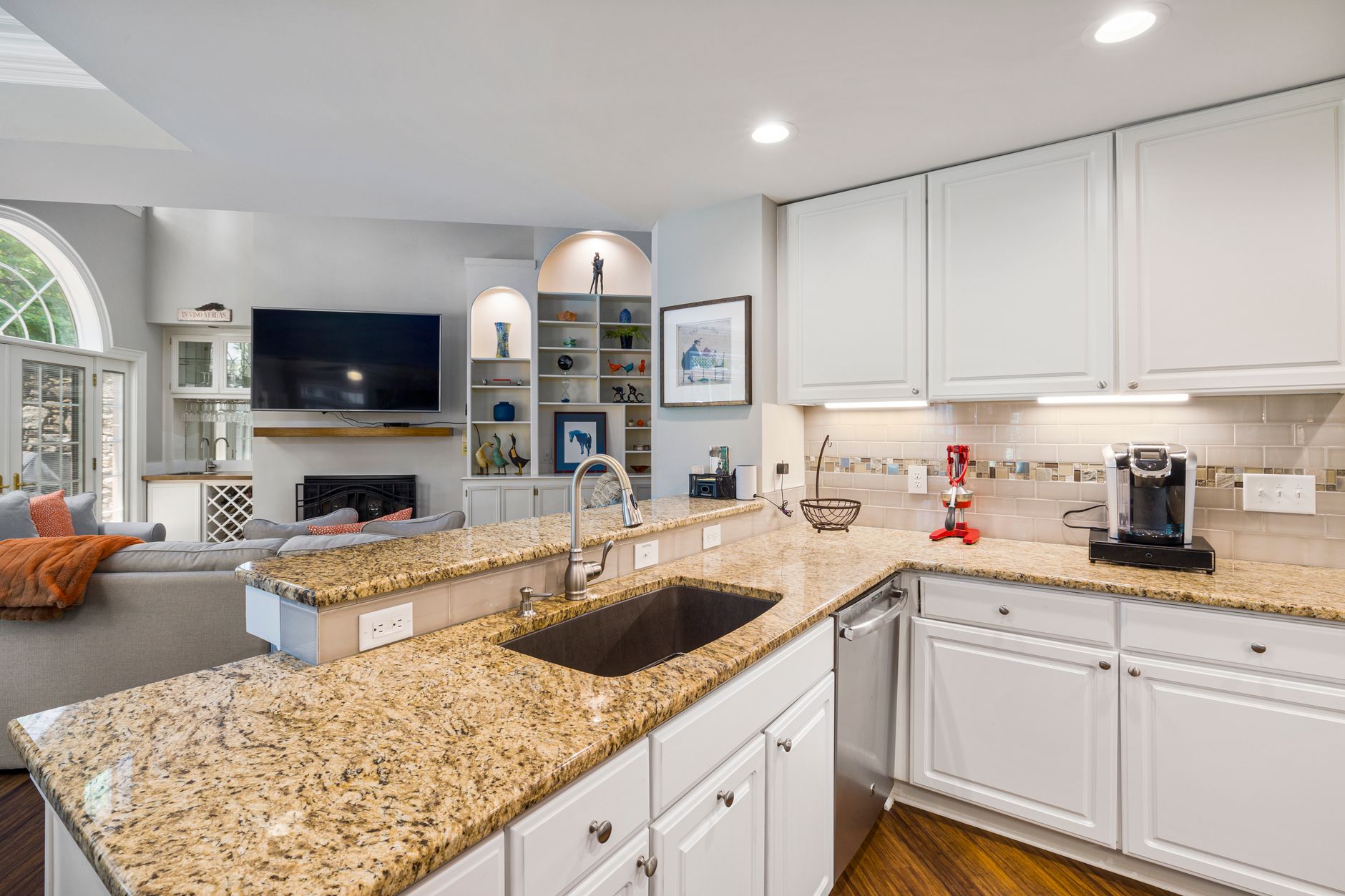
Most feng shui traditions agree the stove should not have its back to the kitchen door, and the cook should be able to see the entrance while at the stove without standing directly in line with it. Beyond that, classical and modern schools give different reasons and different specifics — and this article names which is which.
What does the “commanding position” mean for a stove?
The commanding position is the idea that a person should be able to see the entrance to a room from the main working or resting spot, without being directly in line with the doorway. It is discussed at length on this site’s commanding position explainer, and it applies across rooms — the bed, a desk, and the stove all get treated this way in different schools.
For the kitchen, the practical version of the idea is straightforward: a cook facing away from the door cannot see someone entering the room, which in a working kitchen with knives, open flame and hot pans is a real, unremarkable safety consideration, not a mystical one. Feng shui texts frame the same layout in terms of awareness and control of the space rather than kitchen safety specifically, but the underlying geometry — sightline to the door — is identical.
Why does the stove get special attention in feng shui, more than other appliances?
The stove is treated differently from a sink, fridge or worktop because it represents the fire element and, in older agrarian contexts, the household’s food supply and by extension its prosperity. Classical texts associate the stove with the family’s sustenance in a way that has no equivalent for, say, a cupboard.
This is a claim about symbolism, not a claim about outcomes. The tradition holds that a well-placed stove reflects a well-ordered household; it does not claim a stove position changes income or health, and this site does not present it that way. Readers wanting the wider symbolic system behind fire as an element can see the five elements overview and how fire interacts with the other four.
What does classical Form School say about stove placement?
In Form School (Xingshi), which reads a building’s actual layout, structure and sightlines rather than compass directions alone, the traditional guidance is that the stove should not sit directly opposite the kitchen entrance, and the cook’s back should not face the doorway while cooking. Where the layout of the room makes this unavoidable, some Form School guidance suggests a mirror or reflective surface positioned so the cook can see behind them — an example of the tradition offering a workaround for a fixed structural constraint rather than requiring a renovation.
Form School also generally advises against a stove positioned directly beneath an exposed structural beam, on the same reasoning it applies to beds and seating: a beam overhead is read as a downward pressure point in that framework. No engineering claim is being made about the beam itself; it is a symbolic reading, and this site says so plainly rather than implying otherwise.
Form School’s logic is explained in more depth in the site’s comparison of Form School and Compass School, which also covers where Compass School’s directional calculations add a further, separate layer of guidance based on the compass facing of the building.
Does the BTB adaptation treat the stove differently?
The Black Sect Tantric Buddhist (BTB) adaptation, a twentieth-century Western reworking of feng shui developed by Thomas Lin Yun, generally keeps the same instinct — cook facing the door, not with your back to it — but arrives there through the bagua map anchored to the front door of the home or of the room, rather than through compass direction. Most English-language feng shui content written for Western homes is BTB without saying so, which is why this site names the school explicitly rather than presenting the rule as universal.
BTB material commonly frames the stove as tied to the “wealth” or abundance area of the bagua when the map is overlaid on the kitchen, a reading classical Compass School would not produce, since Compass School locates auspicious and inauspicious directions using a compass reading and the occupants’ personal Kua number rather than a map drawn from the doorway. Readers unfamiliar with how the bagua is applied can start with what the bagua is and how it’s used and how a bagua map is oriented to a home before assuming any one version is the only one.
What about the stove being near the sink or fridge?
Several branches of feng shui advise keeping the stove some distance from the sink or refrigerator, reasoning that fire and water are opposing elements and placing them adjacent is considered a clash. This is part of the five elements framework, specifically the destructive cycle, in which water is said to control fire.
Kitchen designers give a separate, non-feng-shui reason for keeping some distance between a hob and a sink: splash near an open flame or hot element is a genuine practical concern, and the classic “kitchen work triangle” layout used in professional kitchen design already spaces the stove, sink and refrigerator apart for workflow reasons that have nothing to do with feng shui. Where the two traditions land on similar advice, it is worth being clear they arrive there independently.
Can the stove face the door directly?
A stove directly in line with the kitchen door, on the same axis, is one configuration some feng shui schools flag as unfavourable, sometimes described using the same language applied to a door aligned straight with another door or with a bed — see the site’s explainer on what a “poison arrow” is said to be in this tradition, and the related piece on two doors facing each other. The claim is about the axis being read as a channel of fast-moving, un-diffused energy (chi, or qi in pinyin — the term used throughout this tradition for the flow or vitality a space is said to hold).
There is no engineering or safety basis for this specific rule beyond the tradition itself, and this site says so rather than inventing one. Where a stove genuinely cannot avoid that alignment because of fixed plumbing and gas lines, feng shui guidance commonly suggests a visual break — a hanging item, an island, or a change in floor level — as a compromise rather than a structural fix.
Is there a practical design reason behind any of this?
Some of it, yes. A cook who can see the doorway is aware of anyone entering a room with an open flame and sharp tools in use — that is just kitchen safety, independent of any tradition. Adequate space and separation between a hob and a sink reduces splash and crowding at a working surface. Keeping a stove clear of a low, exposed beam or an overhanging cabinet edge is a straightforward clearance and headroom issue.
Where feng shui goes further — into wealth associations, elemental clashes as symbolic conflict, or the reading of a specific compass direction as favourable for a particular household — that is a belief system with its own internal logic, not a design principle with an independent physical basis, and readers should treat the two categories separately. The site’s broader look at what evidence exists for feng shui claims generally covers this distinction in more detail.
What if the stove genuinely can’t be moved?
Most kitchens are built around fixed gas and electrical connections, and moving a stove is a real renovation project, not a furniture rearrangement. This article is not renovation, electrical or gas-safety advice; any change to a stove’s plumbing, wiring or gas supply should go through a qualified, licensed tradesperson and comply with local building regulations, which vary by country and municipality.
Where relocation is not realistic, feng shui practitioners commonly suggest smaller adjustments — a mirror to extend the cook’s sightline, rearranging what sits near the stove, or addressing the room’s layout elsewhere — rather than treating the fixed position as unworkable. For the kitchen’s relationship to the rest of the home’s layout, the site’s room by room archive and entrances and flow archive cover how doorways, sightlines and adjoining rooms are read together rather than in isolation.
About this site. Feng Shui Pack explains what the feng shui tradition holds and which school holds it, from published sources. Feng shui is a tradition of placement and orientation, not a science: nothing here will bring you wealth, health, luck or a relationship, and we never claim otherwise. Where a suggestion has an ordinary practical reason — daylight, airflow, sightlines, less clutter — we say so; where it does not, we say that too. This is not medical, financial, legal or tenancy advice. If a decision matters, talk to a professional in that field.