
The commanding position is a placement rule: put the bed, desk or stove where the user can see the door without being directly in line with it, usually across the room on a diagonal. The reasoning given is that the user sees who enters before being seen, without sitting exposed in the doorway’s direct path.
This single idea shows up under different names across bedroom, office and kitchen advice, and it is one of the few feng shui rules that most schools agree on in substance, even where they disagree on almost everything else. That agreement is worth noticing, because it is rare.
What exactly counts as the commanding position?
It means the furthest point from the door, on a diagonal, with a clear sightline to the doorway and a solid wall behind the piece of furniture. The user is not directly opposite the door, and not blocked by it opening.
Three conditions recur across sources:
- A view of the door from where the person sits or lies, without turning.
- Not positioned directly in line with the door, where anyone entering would be looking straight at them.
- A solid wall behind the bed, desk or stove — not a window, not open space.
The diagonal-from-the-door spot usually satisfies all three at once, which is why it gets named specifically rather than just described in general terms.
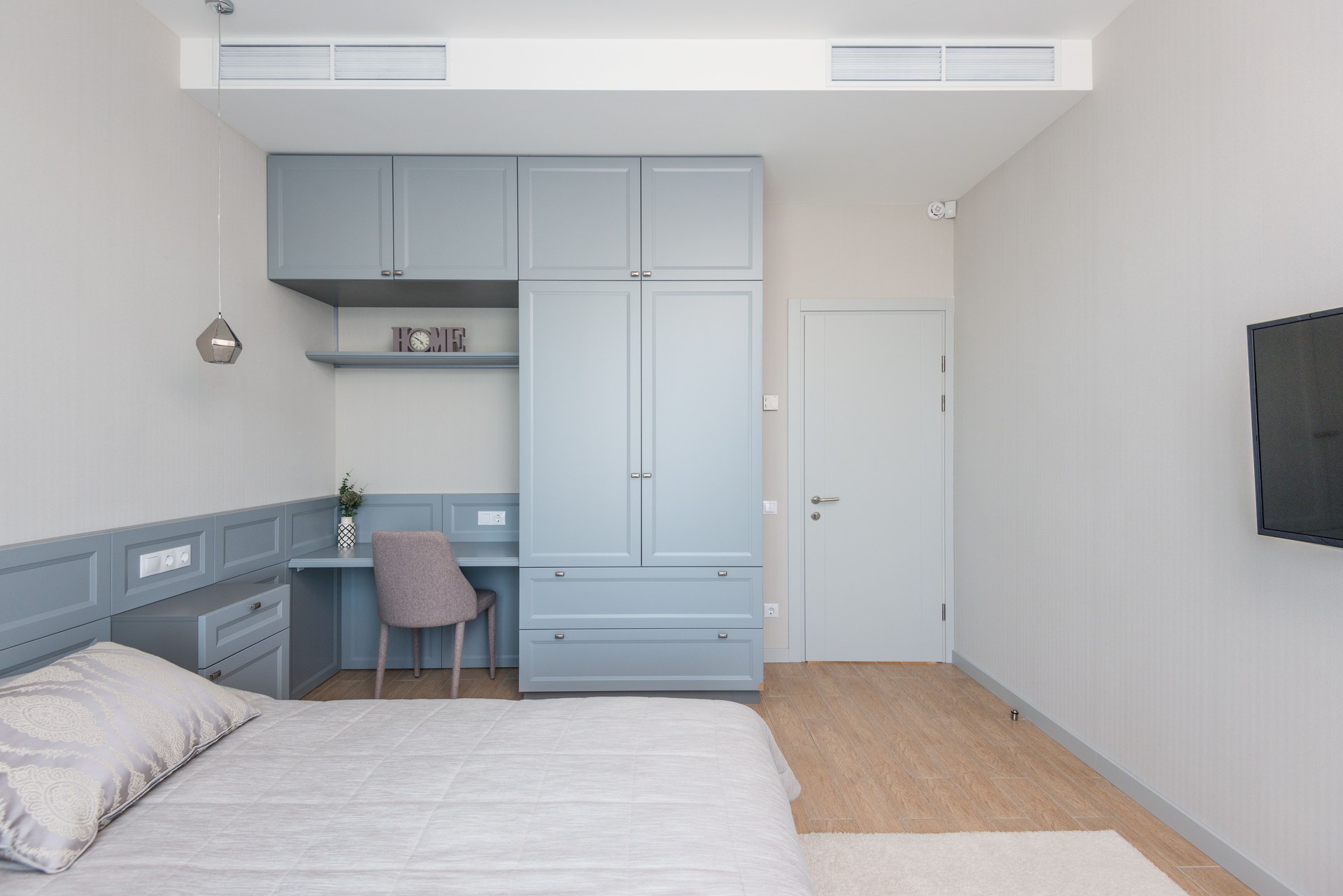
Why does the same rule apply to a bed, a desk and a stove?
Because in Form School (Xingshi) reasoning, all three represent a person in a vulnerable or exposed state — asleep, absorbed in work, or with their back turned while cooking — and the logic is about reducing that exposure, not about the object itself.
Form School developed around the observation of landscape and building shape — the direction water flows, where a hill sits at someone’s back, which way a door faces relative to a room. Applied indoors, a bed or desk with a solid wall behind it and a view of the door is treated the same way a building is treated with a hill behind it and a clear approach in front: protected on one side, aware on the other.
That is why the advice repeats for the stove in traditional kitchen guidance, the desk in office feng shui, and the bed in bedroom guidance. It is one design principle, applied to three different rooms, not three unrelated rules that happen to look similar.
Does classical feng shui actually use this term?
The phrase “commanding position” is the standard English label used mainly in Western, and specifically BTB-influenced, writing. Classical Chinese sources describe the underlying arrangement — orientation to the door, a solid support behind — without necessarily using this exact English phrase.
The Black Sect (BTB) adaptation popularised much of the plain-English vocabulary now used across English-language feng shui writing, including this term. That does not make the underlying logic invalid — the sightline-to-door reasoning appears in older Form School material too — but it is worth knowing that the label itself is a modern shorthand, not a direct translation from a classical text.
Form School and Compass School disagree on how much weight to give compass direction versus physical layout. Compass School (Liqi) practitioners would generally check the room’s orientation and the occupant’s personal directions before finalising a layout; Form School practitioners weight the shape of the room and the sightlines more heavily. The commanding position sits mostly on the Form School side of that split — it is a layout rule first, a directional one only secondarily.
Is there a practical reason for it, or is it purely traditional?
There is a straightforward, non-mystical reason: not being surprised by someone entering a room is a basic comfort most people register without needing a name for it. Facing a solid wall rather than a window also reduces draughts and glare near a bed or desk, which has an ordinary explanation.
Beyond that, no additional practical mechanism is offered in the tradition beyond the reasoning already stated — awareness of the entry point and a sense of being backed rather than exposed. Where a rule has a plain design logic, this site says so directly rather than dressing it up; here, the logic is visibility and a felt sense of security, which is a real and common design consideration in architecture generally, feng shui aside.
What happens when the “ideal” spot is physically impossible?
Most rooms cannot fully satisfy all three conditions — a small bedroom, a shared office, a galley kitchen with the stove backing onto a window are all common. Practitioners generally offer secondary adjustments rather than saying the rule cannot be applied at all.
Commonly suggested adjustments include:
- A mirror placed so the door is visible in reflection from the bed or desk, when a direct sightline is not possible.
- Rearranging so the piece of furniture is off the direct line from the door, even if it cannot reach the far diagonal.
- Treating a window behind the bed as a weaker version of an unsupported wall, sometimes addressed with a solid headboard rather than a full layout change.
None of these promise a different outcome from the “ideal” placement — they are described as workable substitutes when the room’s shape rules out the preferred spot. This is standard practice advice, not a guarantee of anything, and readers weighing a full room layout change might find it useful to read about yin and yang balance in a room first, since brightness, furniture mass and activity level all factor into the same decisions.
How does this connect to the bagua and to chi?
The commanding position is a layout rule about sightlines and support; the bagua is a separate mapping tool overlaid onto a floor plan to associate areas of a room with different life themes. They are often discussed together but are not the same mechanism.
Where the two intersect: once a bed or desk is placed in the commanding position, some practitioners then check which bagua area it falls into, using whichever method — BTB’s front-door-based map or classical Compass School’s compass-based one — that source follows. How the bagua is actually used and how it is oriented to a home are separate questions from where the furniture sits, and conflating them is a common source of confusion in generic advice.
Chi, meaning roughly the flow or movement of air and activity through a space, is the other concept usually invoked alongside this rule — the idea that a person facing the door is positioned to meet that flow rather than have it arrive unseen at their back. What chi actually refers to is worth reading separately, since the term gets used loosely across very different explanations.
Does this apply outside the home — shops, offices, clinics?
Yes — the same reasoning is applied by practitioners to a shopkeeper’s counter, a receptionist’s desk or a clinician’s chair, on the basis that anyone whose job involves greeting people benefits from the same sightline logic as someone sleeping or working at a desk at home.
This is presented in commercial feng shui writing as an extension of the same principle, not a separate rule. The underlying reasoning — see the entrance, avoid sitting directly in its line, have solid support behind — does not change with the type of room; only the furniture named does.
Where does this rule sit within feng shui more broadly?
It is one of the more practically grounded pieces of advice in the tradition, which is likely why it recurs so consistently across schools that otherwise disagree. For the wider set of principles it belongs to, the Basics archive covers the foundational concepts, and the Room by Room archive covers how this and other layout rules get applied to specific spaces in a home.
This article describes design reasoning and traditional practice; it is not professional design, structural, medical or safety advice. Anyone renovating, rewiring a room’s layout for accessibility, or addressing a genuine security concern should consult a qualified architect, occupational therapist or relevant licensed professional rather than relying on this or any feng shui source alone.
About this site. Feng Shui Pack explains what the feng shui tradition holds and which school holds it, from published sources. Feng shui is a tradition of placement and orientation, not a science: nothing here will bring you wealth, health, luck or a relationship, and we never claim otherwise. Where a suggestion has an ordinary practical reason — daylight, airflow, sightlines, less clutter — we say so; where it does not, we say that too. This is not medical, financial, legal or tenancy advice. If a decision matters, talk to a professional in that field.