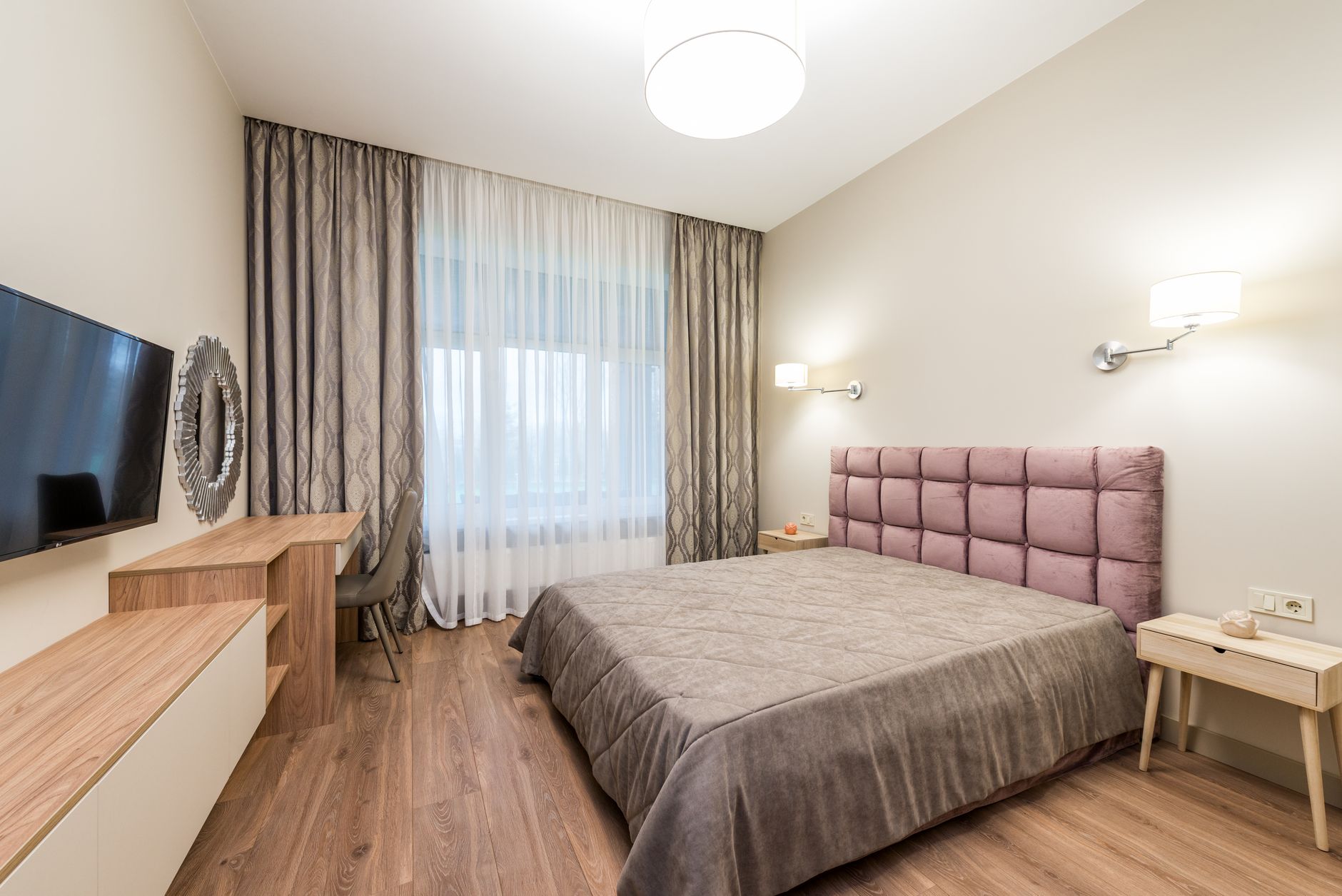
Most schools of feng shui put the bed where the sleeper can see the bedroom door from the bed without lying directly in line with it, with a solid wall behind the headboard and no overhead beam. The exact placement differs by school, but the reasoning given is almost always about sightlines, stability and a calmer approach to sleep.
This is not medical advice. Sleep quality has its own body of research, and anyone with a genuine sleep problem should look to a doctor or a sleep specialist rather than a room diagram. What follows is what the feng shui tradition claims, attributed to the school that makes each claim, and the ordinary design logic behind it where one exists.
What is the “commanding position,” and does the bed have to be in it?
The commanding position is the spot in a room with a clear view of the door but not directly in line with it. In both Form School and the BTB adaptation, the bed is the piece of furniture most consistently placed there, on the reasoning that a sleeper should not be startled by someone entering unseen.
The concept and its history are covered in more depth in the site’s explainer on the commanding position and why it recurs. For a bedroom specifically, commanding position means the bed sits diagonally opposite the door, or at least at an angle where the doorway is visible from a reclining position, rather than tucked immediately behind the door or with the foot pointed straight at it.
Should the bed face the door directly?
Most schools advise against lining the bed up directly with the door, whether the head or the foot points toward it. The practical version of this concerns a straight, unbroken sightline from a doorway to the person in bed, which some find exposing regardless of any feng shui framework.
The stronger version of this rule concerns what Form School and the BTB tradition both call a “poison arrow” — a straight line of fast-moving chi (qi) aimed at a person or a bed, often created by a door, a corridor, or the edge of a wall. The concept is explained fully in what a poison arrow is in feng shui. A bed placed directly in a doorway’s sightline is one of the most commonly cited examples in bedroom advice specifically.
Does the bed need a solid wall behind the headboard?
Yes, in both Form School and BTB guidance — a solid wall behind the head of the bed is treated as offering support, sometimes described as literal support for the sleeper’s back and sometimes in the more symbolic language of stability behind a person’s position in life. No practical mechanism is claimed beyond this; it is presented as tradition, not physics.
Practitioners in this tradition generally advise against:
- Placing the headboard under a window, since there is nothing solid immediately behind it
- Floating the bed in the middle of the room with no wall within reach
- Sharing the wall behind the bed with a bathroom, on the reasoning — not universal, and not explained beyond the tradition itself — that plumbing on the other side disturbs the resting position
What about ceiling beams over the bed?
Exposed structural beams directly above a bed are treated in Form School as a source of pressing or oppressive chi, and the advice is to avoid sleeping under one where possible, or to shift the bed rather than the beam. Where a beam cannot be avoided, some practitioners suggest visually softening it with a false ceiling or fabric canopy rather than any object claimed to counteract it. No engineering rationale is offered for the belief itself, though a low beam is, separately and simply, a real physical obstruction some people find claustrophobic — which is a design observation, not a feng shui one.
What about a mirror facing the bed?
A mirror directly facing the bed is one of the more frequently repeated cautions in BTB-influenced bedroom advice, on the reasoning that a reflected sleeping body is considered disruptive to rest, sometimes described as inviting a “third party” into the relationship represented by the bed. This is a claim of that specific tradition, not a rule found consistently across classical Form School or Compass School texts, and the site’s overview of Black Sect (BTB) feng shui and why it spread explains where much of today’s popular English-language advice, mirror rules included, actually originates.
Does the direction the bed points matter?
In Compass School (Liqi), yes — bed orientation is calculated using the occupant’s kua number, derived from birth year and gender, matched against compass directions considered personally favourable. This is a different system from the commanding-position reasoning used above, and the two can disagree.
Working out a kua number and a corresponding direction requires an actual compass reading of the room, not a guess, which is why the site has a separate explainer on what a feng shui compass is and whether you need one. The broader tension between direction-based Compass School methods and the sightline-based approach of Form School is covered in Form School vs Compass School: the difference — readers weighing conflicting bedroom advice online are very often looking at guidance from two different schools presented as if they were one.
Does yin and yang matter for a bedroom specifically?
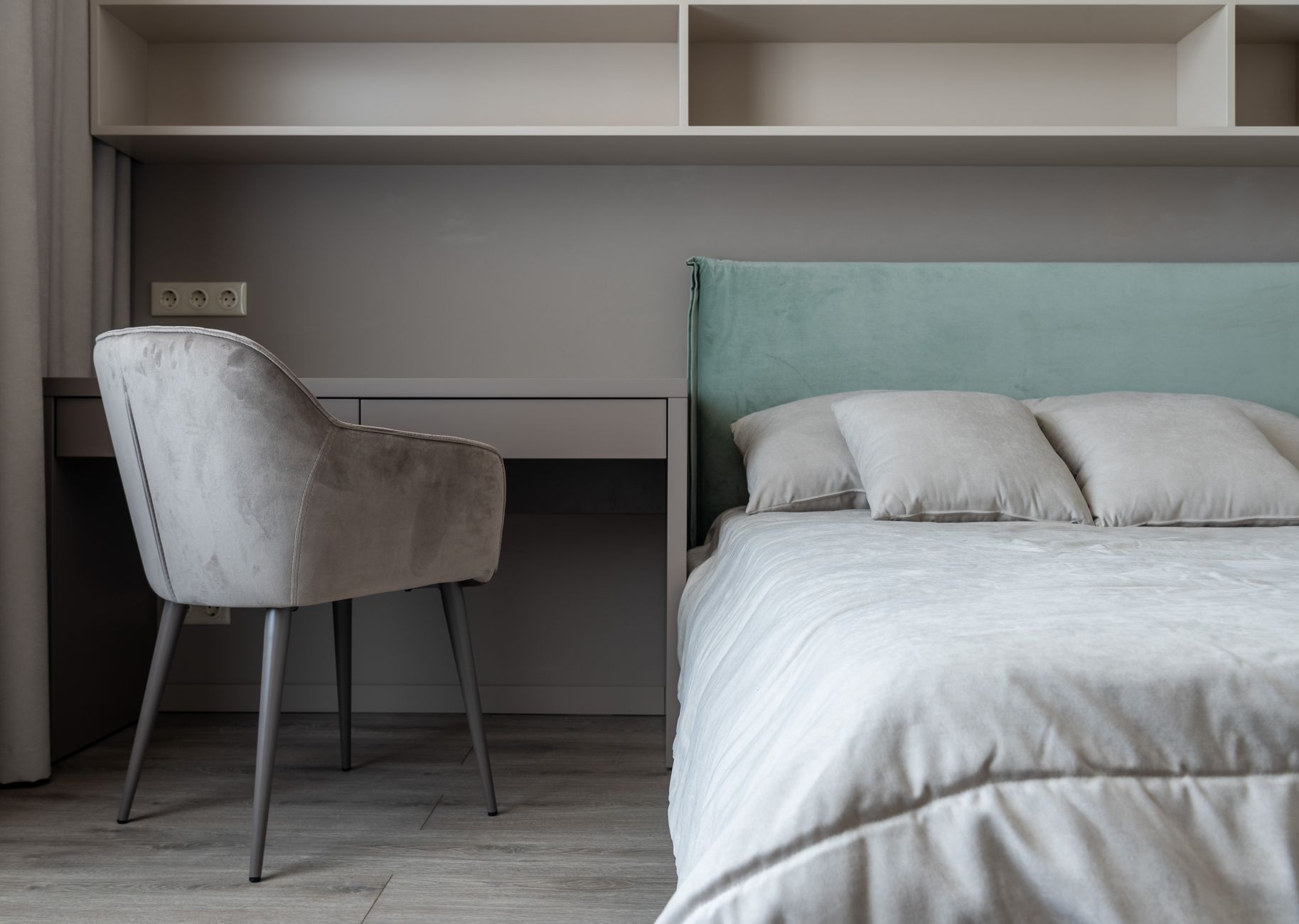
Feng shui treats the bedroom as a yin space — associated with rest, low light and stillness — in contrast to yang spaces like a kitchen or living room, associated with activity and brightness. The tradition’s advice for bedrooms tends to follow from this: softer lighting, fewer sharp angles, and less visual activity than a room meant for daytime use.
This distinction, and how it is applied room by room, is explained in what yin and yang mean in a room. It is worth noting that “more yin” is not the same claim as “better sleep” — the tradition frames it as a matter of balance appropriate to the room’s use, not a guarantee about sleep quality, which remains outside what this article, or feng shui generally, can responsibly claim.
What if the room’s shape makes the ideal placement impossible?
Small bedrooms, box rooms and awkward layouts are common, and most schools acknowledge that an exact commanding position is not always available. Where a straight compromise is unavoidable, practitioners commonly suggest prioritising, in rough order: a solid wall behind the headboard, then a view of the door from the bed, then avoiding a direct line with the door, then compass direction if the household follows Compass School.
Where none of these are fully achievable, the honest position — one the tradition itself does not always state plainly — is that a small, second-floor bedroom with one door and one window has limited configurations, and no system of placement changes the physical geometry of the room. This is one reason the disagreement between schools exists at all; the site’s explainer on why feng shui rules contradict each other so often sets out how much of today’s advice descends from different, sometimes incompatible historical traditions rather than one settled rulebook.
Is there evidence any of this affects sleep or wellbeing?
No controlled evidence ties bed placement, by feng shui’s rules, to measurable sleep outcomes, and the discipline does not present itself as making that kind of claim in its classical form — commanding position, headboard support and the rest are described in Form and Compass School texts as matters of chi, layout and traditional design sense, not clinical outcomes. The site’s separate examination of what evidence exists for feng shui goes into what has and has not been studied, and by whom.
What is separately true, and needs no feng shui framework to justify it, is that a bed with a clear sightline to the door, solid support behind it, decent ventilation and minimal visual clutter is a reasonably sensible way to arrange a room people sleep in. Where feng shui and ordinary design agree, it is worth saying so plainly rather than dressing an ordinary observation in mystical language.
Where to check the underlying framework
Bedroom placement rules sit inside a larger structure — the bagua map, the five elements, and the commanding position concept that recurs across nearly every room in the house. Readers working through a full layout, rather than a single room, may find it more useful to start with the Layout & Furniture archive or the room-specific advice in the Room by Room archive, both of which set out how these same principles are applied — and where they diverge by school — across kitchens, living rooms and entrances as well as bedrooms.
About this site. Feng Shui Pack explains what the feng shui tradition holds and which school holds it, from published sources. Feng shui is a tradition of placement and orientation, not a science: nothing here will bring you wealth, health, luck or a relationship, and we never claim otherwise. Where a suggestion has an ordinary practical reason — daylight, airflow, sightlines, less clutter — we say so; where it does not, we say that too. This is not medical, financial, legal or tenancy advice. If a decision matters, talk to a professional in that field.