
Yes, in most branches of feng shui a mirror facing the bed is treated as a problem, though the reasoning differs by school. Form School objects on practical grounds — a startling reflection disturbs sleep. Compass School and the BTB adaptation frame it as a disruption of chi (qi), the life-force energy the tradition holds moves through a room. No school treats it as neutral.
What does feng shui actually say about a mirror facing the bed?
Across the major schools, a mirror positioned so it reflects a sleeping person is considered undesirable, though the stated reason changes depending on which tradition is being consulted.
In classical Form School (Xingshi), the concern is behavioural and physiological. A body glimpsed suddenly on waking — in low light, in a half-asleep state — is said to startle the sleeper, and a startled waking is treated as a poor way to begin rest. This is closer to environmental psychology than to metaphysics, and it is the version of the rule that survives contact with a bright light switched on at 3am.
Compass School (Liqi), which works from directional calculations rather than room shape, folds the mirror concern into its wider treatment of reflective surfaces as active, not passive, objects. A mirror is treated as something that redirects and doubles whatever it faces — including a sleeping body — rather than simply showing it.
The BTB (Black Sect) adaptation, the most common source for English-language feng shui advice, states the objection most bluntly: a mirror facing the bed is said to double disturbances in the room, including arguments, restlessness or ill health, and to unsettle the sleeper’s energy overnight. This is a claim from that tradition specifically — BTB is a 20th-century Western adaptation, not a classical Chinese text, and it is worth naming as such rather than presenting it as feng shui in general.
Whichever school is cited, the outcome is the same recommendation: avoid a direct mirror-to-bed sightline, or address it if the layout makes that unavoidable.
Why does Form School treat it as a design problem, not a symbolic one?
Form School’s objection to a bed-facing mirror sits inside a broader set of concerns about what the sleeper actually perceives on waking, which is also why it cares about sightlines to the door — the basis of the commanding position a bed is traditionally given in a room.
A mirror opposite a bed reflects movement, light changes and, at night, whatever ambient glow enters the room — headlights through a curtain gap, a hallway light left on, moonlight. Reflected motion at the edge of vision is a known trigger for waking or partial waking. None of that requires belief in chi to accept; it is closer to the reasoning behind not placing a bed where a draught crosses it, discussed in general terms in the site’s guide to ventilation and stale air.
Form School’s practical bent is also why it is comfortable saying plainly when a rule has no design logic behind it at all — a caution repeated across this site because a lot of mirror advice online blends schools without saying so.
What does the BTB (Western Black Sect) tradition specifically claim?
The BTB adaptation is explicit that a mirror facing the bed is one of its standard bedroom cautions, and it frames the concern in terms of energy rather than sleep physiology.
In this tradition, a mirror is treated as an amplifier: whatever state the room or the sleeper is in — rest, tension, illness — is said to be intensified by a mirror reflecting it back overnight, particularly one facing the bed directly. BTB also extends this caution to a mirror reflecting the door, treated separately and in more detail in the site’s guide to a mirror facing the front door, which is a related but distinct placement question.
It is worth being direct about sourcing here: this framing is BTB’s own vocabulary, developed by Thomas Lin Yun’s school in the West from the 1980s onward, and it is not found in classical Chinese texts in this form. The site’s explainer on what BTB is and where it differs from older schools covers this distinction in more depth, and it is the single most useful piece of context for reading most English-language feng shui advice, including advice about mirrors.
Does the mirror’s exact position change anything?
Both schools care less about a mirror existing in the bedroom than about its precise sightline relative to the bed — a small change in angle is treated as resolving most of the objection.
A wardrobe mirror on a side wall, a dressing-table mirror angled toward a window rather than the bed, or a mirror on the inside of a closet door that stays shut are all treated as unproblematic in both Form School and BTB readings, because none of them puts a reflection of the sleeper in the sleeper’s own eyeline.
The site’s general guide to mirror placement across feng shui schools and the bedroom-specific piece on mirrors in the bedroom both cover this in more detail, including ceiling mirrors, mirrored wardrobe fronts and the common case of a mirror that only catches the bed’s reflection at certain times of day.
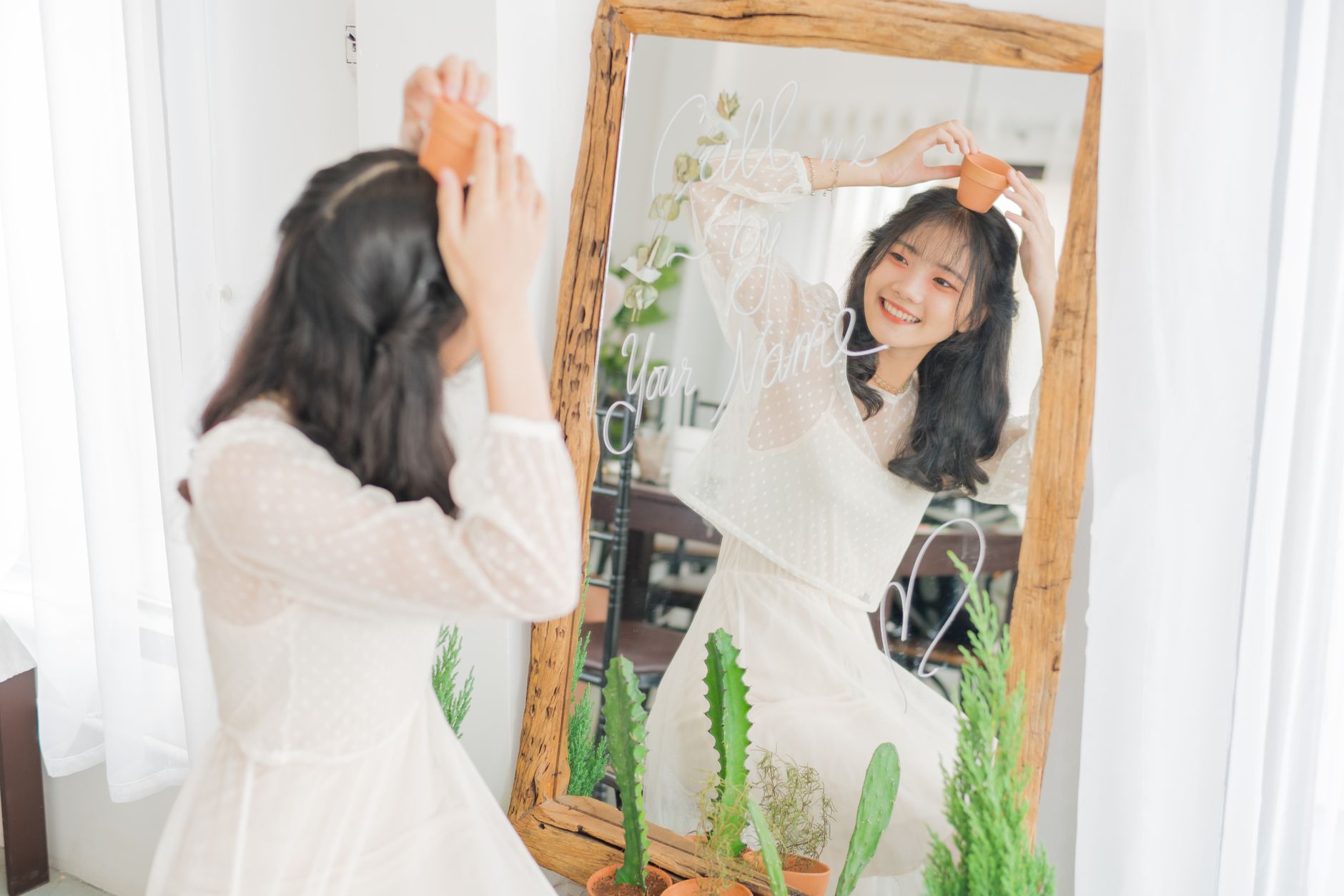
What if the mirror can’t be moved?
Where the room’s layout makes repositioning impractical — a fitted wardrobe with a full-length mirrored door is the most common case — the standard suggestions across schools are to cover it overnight or turn its face away from the bed rather than remove it.
- A curtain, sliding panel or fabric throw hung over the mirror at night, drawn back by day.
- Repositioning the bed itself, even by a small angle, so the headboard or footboard breaks the direct sightline rather than the mirror facing it squarely.
- Where the mirror is on a wardrobe door, keeping that door closed overnight rather than covering the glass separately.
None of these is presented in any school as a guaranteed remedy for anything beyond the stated concern — a disturbed reflection, or a doubled disturbance in BTB’s terms. No school claims a covered mirror improves health, sleep quality or anything else measurable, and this site does not either; if sleep itself is the actual problem, that is a matter for a GP or a sleep specialist, not a placement change.
Is there evidence this affects sleep or anything else?
There is no clinical evidence that a mirror’s position relative to a bed affects sleep quality, health or any other outcome, beyond the general and well-documented effect that sudden visual stimuli can cause waking. Feng shui’s claims here are traditional, not medical, and should not be read as either.
The reasoning that a startling reflection disrupts a light sleep stage is plausible and grounded in ordinary perception — it does not require the wider framework of chi to make sense. The claim that a mirror “doubles” negative energy, by contrast, is a claim from within the BTB tradition specifically, resting on that school’s own model of how a room’s energy behaves, and it is not a claim this site can verify or attribute to feng shui as a whole. The site’s longer piece on what evidence exists for feng shui claims generally covers this distinction across many other rules, not just mirrors.
Does this connect to other bedroom layout rules?
The mirror-facing-bed rule sits inside a wider set of bedroom conventions concerned with what the sleeper sees, and how the room is arranged around the bed, rather than being an isolated superstition.
It shares logic with the preference for a bed positioned so the door is visible without lying directly in line with it, covered in the site’s guide to the most common feng shui mistake in a bedroom, and with guidance on headboard placement in the piece on how a headboard should be positioned. Reflective surfaces more generally, including metal and glass finishes near a bed, are addressed in the site’s guide to metal and glass in a room.
Readers working through a bedroom layout from the ground up may find it more useful to start with the broader hub for room-by-room guidance or the objects and materials archive, both of which set mirrors in context alongside the other choices — furniture, lighting, storage — that shape how a bedroom is actually used.
About this site. Feng Shui Pack explains what the feng shui tradition holds and which school holds it, from published sources. Feng shui is a tradition of placement and orientation, not a science: nothing here will bring you wealth, health, luck or a relationship, and we never claim otherwise. Where a suggestion has an ordinary practical reason — daylight, airflow, sightlines, less clutter — we say so; where it does not, we say that too. This is not medical, financial, legal or tenancy advice. If a decision matters, talk to a professional in that field.