
The mistake most consistently named across English-language feng shui writing is a bed placed so the sleeper cannot see the bedroom door from it — no “command position,” in the phrase used by the BTB (Black Sect Tantric Buddhist) adaptation of feng shui. Practitioners in that tradition treat this as the single most correctable layout error in a home.
Why does the bed’s position get singled out?
The bed is where a person spends roughly a third of their life unconscious and unable to react to their surroundings. Every major branch of feng shui — Form School, Compass School, and BTB — treats the bed as the most consequential object in the home precisely because of that vulnerability, even though they disagree on exactly how to place it.
Form School’s reasoning is closer to old defensive logic: a sleeper’s back should not be exposed to an unwatched entry point. Compass School layers in directional calculation based on a person’s kua number. BTB, the version most common in Western books and blogs, simplifies this into a single rule of sightline — can the person in bed see who or what comes through the door.
What is the “command position,” and why is it named the top mistake?
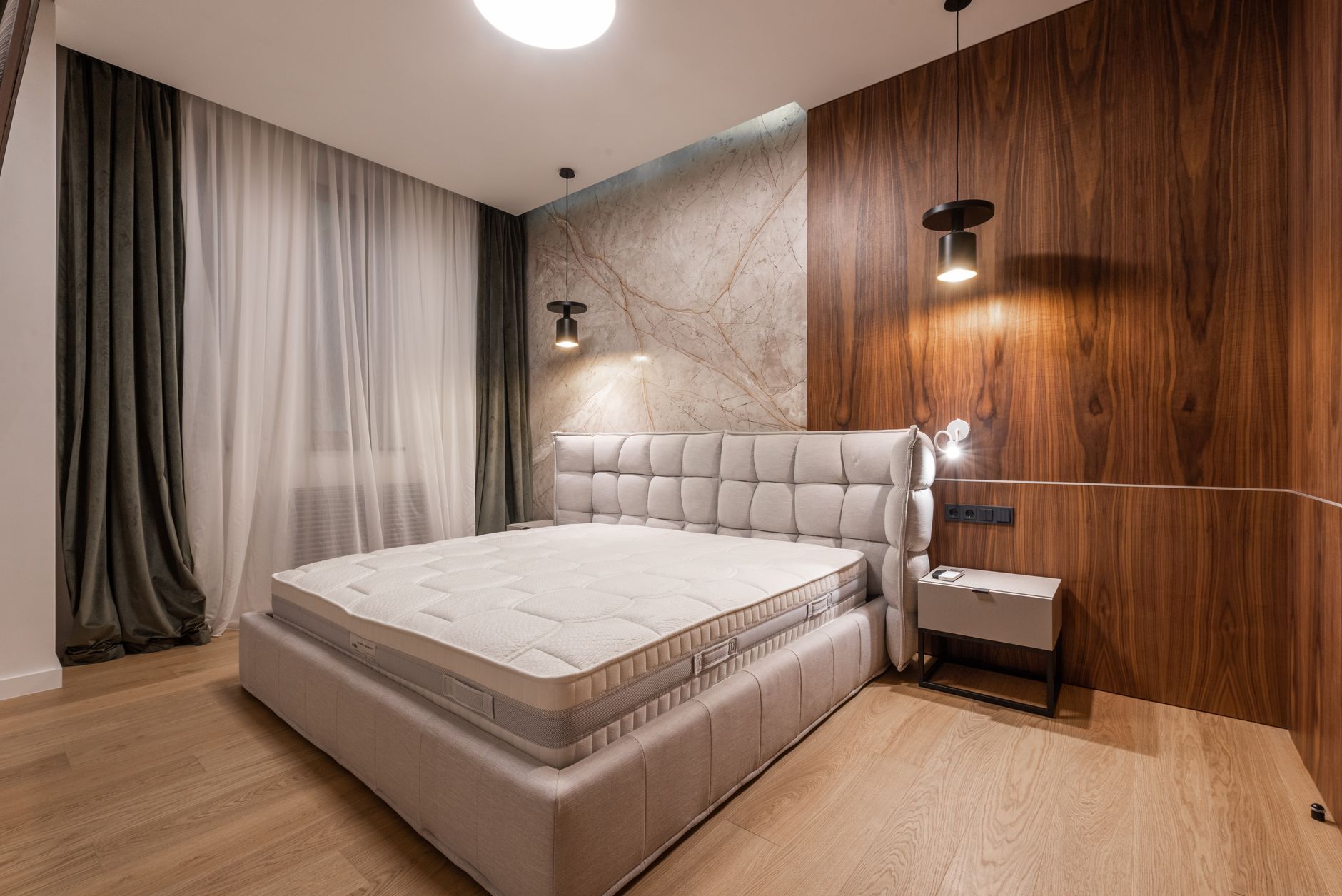
The command position means the bed is placed so its occupant can see the door without being directly in line with it, ideally with solid wall behind the headboard rather than open space or a window. A bed that fails this test — tucked behind the door’s swing, facing away from it, or wedged so the door opens onto the sleeper’s feet — is the layout flaw practitioners flag most often, because it is common in small or oddly shaped bedrooms and easy to overlook.
The reasoning given, consistently across sources, is about awareness rather than superstition: a person entering the room is registered immediately rather than as a surprise. Whether or not one accepts the energetic framing, the practical logic of not being startled awake is easy to state plainly, and the site’s page on the command view of a room sets out how this principle is applied in practice.
What other mistakes get named alongside it?
A handful of related placement errors turn up repeatedly in feng shui writing, and they are often mistaken for the same rule when they are separate points:
- A bed pushed under a window, which BTB treats as unsupported and exposed even when the wall behind it is solid — the reasoning is set out on the site’s page about a bed placed under a window.
- A mirror positioned to face the bed directly, which some Form School and BTB sources describe as disruptive to rest; the general reasoning for mirror placement is covered in the guide to feng shui and mirrors.
- A bed with no headboard, or a headboard against a window rather than a solid wall — treated as a milder version of the same “unsupported bed” concern.
- An asymmetrical bedroom layout, such as one nightstand and one lamp, which BTB associates with relationship balance; this is addressed separately in the page on symmetry in a bedroom.
These are frequently listed together as “bedroom mistakes,” but they are distinct claims from distinct reasoning, not one rule repeated four ways.
Is there a practical reason, or is this purely traditional?
For the command position specifically, yes — there is an ordinary, checkable reason that has nothing to do with chi (qi, the flow of energy through a space). Sleep researchers and interior designers, working entirely outside feng shui, also generally advise against placing a bed where a sleeper cannot see the door, on the basis that unexpected movement or light from an entry point is more likely to disturb sleep if it isn’t visible in advance. Feng shui arrived at a similar layout recommendation from a different starting point.
Other bedroom guidance has thinner practical grounding. No practical reason is generally given for the symmetry rule beyond the tradition itself — it is a proposition about balance in the room’s arrangement, not about sleep quality or safety, and readers should treat it as a matter of preference rather than a design fix for anything measurable.
This article is not sleep or health advice. Anyone with ongoing sleep difficulty should consult a doctor or a qualified sleep specialist rather than treat furniture placement as a solution.
How does the mistake get defined differently between schools?
The disagreement matters because “fixing” the same bedroom can mean different things depending on which system is being followed. BTB’s version of the mistake is purely about sightline to the door — solvable by turning or shifting the bed even slightly. Compass School’s version folds in the room’s compass orientation and the occupant’s personal kua direction, meaning the same bed position could be “correct” for one person and “wrong” for another sharing the room. Form School cares less about compass bearing and more about the shape of the room and what sits opposite the bed — a beam, a corner, a corridor.
A reader following an online checklist without knowing which school it comes from can end up trying to satisfy three different, sometimes contradictory, standards in one room. The site’s broader explanation of how these systems differ is at The Basics, and the wider question of why the rules conflict at all is worth reading before adopting any single fix as universal.
What should someone actually check in their own bedroom?
Setting aside which school is being followed, three questions cover most of what gets raised under “the bed is wrong”:
- From lying in bed, is the door visible without turning the head sharply?
- Is the headboard against a solid wall, rather than a window or open space?
- Is the bed directly in the path of the door’s swing, so it is the first thing struck or seen on entry?
A bedroom that fails all three is not unusual — many rooms are simply the wrong shape or size for a textbook layout, and feng shui sources acknowledge this by offering secondary fixes (a mirror placed to extend the sightline, for instance) rather than insisting on a single floor plan. Broader furniture placement, including what a solid wall behind a bed is doing structurally, is covered in the Layout & Furniture section, and how a bedroom compares to other rooms in this respect is set out across Room by Room.
Does this matter for a shared bedroom or a small flat?
Yes, and arguably more than for a single generous room. In small flats, the bed is frequently the piece of furniture with the fewest possible positions, and the command position often loses out to simply fitting the bed and a door swing into the available floor area. Where every wall is compromised — one has a window, one has the door, one is shared with a bathroom — practitioners generally suggest treating sightline to the door as the priority over the others, since it is the one most consistently tied to a practical rationale rather than tradition alone.
For a shared bedroom with two people, the symmetry question becomes more relevant, since two nightstands and two accessible sides of the bed are also a matter of ordinary shared use, not only feng shui balance.
A final note on how this is best used
The command position is the most-cited bedroom mistake because it is the easiest to check, the easiest to fix without buying anything, and the one with a plain, statable reason behind it. Where this article discusses BTB or Form School reasoning, that is what is being described — a specific tradition’s claim, not a universal law of rooms. Readers making structural changes to a home, including anything affecting a tenancy agreement, should confirm requirements with their landlord or a qualified professional rather than rely on layout advice of any kind for that decision.
About this site. Feng Shui Pack explains what the feng shui tradition holds and which school holds it, from published sources. Feng shui is a tradition of placement and orientation, not a science: nothing here will bring you wealth, health, luck or a relationship, and we never claim otherwise. Where a suggestion has an ordinary practical reason — daylight, airflow, sightlines, less clutter — we say so; where it does not, we say that too. This is not medical, financial, legal or tenancy advice. If a decision matters, talk to a professional in that field.