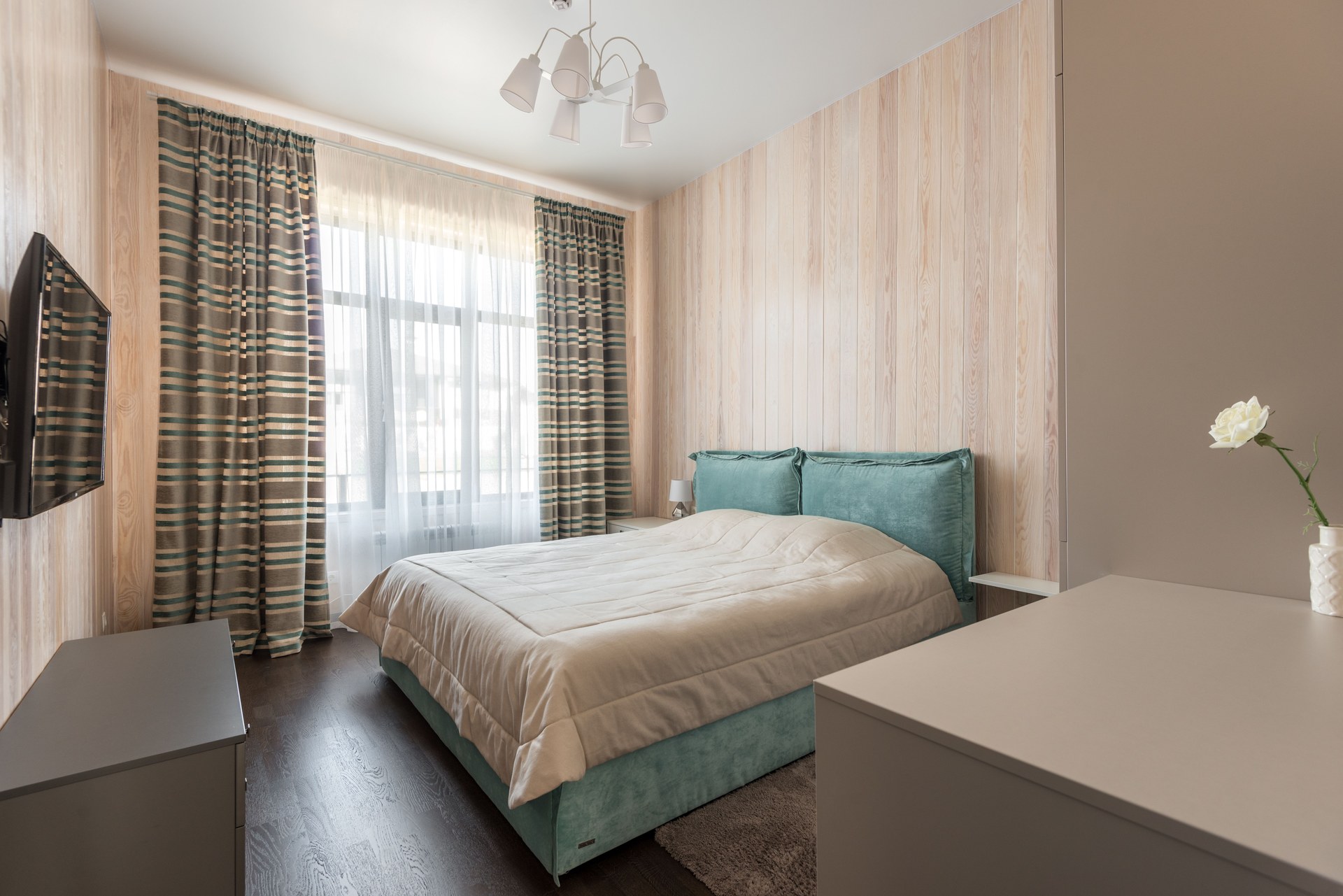
Feng shui does not require ownership. Most of what the tradition asks for — furniture position, clutter, lighting, what’s on the walls — is movable, and renters can do all of it. What can’t be changed (a fixed door, a building’s orientation, a landlord’s no-drilling clause) is worked around, not fought, using placement, mirrors, plants and lighting instead of structural change.
Which feng shui rules actually require structural change?
Fewer than most people assume. The rules that depend on structure come mainly from classical Form School (Xingshi) and Compass School (Liqi), both of which evolved to judge land, building shape and fixed orientation — things a builder or a landowner decides, not a tenant.
Compass School assigns qualities to the eight compass directions of a building and its rooms. A renter cannot move a wall to change which direction a room faces. What a renter can do is work with the room as it is: where the desk sits within a north-facing room, for instance, rather than trying to relocate the window. That distinction — orientation is fixed, arrangement within it is not — is explained in more detail in the piece on what feng shui says about north-facing rooms.
The BTB (Black Sect Tantric Buddhist) adaptation, which is the source of most English-language “feng shui tips” without ever naming itself, is far less concerned with compass direction and far more concerned with what’s inside a room: clutter, sightlines, what a mirror reflects, whether a hallway is blocked. Almost none of this requires touching the building itself.
What can a renter actually change without permission?
Nearly everything the BTB tradition treats as significant. Furniture position, what’s stored where, what hangs on walls (with removable hooks rather than fixed screws), lighting layers, textiles, and what’s kept versus discarded are all within a tenant’s control regardless of the tenancy agreement.
- Where the bed, sofa or desk sits within the room
- What is visible from the bed or desk — see the discussion of the commanding position and what to do if the bed can’t be moved
- Lighting layers, rather than relying on a single overhead fixture the landlord installed
- Clutter, which most schools treat as the first problem regardless of layout — see why clutter is the first problem in every feng shui school
- What’s under furniture, on shelves, or hung on the wall as artwork
None of this needs a landlord’s sign-off, and none of it is architectural.
What if the bed can’t be moved out of the “wrong” position?
The tradition’s usual answer is to compensate rather than force a move. A bed facing the door directly, or backed onto a shared wall, or under a window, comes up constantly in small rented bedrooms where there’s genuinely only one place a bed fits.
The commanding position — being able to see the door from the bed without lying directly in line with it — is a BTB-derived principle, not a universal rule, and it has an ordinary practical logic behind it: a door that opens without warning is startling regardless of anyone’s beliefs about chi (qi). Where the layout makes the ideal position impossible, practitioners commonly suggest a mirror positioned to extend the sightline, or simply accepting the compromise and addressing what can be changed instead — bedding, lighting, what’s stored beneath the bed. That specific problem is covered directly in the guide on what feng shui actually suggests when you can’t move the bed, and the related question of what to keep under it is addressed in what feng shui says about storing things under the bed.
Does the front door matter if it’s fixed by the building?
The door itself, its direction and its position in the wall are fixed. What happens on either side of it is not.
In the BTB adaptation, the front door is treated as the “mouth of chi” — the main point through which energy is said to enter a home — and a great deal of BTB advice concerns keeping the area in front of and behind it clear, well lit and free of a direct straight-line view to a back door or window. A renter can’t move a front door, but can absolutely control what sits in the entryway, whether shoes and clutter block it, and whether a mirror is placed facing it. These are covered in the Entrances & Flow archive, which deals specifically with the parts of a layout that function as circulation rather than as rooms in their own right.
Is it worth buying objects to compensate for a fixed layout?
The tradition does not require purchases, and this site does not recommend any. Where BTB practice uses an object — a mirror, a plant, a wind chime — it’s describing what that object is said to do within the system, not selling a fix. A mirror said to “extend” a cramped sightline works the same whether it’s inherited, charity-shop, or new.
Marketing that frames a specific crystal, coin or figurine as a required purchase to correct a rental’s layout is not something the tradition itself asks for, and it’s worth being skeptical of it. The reasoning is laid out fully in why “buy this lucky object” is bad feng shui advice.
What about walls a tenant can’t paint or fixtures they can’t remove?
Colour and fixed lighting are two of the most common rental frustrations, and both have workaround approaches that don’t touch the lease.
Where a wall colour can’t be changed, textiles do a lot of the same work in feng shui terms — a rug, curtains, cushions and throws introduce the tone and material association a wall colour would otherwise carry. The Five Elements framework, which associates colours and materials with wood, fire, earth, metal and water, is explained in which materials are associated with which element in feng shui, and applies just as well to a rug or a curtain as to paint.
Where overhead lighting is fixed and can’t be swapped for something softer, layering in floor lamps, table lamps and portable fixtures addresses the same concern the tradition raises about a single harsh downlight — a concern with an ordinary practical basis, since uniform overhead light flattens a room and gives no control over mood or task lighting. This is covered in what feng shui says about overhead lighting.
Does a small or oddly shaped rental need different treatment?
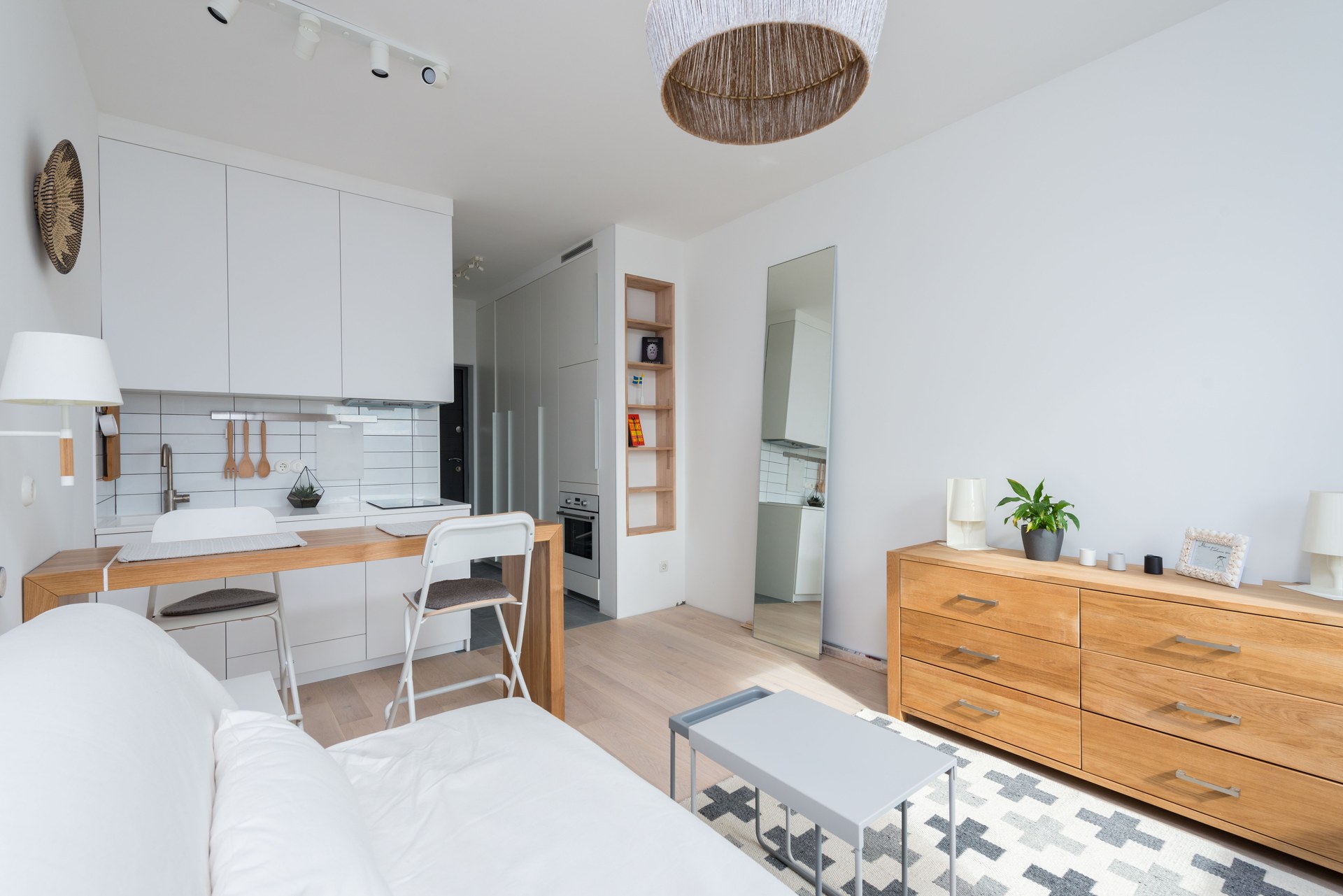
Renters, more than owners, tend to live with a single room doing two or three jobs — a bedroom that’s also an office, a living room with a dining table wedged in a corner. The tradition’s approach to this is about zoning with furniture and rugs rather than walls, since walls aren’t an option.
Using a rug, a bookshelf, or a change in lighting to signal where one function ends and another begins is standard advice in both classical and BTB approaches to dual-purpose space, covered in how to arrange a room that does two jobs. Similarly, furniture that has to sit flush against every wall because the room is narrow raises a genuinely practical question about circulation, not just a symbolic one — addressed in furniture against walls: what feng shui actually says.
Is any of this a substitute for reading the tenancy agreement?
No. This article describes feng shui reasoning about layout and objects; it is not legal advice about what a lease permits, what a landlord can refuse, or what counts as a fixture a tenant is entitled to alter. Painting, drilling, or altering fixed installations may be restricted by a specific tenancy agreement or by local housing law, and those questions should go to a solicitor, a tenants’ rights organisation, or the relevant government housing authority in the reader’s own country — not to a feng shui guide.
Where does a renter start?
The lowest-friction starting point is almost always the same regardless of what school is being followed: clear what’s blocking movement, particularly around the entrance and any main walkway, since a cluttered path is treated as a problem by Form School, Compass School and BTB alike for the same basic reason — it’s harder to move through and harder to keep clean. From there, furniture position and lighting layers do the bulk of the remaining work. The Layout & Furniture archive and the Basics archive cover the underlying principles in more depth, including which rules are genuinely near-universal across schools and which are specific to one tradition.
About this site. Feng Shui Pack explains what the feng shui tradition holds and which school holds it, from published sources. Feng shui is a tradition of placement and orientation, not a science: nothing here will bring you wealth, health, luck or a relationship, and we never claim otherwise. Where a suggestion has an ordinary practical reason — daylight, airflow, sightlines, less clutter — we say so; where it does not, we say that too. This is not medical, financial, legal or tenancy advice. If a decision matters, talk to a professional in that field.