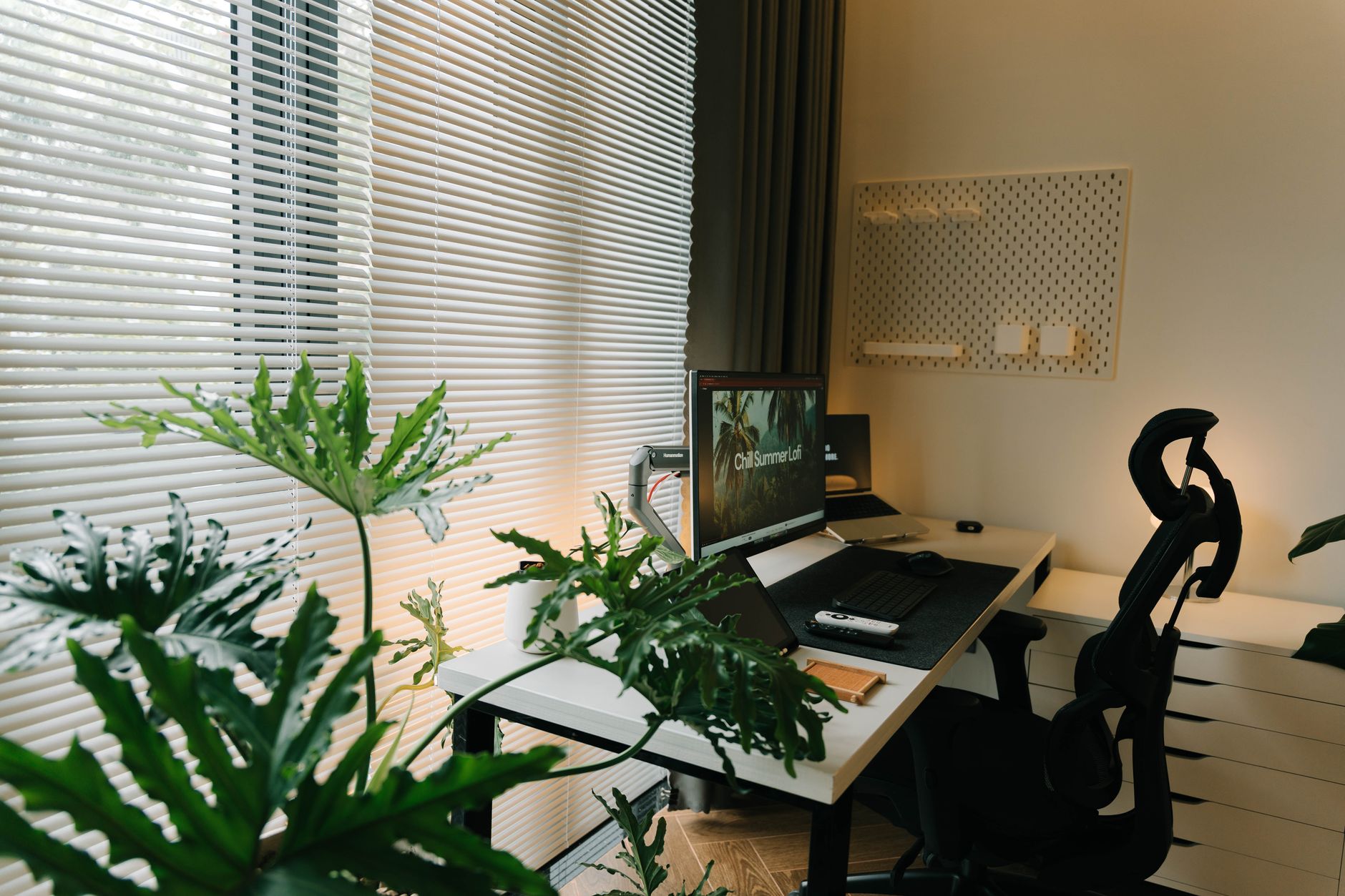
Most feng shui traditions agree a desk should let the person sitting at it see the door of the room without being directly in line with it — a position usually called the “commanding position.” Beyond that, the answer splits by school: Compass School ties it to compass directions and a personal number, while Black Sect (BTB) ties it to the bagua map laid over the room.
What is the “commanding position,” and why does it apply to a desk?
The commanding position is a Form School (Xingshi) concept: a seat placed so the occupant can see the entrance to the room without sitting directly opposite it, ideally with solid wall behind rather than a window or open doorway. Applied to a desk, this usually means placing it diagonally across from the door, not lined up with it, and not with the chair’s back to it.
The reasoning given is practical rather than mystical: a person facing away from an entrance can be startled by someone entering, and a chair with nothing solid behind it offers less physical support and no clear view of who else is in the room. This same logic recurs across bedroom and living room advice on this site — see how it applies to where the bed should go in a bedroom and to where a sofa should go in a living room. The full background on the concept is covered separately in what the commanding position is, and why it recurs.
Should the desk face the door directly?
Most Form School guidance advises against lining the desk up squarely with the door. A desk directly in line with a doorway is sometimes described as sitting in the path of a “poison arrow” — a straight, fast line of movement toward the person seated there.
The term and its logic are explained in detail in what a “poison arrow” is in feng shui. The practical version of the advice holds regardless of school: a desk set at an angle to the doorway, rather than dead-on, keeps the sightline to the door without putting the chair directly in a corridor of foot traffic.
What if the desk can’t face the door directly?
Where the room’s layout makes the commanding position impossible — a small home office, a desk built into an alcove, a shared room with only one workable wall — Form School practitioners commonly suggest a mirror positioned so it reflects the doorway into the occupant’s line of sight while seated.
This is a workaround, not a universal fix, and no source claims it performs identically to an unobstructed sightline. If a mirror is used, it is worth checking how mirror placement is treated elsewhere on the site, since the same object is discussed with different logic in bedrooms; see what feng shui says about mirrors in a bedroom.
Does the desk need to face a specific compass direction?
In classical Compass School (Liqi), including the Eight Mansions (Ba Zhai) method, the answer depends on a person’s kua number, calculated from birth year and gender, which is said to correspond to four “auspicious” and four “inauspicious” compass directions for that individual. A desk facing one of the auspicious directions for the occupant’s kua number is the recommendation under this system.
This is a distinct method from the commanding-position approach above, and the two can conflict — a compass-favourable direction may not match the room’s best sightline to the door. Classical texts treat direction and room layout as separate questions with separate rules, which is one reason feng shui advice online often contradicts itself; the underlying reason is explained in why feng shui rules contradict each other so often. Working out a genuine compass reading for a room requires an actual compass reading, not a guess at which wall is “north” from the street; see what a feng shui compass is, and whether one is needed.
How does the BTB approach to desk direction differ?
The Black Sect (BTB) adaptation, developed in the West in the late twentieth century, does not use compass directions or a person’s kua number. Instead it overlays a bagua (pa kua) map onto the room from the position of the main entrance, dividing the room into zones commonly associated with themes such as career, wealth, or knowledge.
Under this method, a desk’s location is chosen according to which bagua zone it falls into, rather than which compass direction it faces. This is a meaningfully different system from classical Compass School, and conflating the two is a common source of confusion in English-language advice. The distinction is set out fully in what BTB feng shui is, and why it spread, and in Form School versus Compass School: the difference. For how the bagua map itself is meant to be laid over a floor plan, see how to orient a bagua map to a home.
What about facing a window versus a wall?
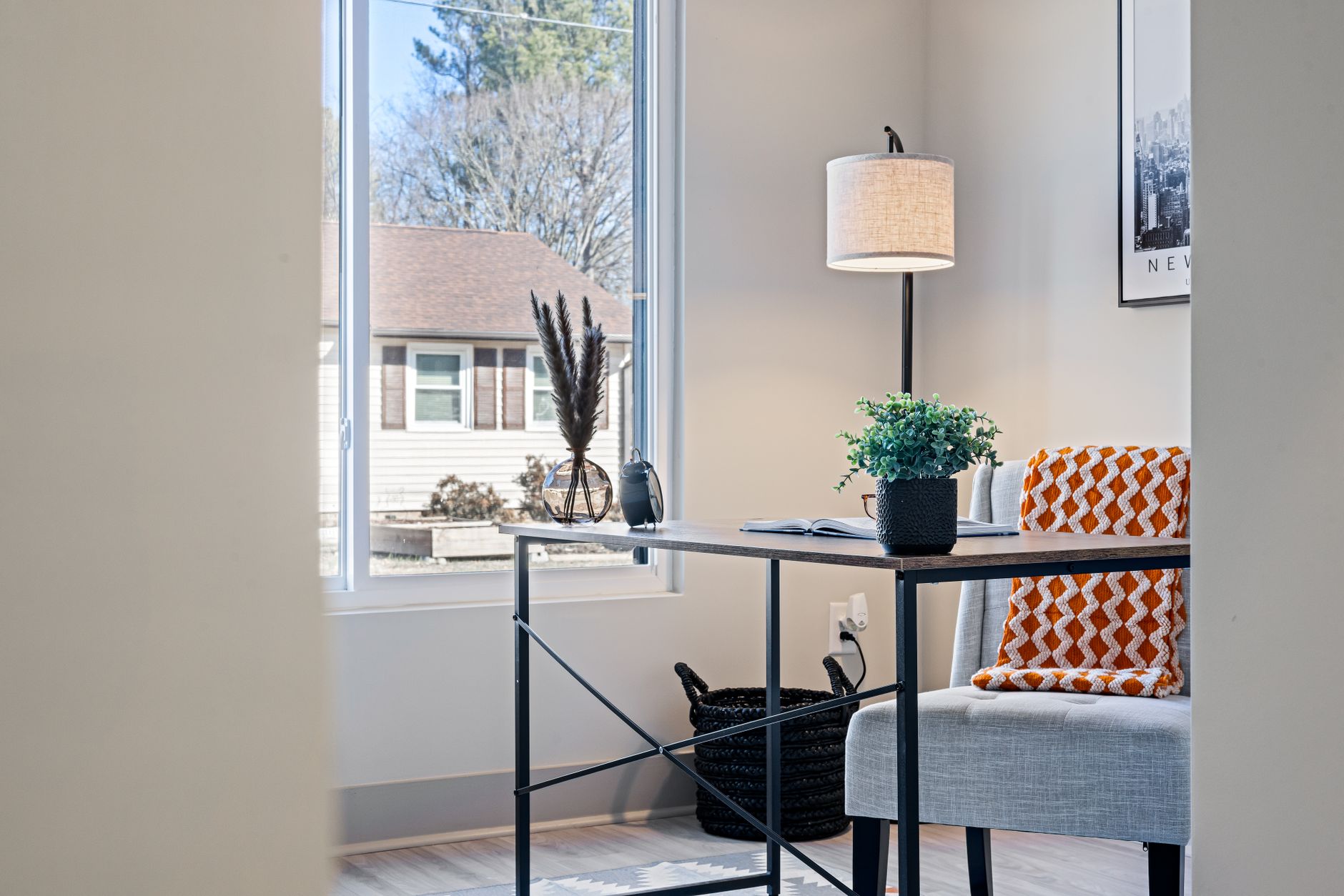
Form School guidance generally prefers a solid wall behind the chair over a window. The stated reasoning is that a window at the back offers no physical backing and, in daylight, can put the seated person’s screen or face in silhouette against outside light — a practical issue for anyone on video calls as much as a traditional one.
Facing directly into a wall at close range is treated differently: without a door in view, the arrangement removes the sightline the commanding position is meant to provide, and can also mean staring at a blank surface a few inches from the eyes for long working hours, which has no feng shui content at all — it is simply a matter of comfortable sightlines and eye strain over a working day.
Does it matter if the “home office” is really a corner of the bedroom?
A desk sharing a room with a bed raises a separate set of questions this site treats elsewhere, because bedroom guidance and desk guidance do not always point the same way. A bed and a desk both want a sightline to the door under Form School logic, but they cannot always both occupy the single best-angled spot in a small room, and a choice has to be made.
Where the desk sits within view of the bed, some practitioners suggest screening it off or closing a laptop at night, on the reasoning that a visible workspace keeps the mind on work in a room meant for rest — a claim about association and habit, not measurable outcome. For the bed’s own placement rules, see where the bed should go in a bedroom and what feng shui says about bedroom door alignment.
Is any of this backed by evidence?
No controlled study has tested desk orientation against measurable work outcomes, and none of the schools above claims one has. The sightline-to-door reasoning under Form School overlaps with ordinary environmental psychology — people are generally more at ease when they can see who is entering a room — but that is a separate claim from feng shui’s own framework of chi (qi) flow, and the two should not be conflated as if one proves the other.
A broader look at what can and cannot be verified about the tradition is in is there evidence for feng shui, and what kind exists, and a plain statement of what the practice does and does not claim is set out in what feng shui actually claims, and what it does not.
Practical takeaways for arranging a home office desk
- Where the room allows it, place the desk so the door is visible from the chair without sitting directly in line with it.
- Favour a solid wall behind the chair over an open doorway or a window at the back.
- If a compass-based direction is wanted, that requires an actual reading and, under classical Compass School, a personal kua number — not a guess at the room’s orientation.
- Under BTB, direction is less relevant than which bagua zone of the room the desk occupies, mapped from the entrance.
- Where a desk and a bed share a room, treat them as two separate placement problems, since the ideal spot for one is not always available to both.
This article is a description of feng shui traditions, not career, workplace ergonomics, or financial advice. For questions about desk height, screen distance, or workstation safety, a qualified ergonomics resource or occupational health professional is the appropriate source, not a feng shui guide.
For related layout questions across the rest of the home, see the Layout & Furniture archive, the Room by Room archive, and the The Basics archive for how these schools developed and why they disagree.
About this site. Feng Shui Pack explains what the feng shui tradition holds and which school holds it, from published sources. Feng shui is a tradition of placement and orientation, not a science: nothing here will bring you wealth, health, luck or a relationship, and we never claim otherwise. Where a suggestion has an ordinary practical reason — daylight, airflow, sightlines, less clutter — we say so; where it does not, we say that too. This is not medical, financial, legal or tenancy advice. If a decision matters, talk to a professional in that field.