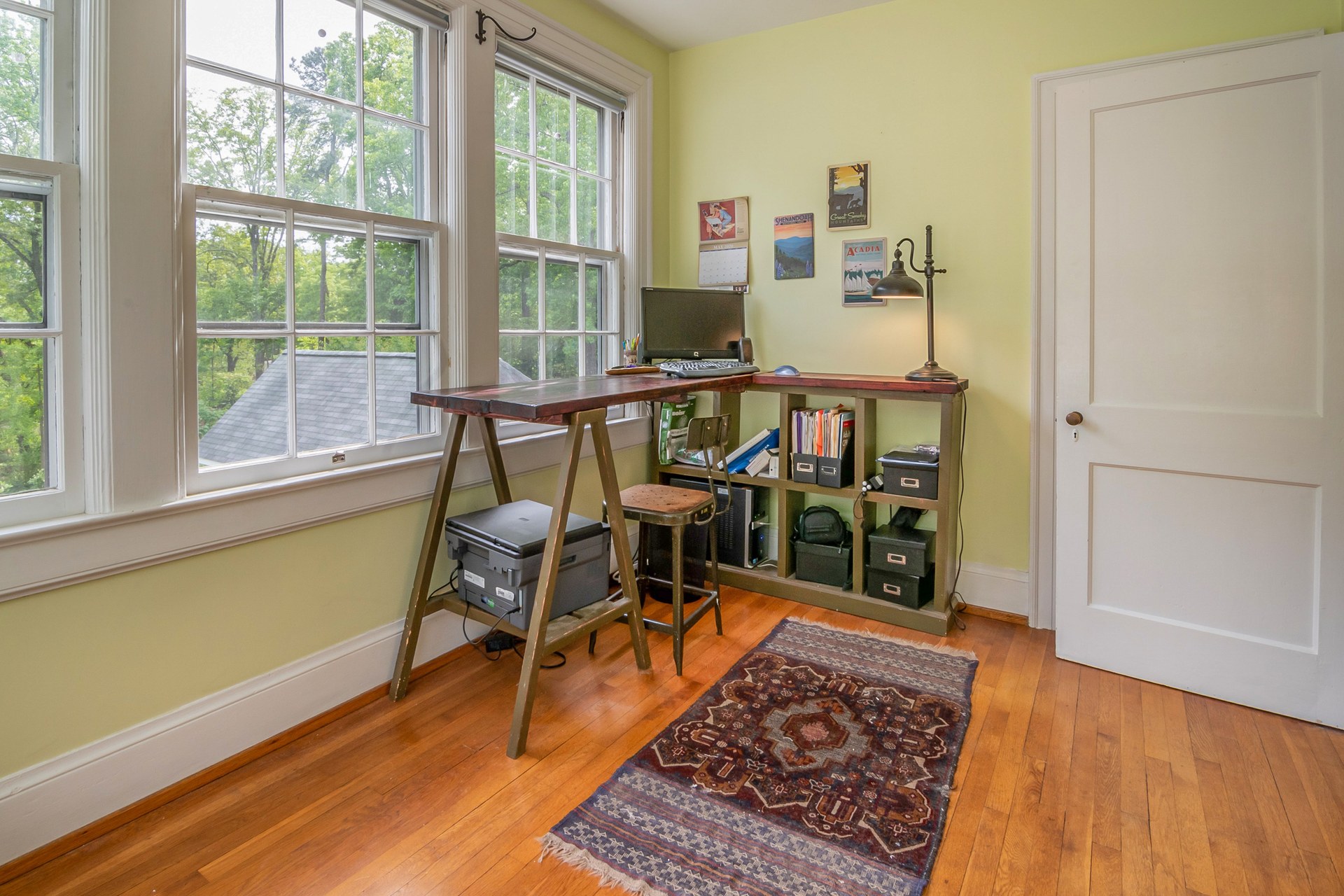
A study or work corner is arranged, in most feng shui traditions, so the desk sits in the commanding position — facing the door but not directly in line with it, with a solid wall behind the chair rather than a window. Beyond that, advice diverges by school, and this article says where.
Where should the desk actually face?
Most English-language guidance says the desk should face the door of the room, positioned diagonally across from it rather than directly opposite. This is the commanding position, a concept that recurs across almost every branch of the tradition and is covered in detail in this explainer on the commanding position.
The practical logic is straightforward: a person seated with a view of the entrance is not startled by someone entering, and can see the room rather than working with their back exposed to it. Sitting with a solid wall behind the chair, rather than a window, is usually explained the same way — it removes the sense of nothing solid at your back. Where a desk cannot avoid facing away from the door, some practitioners suggest a small mirror positioned to reflect the entrance into the worker’s line of sight; the tradition treats this as a workaround rather than a first choice.
Compass School practitioners go further and calculate a personal favourable direction using birth data and the kua number, then orient the desk toward that compass bearing rather than toward the door. This is a genuinely different method from the commanding-position approach, and the two can give conflicting instructions in the same room. For a fuller comparison, see the guide to home office desk direction and Form School vs Compass School.
Does it matter which school of feng shui you follow?
Yes, and this is the point most articles on the subject skip. Form School (Xingshi) reasons from the shape of a room and the placement of solid objects — walls, doors, the direction of view. Compass School (Liqi) reasons from directional calculation tied to a person’s birth data and the compass bearing of the building. The BTB (Black Sect Tantric Buddhist) adaptation, common in North American and much online writing, drops the compass calculation almost entirely and instead maps a bagua grid from the front door of the home or room, assigning life areas — career, knowledge, wealth and so on — to zones of the floor plan.
These are not three versions of the same rule. A desk placement that satisfies BTB’s bagua zoning may say nothing about the compass direction a Compass School practitioner would check, and vice versa. Why feng shui rules contradict each other covers this in more depth, and Black Sect (BTB) feng shui explained traces where the BTB method came from and why it spread so widely in home-office writing specifically.
What role do the five elements play in a work corner?
The five elements — wood, fire, earth, metal and water — are used in the tradition as a way of describing the character of materials, colours and shapes in a space, and how they are thought to reinforce or drain one another. A desk of solid wood, a metal lamp, a small ceramic dish: each is read as belonging to one of the five categories, and practitioners commonly suggest choosing a mix rather than letting one element dominate.
Wood is associated with growth and is often suggested for a work surface itself. Metal objects — a laptop, filing trays, a metal desk lamp — are common in any case in a work corner, and the tradition does not treat this as a problem so much as something to balance with at least one or two elements from elsewhere in the cycle. The reasoning behind which elements reinforce each other is explained at the productive cycle of the five elements, and where one element is thought to weaken another at the destructive cycle. The five categories themselves are introduced at what are the five elements in feng shui.

Does clutter on a desk actually matter?
This is one area where the tradition’s reasoning and ordinary practical sense line up closely. A cluttered desk is harder to work at, obscures the sightline to the door that the commanding position depends on, and — in BTB terms — is described as blocking the flow of chi (qi), the tradition’s term for the flow of energy or influence through a space, explained in general at what is chi, and what does energy flow mean.
Where there is a genuine practical case (visibility of the door, room to work, less visual noise), this article says so plainly. Where a specific rule — a particular object placed in a particular corner, for instance — has no functional explanation beyond the tradition itself, that is stated too: no practical reason is given for many bagua-zone object placements beyond the symbolic logic of the school proposing them.
What if the work corner is inside a bedroom?
A desk sharing a room with a bed is common in small homes, and the tradition generally treats work and rest as different categories of activity that ideally do not overlap in the same functional space. Where they must share a room, practitioners commonly suggest keeping the desk out of direct line of sight from the bed, or screening it, on the reasoning that a visible workspace keeps the mind on tasks rather than rest.
This overlaps with broader bedroom guidance the site covers elsewhere: how a headboard is positioned, what bedroom door alignment is thought to affect, and what a mirror facing the bed is said to do. See how a headboard should be positioned, bedroom door alignment, and mirrors in the bedroom. None of this is sleep or health advice; a reader with ongoing sleep difficulty should consult a physician or a sleep specialist rather than a layout guide.
What should be avoided in a work corner, according to the tradition?
Several recurring cautions appear across schools, though not with identical justification:
- A desk positioned directly in line with the door, so the sharp, direct line of sight is sometimes described as a minor version of a “poison arrow” — a term covered at what is a poison arrow in feng shui.
- A desk backed onto a window rather than a wall, on the reasoning already given above.
- Sitting with an overhead beam directly above the chair, a Form School concern about a visually oppressive ceiling feature rather than the beam itself.
- Facing a blank wall a few inches from the face, which has an ordinary practical explanation — poor sightline, no sense of the room — independent of any school’s rule.
The bagua map itself — the grid some schools use to assign zones of a room or home to categories like career or knowledge — is explained generally at what is the bagua, and how is it used, with the method for placing it over a floor plan at how to orient a bagua map to a home.
Is there evidence any of this changes work outcomes?
No controlled evidence links desk orientation to productivity or career outcomes, and this article does not claim otherwise. What is checkable is the design logic behind specific rules — sightlines, solid backing, reduced clutter — which have ordinary ergonomic explanations independent of feng shui. Readers interested in what evidence exists for feng shui more broadly can see is there evidence for feng shui and what feng shui actually claims, and what it does not.
For layout questions in other rooms, the site’s Layout & Furniture archive and Room by Room archive cover comparable reasoning for kitchens, bedrooms and living rooms. This article is not ergonomic, medical or workplace-safety advice; a reader setting up a long-term workstation should also consult standard ergonomic guidance from an occupational health source.
About this site. Feng Shui Pack explains what the feng shui tradition holds and which school holds it, from published sources. Feng shui is a tradition of placement and orientation, not a science: nothing here will bring you wealth, health, luck or a relationship, and we never claim otherwise. Where a suggestion has an ordinary practical reason — daylight, airflow, sightlines, less clutter — we say so; where it does not, we say that too. This is not medical, financial, legal or tenancy advice. If a decision matters, talk to a professional in that field.