
A headboard should sit against a solid wall, with the bed placed so the sleeper can see the bedroom door without lying directly in line with it. This is the “commanding position,” a Form School principle. Compass School adds directional preferences based on personal or house charts; BTB practice adds its own overlays. The schools agree less than most articles admit.
What does “commanding position” mean for a headboard?
It means the head of the bed is placed so the person lying down can see the door of the room without being directly in its line, and ideally without a wall at their back that is actually a window or a shared wall with a bathroom.
This idea comes from Form School (Xingshi), the older of the two major branches of feng shui, which reasons from the physical shape and layout of a space rather than from compass direction. The logic given is straightforward: a sleeper who cannot see the entrance to the room is said to be in a vulnerable position, historically tied to concerns about who might enter unannounced. Whether or not the underlying claim about vulnerability is accepted, the practical version of this advice — not sleeping with your back to a door, being able to see who comes in — overlaps with ordinary common sense about a restful room. The site has a full explanation of this idea at what the commanding position is and why it recurs.
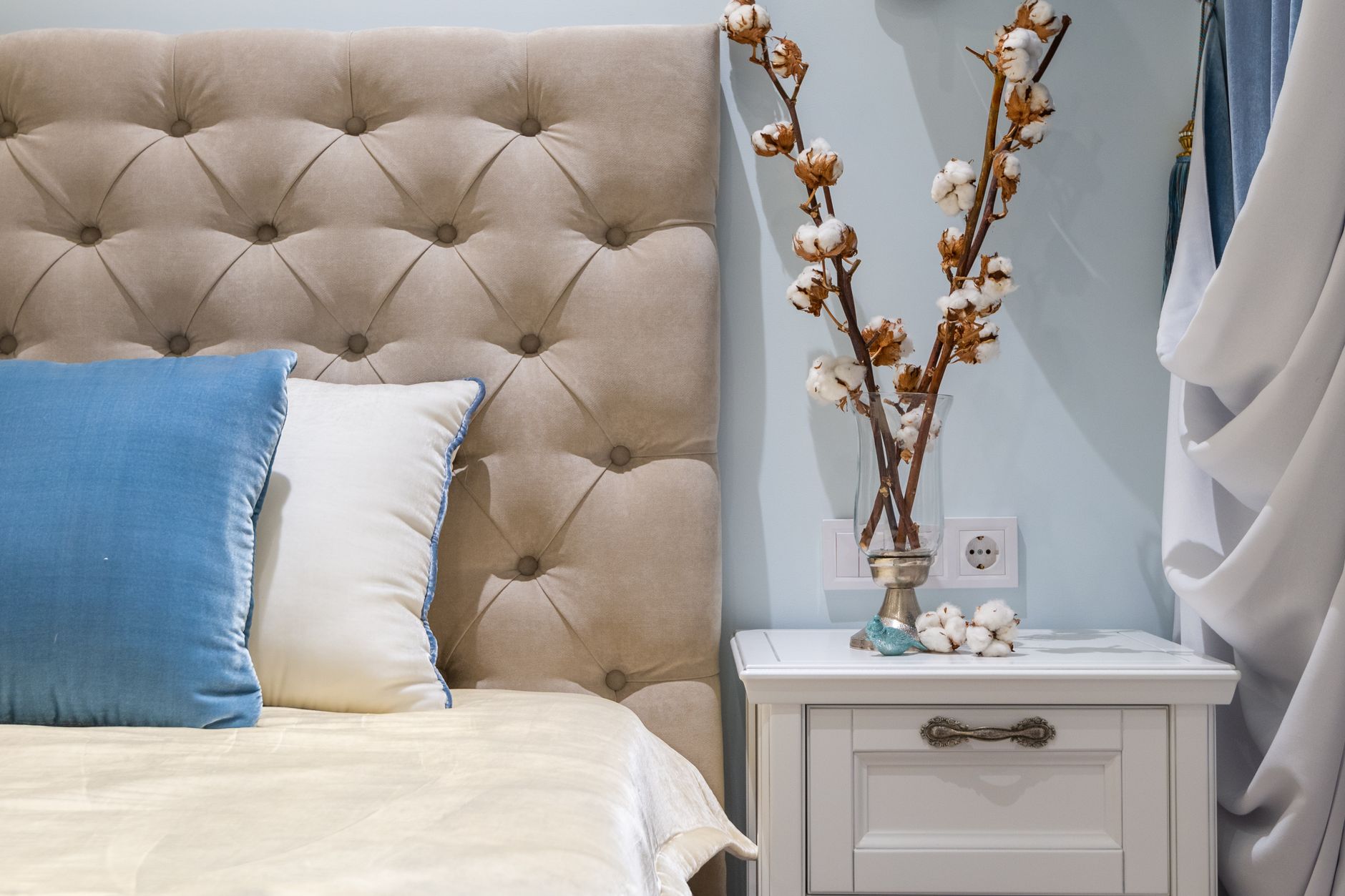
A headboard against a solid wall is the standard way to achieve this. The wall gives the bed a fixed, stable backing; the sleeper is not positioned with open space, a window, or a doorway behind the head.
Why does the wall behind the headboard matter?
A solid wall behind the head of the bed is preferred because it is treated as stable support. A window, an open doorway, or a shared wall with a working toilet or shower in the room behind is generally discouraged.
Form School reasoning frames a solid wall as the equivalent of a hill or mountain at the back — something the older, landform-based version of feng shui treats as protective by analogy to a house sited with high ground behind it and open ground in front. This is a classical metaphor carried into interior placement rather than a claim about the wall material itself.
Where a headboard must go against a window — common in smaller or oddly shaped rooms — several remedies are commonly suggested in the literature: heavier curtains, a solid headboard tall enough to cover most of the glass, or simply accepting the layout and prioritising other factors, since few rooms satisfy every principle at once. No practical structural reason is given for avoiding a window wall beyond the tradition’s own reasoning about support and stability; it is a durable position within the practice, not an engineering claim.
A shared wall with a bathroom is treated differently, and the concern there is more often about plumbing noise and the symbolic association of water and drainage close to where a person’s head rests during sleep — again, an attributed belief rather than a proven mechanism.
Should the bed face the door directly?
No — most schools of feng shui recommend avoiding a direct line between the foot of the bed and the door, sometimes called the “coffin position” in English-language sources, because it echoes how a body was traditionally laid out for viewing.
The preferred placement is diagonal: the headboard against a wall at an angle from the door, so the sleeper has a clear sightline to the entrance without being directly aligned with it. This is consistent across Form School descriptions and is one of the more stable, non-contradictory pieces of advice in the tradition. A related concern is a bed placed in the direct path of a door swing or a hallway pointed straight at it — treated in some texts as a version of a “poison arrow,” a term covered in detail on this site at what a poison arrow is in feng shui.
Where the room genuinely allows no diagonal option, the practical fallback given in most sources is simply distance and a clear sightline — the bed positioned so the door is visible from a reclining position, even if not at an angle.
Does the compass direction of the headboard matter?
In Compass School (Liqi), yes — direction is central. Practitioners use a person’s Kua number, calculated from birth year and sex in the classical method, to identify favourable and unfavourable compass directions for the head of the bed. Form School does not use this calculation at all.
This is one of the clearest points of genuine disagreement inside feng shui, and it is worth naming plainly rather than blending the two into one set of rules, which is how most English-language articles handle it. Compass School treats the sleeper’s personal directions — derived from the Later Heaven bagua and the eight house directions — as the primary factor, sometimes overriding what Form School would recommend based on the room’s shape alone. The difference between the two approaches, including where they conflict outright, is set out in more detail at Form School versus Compass School.
A reader who wants to apply Compass School directions accurately needs an actual compass reading of the room, not a guess from a floor plan; the site’s explainer on what a feng shui compass is and whether one is needed covers how that reading is taken and what a luopan does differently from a phone compass app.
What does BTB feng shui say about headboard placement?
The Black Sect (BTB) adaptation, developed in the United States from the 1980s, generally keeps the commanding-position principle but drops the birth-based compass calculations of classical Compass School, replacing them with a bagua map oriented from the entrance of the room or home.
Because BTB is the version most repeated in Western interior-design content, it is often presented as “feng shui” without the label, which flattens real disagreement between schools into one voice. This site treats that flattening as worth flagging every time it comes up; the background on how BTB developed and why it spread so widely in English-language design media is at Black Sect (BTB) feng shui: what it is, and why it spread. A reader trying to reconcile conflicting headboard advice from different websites is very often reading BTB and classical Compass School sources that were never meant to agree, a pattern discussed generally at why feng shui rules contradict each other.
What is actually under or near the headboard?
Feng shui guidance extends past the wall behind the bed to what sits directly under it and around it — storage, mirrors, and electronics are the three most commonly addressed.
Clutter or storage boxes directly beneath the bed are discouraged in most sources on the reasoning that they block free movement of chi (qi) — the term for the flow or circulation of energy central to feng shui’s vocabulary, explained fully at what chi is and what energy flow means. What specifically should or shouldn’t go under a bed, including which storage types are treated as acceptable, is addressed directly at what should be under the bed in feng shui, and what shouldn’t.
Mirrors facing the bed are one of the most frequently repeated cautions in the tradition, generally on the reasoning that a mirror is thought to double or disturb energy during sleep, sometimes tied to older beliefs about a sleeping body’s vulnerability. The full argument, and where it comes from, is set out at what feng shui says about mirrors in a bedroom.
None of this is medical or sleep-hygiene advice. A reader with a genuine sleep problem, or concerns about a room’s ventilation, damp, or safety, should consult a qualified professional or their own doctor rather than treat feng shui placement as a substitute.
How does headboard placement fit into the room as a whole?
A headboard is one part of a larger bed-placement question that also covers distance from the door, what’s visible from the bed, and how the room’s bagua is read — the placement of the headboard rarely stands alone in the tradition’s own logic.
For the fuller picture of where a bed should go within a bedroom of any shape or size, including corner placements and shared walls, see where the bed should go in a bedroom. For readers wanting to understand the bagua map itself — the grid of life areas some schools overlay onto a floor plan — the background is at what the bagua is and how it’s actually used, with the practical question of orientation covered at how to orient a bagua map to a home.
Broader questions about layout and furniture placement generally, across rooms beyond the bedroom, are gathered at the Layout & Furniture archive, and the underlying framework — the five elements, yin and yang, and the difference between the schools — is covered in the Basics archive.
Is there evidence any of this affects sleep?
Not in the sense of controlled studies tied specifically to feng shui headboard placement. What exists is overlap between some feng shui recommendations — a clear sightline to the door, a stable wall, reduced clutter — and general principles of restful room design that have separate, non-feng-shui rationales.
A broader look at what kind of evidence exists for feng shui claims generally, and what kind does not, is at is there evidence for feng shui. This article does not make a health claim about sleep quality, and readers with ongoing sleep difficulties should treat that as a matter for a medical professional, not a placement adjustment.
About this site. Feng Shui Pack explains what the feng shui tradition holds and which school holds it, from published sources. Feng shui is a tradition of placement and orientation, not a science: nothing here will bring you wealth, health, luck or a relationship, and we never claim otherwise. Where a suggestion has an ordinary practical reason — daylight, airflow, sightlines, less clutter — we say so; where it does not, we say that too. This is not medical, financial, legal or tenancy advice. If a decision matters, talk to a professional in that field.