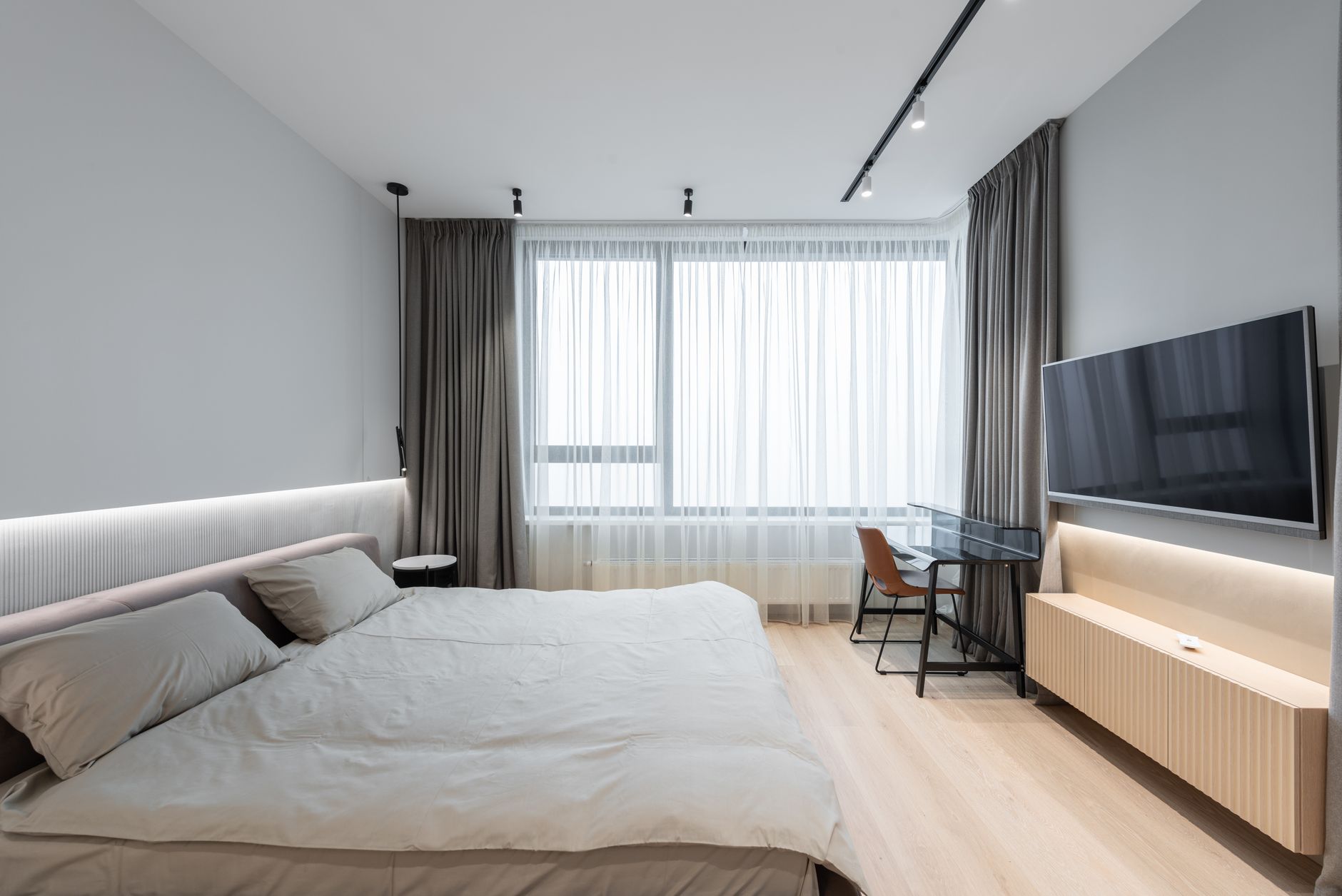
A sloped ceiling is handled by moving the bed to where the ceiling is highest, keeping the head and body clear of the lowest, most acute angle, and treating the slope as a compression of space to be offset rather than a flaw to be hidden. No school of feng shui holds that a sloped ceiling makes a room unusable.
Why does feng shui treat a sloped ceiling as a problem at all?
The concern is about a low mass pressing down over the body, not about the slope as a shape. In Form School reasoning, anything overhead and close to a sleeper — a beam, a shelf, a sharply pitched ceiling — is read as pressure on the person beneath it. The lower the angle comes down toward the head or chest, the more weight is assigned to the problem.
This has an ordinary physical counterpart worth stating plainly: a very low ceiling directly above a bed reduces headroom, can make a room feel confined, and in real attic conversions is often close to a window, a hatch, or reduced ventilation. None of that is feng shui; it is just what a converted loft or an eaves room tends to involve, and it is worth keeping in mind when placing furniture regardless of any tradition.
Where should the bed go under a sloped ceiling?
The bed goes under the highest part of the ceiling in the room, with the head positioned away from the point where the slope meets the low wall. Where the room has a flat section and a raked section, the flat section is generally treated as the more comfortable place for the bed.
This follows the same logic used everywhere else in the bedroom: the bed should sit in what is often called the commanding position, with a clear view of the door but not directly in line with it, and not jammed against the lowest, most pressing part of the room. A sloped ceiling does not override that placement rule — it adds a second constraint to check alongside it. Where the door and the high point of the ceiling are on opposite sides of the room, the layout has to be worked out as a compromise, and there is no single correct answer given in classical or BTB sources for every configuration.
If the room’s only viable bed position is under the slope itself, Form School guidance generally recommends aligning the bed so the lowest point of the ceiling is over the foot of the bed rather than the head.
Does the direction of the slope matter?
Compass School (Liqi) practice works from the eight compass directions and the trigrams assigned to them, and in principle a sloped ceiling could be read in relation to which direction it faces from the room’s center. In practice, published Compass School material is far more focused on door and building orientation than on ceiling geometry, and there is no widely cited compass rule specifically for slope direction. Where a compass reading is wanted for the room as a whole, that is a separate exercise from handling the slope, and it requires a fixed reference point — see what a feng shui compass is and whether one is needed before assuming a reading is required here.
The BTB (Black Sect) adaptation, which maps the bagua from the entrance of the room rather than from compass direction, treats the sloped ceiling mainly as a matter of where it falls relative to the door and the bed, not which cardinal direction it faces. Readers should know which system a piece of advice is drawing on, since the two do not use the same reference point — this is explained further in the article on what BTB feng shui is and why it spread.
What about a beam or ridge line running across the slope?
A structural beam running across a sloped ceiling, especially one that crosses directly over where the head of the bed would sit, is treated in Form School as a stronger version of the same pressure concern as the slope itself. The traditional response is to move the bed so the beam runs along the length of the body rather than across it, or to move the bed out from under the beam entirely.
The concept behind this and other sharp overhead or edge-on features is covered in more depth in the article on what a “poison arrow” is in feng shui. No practical structural reason is typically offered for why a beam along the body is preferable to one across it — the reasoning given is traditional, not architectural, and it should be read that way.
Should a headboard be used against a sloped wall?
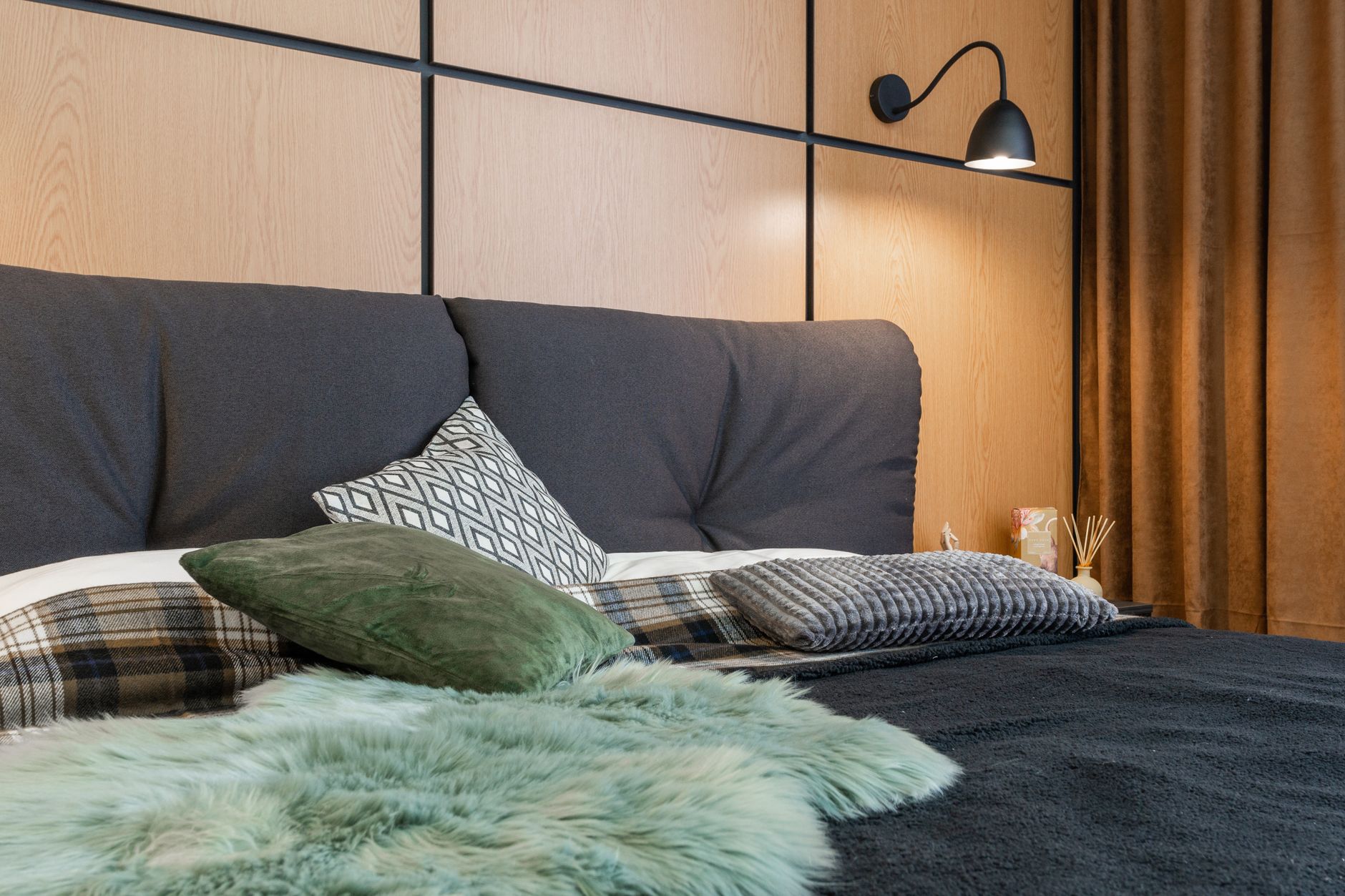
A solid headboard is commonly recommended in Form School guidance wherever the wall behind the bed is unusual — sloped, uneven, or set with a window — because it gives the sleeper a firm, defined edge behind the head rather than open or irregular wall. This is one of the more practically grounded pieces of headboard advice: a solid surface at the head end also has the ordinary benefit of blocking drafts, which a sloped-ceiling room with a dormer window may have more of than a standard rectangular bedroom.
Fuller guidance on headboard shape, material and placement is set out in the article on how a headboard should be positioned, which applies without change to a room with a sloped ceiling — the slope affects where the bed can go, not what the headboard itself should be.
How should storage and furniture be arranged in the low parts of the room?
The low, sloped sections of an eaves room are generally treated as storage and circulation space, not sleeping or sitting space. Built-in wardrobes, drawers, or shelving fitted into the low part of the slope are a common practical solution independent of feng shui, and Form School has no objection to storage sitting under a low ceiling — the concern is specifically about a person’s head or body being under sustained pressure while asleep, not about the space itself being used.
What is kept under the bed is a separate question from the ceiling above it, covered in the article on what should and shouldn’t be kept under the bed. Where a mirror is being considered for a sloped-ceiling room — sometimes used to make a low space feel larger — the placement rules relative to the bed are the same as in any bedroom, and are addressed in the guide to mirrors in the bedroom.
Does it matter if the room was originally an attic or loft conversion?
Feng shui texts, classical or contemporary, do not distinguish a converted attic bedroom from a purpose-built one with a sloped roofline — the tradition addresses the geometry of the ceiling above the sleeper, not the building history of the room. Structural, insulation, fire-egress and ventilation standards for converted loft spaces are matters of building regulation, not feng shui, and vary by jurisdiction; a reader converting or renovating such a room should confirm requirements with a qualified builder, architect or the relevant local authority rather than relying on this or any feng shui source.
This article is not building, safety or health advice. Where a sloped-ceiling room raises concerns about headroom, ventilation, or safe egress, those questions belong with a licensed professional and local building code, not with feng shui guidance.
How does this fit with placing the bed generally?
The sloped ceiling is one constraint among several that determine where a bed can reasonably go — door alignment, the wall behind the headboard, and the room’s proportions all matter as well. The general framework for finding the best bed position in any room, sloped or not, is laid out in the guide to where the bed should go in a bedroom, and the question of how the door and the bed interact is treated separately in the article on bedroom door alignment.
For the wider set of room-specific questions this site covers — nurseries, guest rooms, children’s bedrooms, home offices — the Room by Room archive gathers them together, and general placement principles that apply across rooms are collected in the Layout & Furniture archive.
Is there evidence that a sloped ceiling affects sleep or wellbeing?
There is no controlled evidence, feng shui or otherwise, showing that ceiling angle above a bed affects sleep quality, health or anything else measurable. What is documented is a design tradition — chiefly Form School — that treats overhead mass close to the body as something to be minimised, alongside genuine architectural considerations like headroom and airflow that apply to any low-ceilinged room regardless of belief. Readers wanting a clearer sense of what feng shui claims and what it does not should see the article on what evidence exists for feng shui and the companion piece on what feng shui actually claims.
About this site. Feng Shui Pack explains what the feng shui tradition holds and which school holds it, from published sources. Feng shui is a tradition of placement and orientation, not a science: nothing here will bring you wealth, health, luck or a relationship, and we never claim otherwise. Where a suggestion has an ordinary practical reason — daylight, airflow, sightlines, less clutter — we say so; where it does not, we say that too. This is not medical, financial, legal or tenancy advice. If a decision matters, talk to a professional in that field.