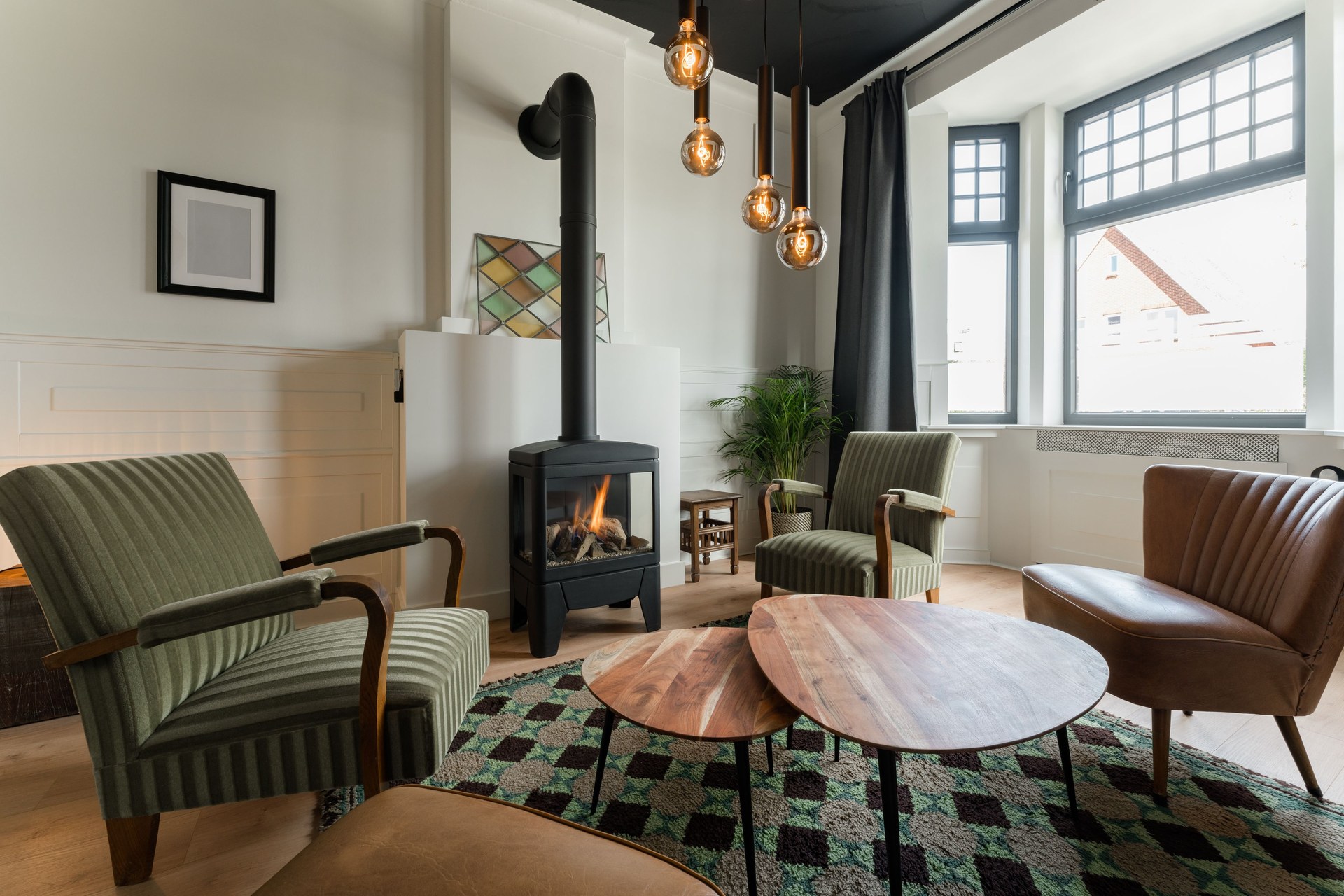
Seating works best arranged in a loose semicircle or square facing the fireplace, with no chair backing directly onto it and at least one seat still able to see the room’s entrance. The fireplace acts as a secondary focal point; the door remains the point the room is organised around first.
This is a case where practical room design and feng shui reasoning mostly agree, which is worth saying plainly before going further. A fireplace is a heat source, a visual anchor and, in older houses, often the only fixed architectural feature on an interior wall. Any sensible layout accounts for it. Feng shui adds a specific vocabulary — the fire element, command position, the idea of a room having more than one draw on attention — but the underlying advice is not exotic.
Does the fireplace or the door take priority?
The door takes priority. In both Form School (Xingshi) and the BTB (Black Sect/Black Hat) adaptation common in Western books, the entrance to a room is the reference point for where the “command position” sits — the seat with a clear view of who is coming in, not backed directly onto the doorway. A fireplace is treated as a strong secondary feature, not a replacement for this.
Where a room has both a door and a fireplace on different walls, the practical solution is usually the same one a furniture layout arrives at without any feng shui language at all: the main seat or sofa is placed so it can see both, angled rather than pointed squarely at either. The concept of command position is covered in more detail on this site’s guide to a room’s command view.
Why does feng shui treat fire as a specific element?
In the five-element framework used across Chinese philosophy and folk practice, fire (huo) is one of five phases alongside wood, earth, metal and water, each said to generate and restrain the others in a fixed sequence. A fireplace is read as a literal expression of the fire element in a room — a source of heat, light and movement, sitting in contrast to more static, solid furniture.
The practical implication drawn from this is that a fireplace, real or not currently in use, tends to pull the eye and the seating layout toward it whether or not anyone intends this. Chairs angled away from a fireplace often look and feel wrong in a way most people notice before they can explain why. The five-element system is explained on its own terms in this site’s overview of the five elements; readers wanting the mechanics of how one element is said to feed or check another can see the productive cycle and destructive cycle pages.
Should a sofa face the fireplace directly?
A sofa placed square-on to the fireplace, with its back to the door, is generally discouraged in both Form School and BTB reasoning — not because of the fireplace itself, but because it puts the main seat in a position where the room’s entrance is out of view. The fix is usually an angle rather than a wholesale rearrangement: the sofa turned slightly so it faces the fireplace at maybe ten or fifteen degrees off-centre, keeping the door within peripheral sight.
This is the same command-position logic applied to a living room generally. The site’s guide to sofa placement in a living room covers the reasoning in more depth, and the guide to arranging a living room for conversation deals with the layout question — semicircle, square, or facing pairs — that a fireplace usually decides.
What about chairs with their backs to the fireplace?
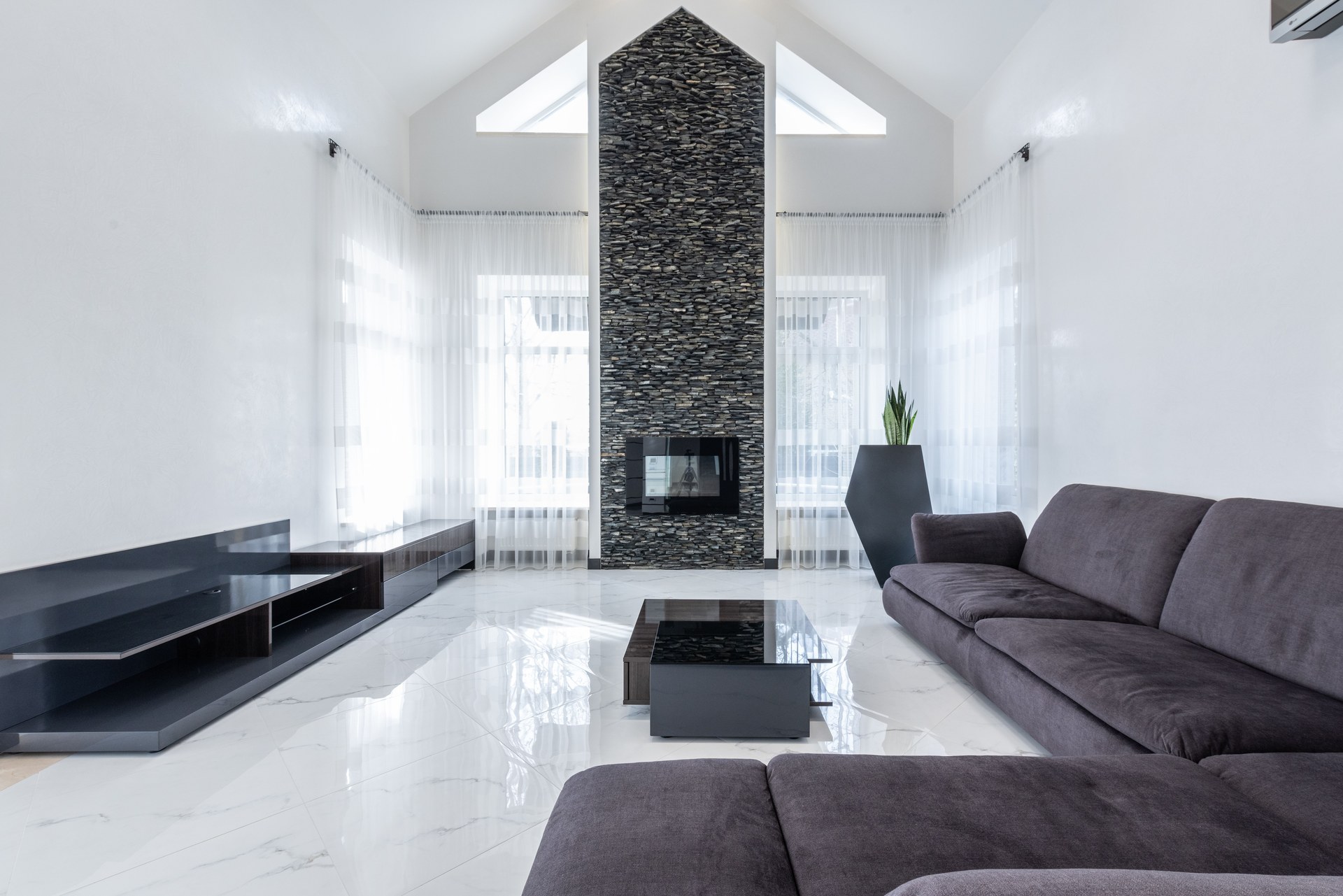
A single chair backed onto a fireplace is treated differently from a chair backed onto a door or a window. Classical Form School reasoning is concerned mainly with a seat’s back having solid support — a wall, in effect — rather than an opening a person or a draught could come through unseen. A fireplace wall, being solid masonry in most houses, satisfies that condition in the same way any other interior wall would.
Where the objection does appear in some BTB-influenced writing is about the fire element directly at a person’s back — the reasoning given is that an active or symbolic fire source behind someone is thought to unsettle rather than support. No practical fire-safety objection is being made here; a working fireplace obviously needs its own hearth clearance for heat and sparks, which is a matter for a fireplace installer or building regulations, not for feng shui. Where the fire element concern is raised, it is a symbolic one and is presented that way, not as a safety rule.
How many seats should face the fireplace directly?
There is no fixed number given in classical texts, and claims of a specific “correct” seat count around a fireplace are not something checkable sources support. What does recur across Form School layout advice is a preference for an even, balanced arrangement — pairs of chairs, or a sofa flanked symmetrically — over one chair set noticeably apart from the rest.
This is closer to a design observation than a metaphysical rule: an odd chair pulled out of a symmetrical grouping tends to read as an afterthought, and a fireplace, being itself a symmetrical architectural feature (mantel, surround, hearth), tends to expose asymmetric seating more than a plain wall would. Readers interested in how feng shui treats balance and mirrored arrangement elsewhere in a room can see the site’s piece on symmetry, written for a bedroom but built on the same reasoning.
Should the television go near the fireplace?
This is one of the more common practical conflicts in a real living room, and feng shui writing on it varies by school and by author rather than converging on one answer. A television is sometimes described in BTB-derived sources as an active, “yang” object that competes with the fireplace for attention, and placing both on the same wall is said by some writers to divide a room’s focus rather than settle it.
Others make no such distinction and simply note that a fireplace above which a television is mounted forces seating to face one thing while the other becomes a strain on the neck — an ordinary ergonomic problem, not a feng shui one. The site’s dedicated page on a television in the living room sets out where the schools agree and where the advice is really just interior-design common sense repackaged.
What if the fireplace is not centred on the wall?
An off-centre fireplace does not need to be treated as a flaw to correct. Both practical layout advice and feng shui reasoning generally suggest working with the room’s actual proportions rather than forcing symmetry the architecture does not have — an asymmetric grouping of seating, with a larger piece balancing the visual weight of the fireplace from the opposite side of the room, is a standard solution outside feng shui writing as well.
Where a fireplace sits on a long wall in a long, narrow room, the seating problem is really a shape problem first. The site’s guide to arranging a long narrow room and its guide to how much floor should stay empty both address the geometry that a fireplace-led room often runs into — too much furniture pushed to one end, or a walking path that cuts straight across the seating group.
Does a non-working or decorative fireplace count?
Feng shui writing does not generally distinguish between a working fireplace and a decorative or blocked one when it comes to seating arrangement — the element is read as symbolic, tied to the form and presence of the fireplace rather than to whether it is lit. A converted or purely ornamental fireplace is treated the same way in the layout advice above.
Where a fireplace has been blocked and a vent or flue remains, or where an electric insert has been fitted, any question about safe clearances, ventilation or building regulations is a matter for a qualified fireplace installer or the relevant building authority — this article does not cover that ground and should not be read as safety advice.
Where does this fit into a wider room plan?
A fireplace is one of several fixed points a living room has to be planned around — a door, a window, a radiator, a chimney breast. Feng shui’s contribution is less a set of new rules than a consistent way of prioritising those points: entrance first, then the room’s strongest secondary feature, then balance between what is seen and what is left empty.
Readers building a full layout rather than solving the fireplace question alone may find the site’s broader Layout & Furniture section useful, along with the guide to arranging furniture so a room feels calm, which covers the same command-position and balance logic applied across a whole floor plan rather than one wall.
None of this is medical, structural or safety guidance. Questions about a fireplace’s condition, ventilation, or fire safety belong with a qualified installer, chimney sweep or the relevant building authority, not with feng shui advice of any school.
About this site. Feng Shui Pack explains what the feng shui tradition holds and which school holds it, from published sources. Feng shui is a tradition of placement and orientation, not a science: nothing here will bring you wealth, health, luck or a relationship, and we never claim otherwise. Where a suggestion has an ordinary practical reason — daylight, airflow, sightlines, less clutter — we say so; where it does not, we say that too. This is not medical, financial, legal or tenancy advice. If a decision matters, talk to a professional in that field.