
Feng shui treats furniture height mainly as a question of sightlines and proportion: pieces that let a seated or lying person see the door and the room are favoured over pieces that block the view or tower over the body. The reasoning is about visibility and a sense of scale, not about a fixed number of inches.
This shows up differently depending on which tradition is being consulted. Form School (Xingshi), the older body of practice concerned with landscape, shape and sightline, explains furniture height mostly through the commanding position — the idea that a bed, desk or main chair should let the occupant see the entrance without being directly in line with it. The Western Black Sect (BTB) adaptation, which is where most English-language “feng shui rules” for furniture actually come from, adds symbolic readings — that a headboard “should” reach a certain height for support, for example — that classical Chinese texts do not spell out in the same terms. Classical Compass School (Liqi) material, which is built around directional calculation, says almost nothing specific about furniture height at all; it is concerned with orientation, not the dimensions of objects in a room.
Why does feng shui care about furniture height at all?
The core concern is whether a piece of furniture helps or hinders a clear line of sight and an unobstructed path through a room. Furniture that is too tall relative to the person using it — or to the room itself — is described in Form School terms as overpowering; furniture that is too low is described as offering no sense of enclosure or support.
This is one of the few areas of feng shui where the underlying design logic is genuinely practical. A chair or bed positioned so the occupant can see who enters a room is easier to relax in, in ordinary human terms, regardless of any school of thought. Feng shui’s contribution is to name that instinct and formalise it as the commanding position, a concept discussed at greater length elsewhere on this site.
Does a bed or headboard need to be a specific height?
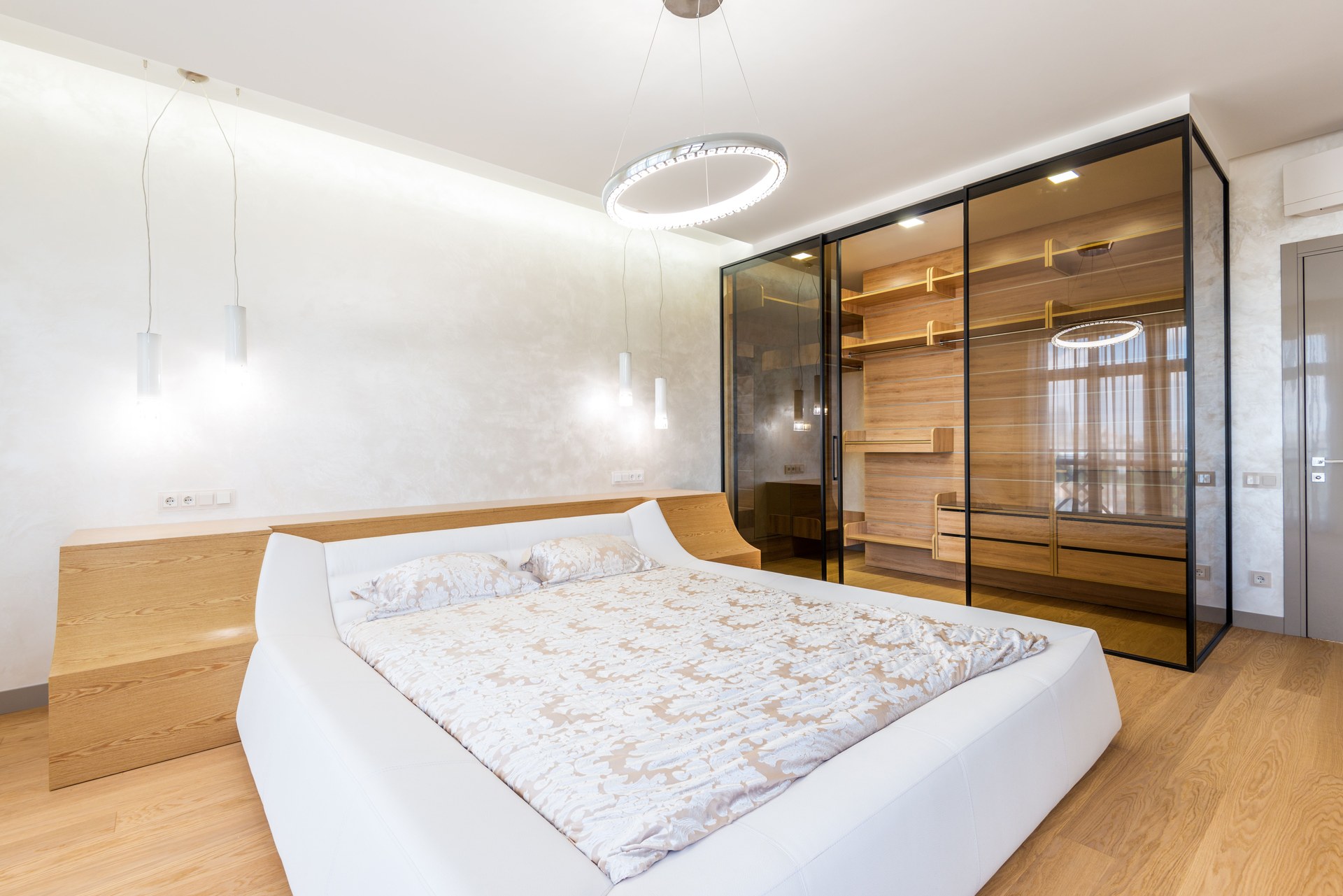
No fixed measurement is given in classical texts. What is consistently described — mostly in BTB-influenced advice — is a preference for a headboard that is solid, attached firmly to the frame, and tall enough to sit above the sleeper’s head when they are lying down, on the reasoning that it provides a stable backdrop rather than open space behind the body.
Beyond that reasoning, no practical rationale is given for exact headboard heights beyond the tradition itself. The more consistently repeated point, across schools, is about placement rather than dimension: the bed should not sit directly in the path of the door, and it should allow a clear view of the room’s entrance. How a headboard should be positioned covers this in more detail, including why a headboard against an exterior wall or window is treated differently from one against a solid interior wall — a question also addressed in the discussion of a bed placed under a window.
What about tall wardrobes, bookshelves and storage units?
Tall storage is treated cautiously mainly where it sits close to where someone sleeps or sits for long periods, on the reasoning that a large mass of furniture directly overhead or beside the body reads as pressing down on it. This is the same logic used for structural beams.
The parallel with architecture is explicit in the literature: a wardrobe or bookshelf positioned directly above a bed’s headboard, or close beside a desk chair, is discussed in similar terms to a low ceiling beam crossing the same spot — a mass overhead that the occupant cannot avoid seeing. The reasoning given in both cases is about the discomfort of an overhanging object rather than any energetic mechanism that can be tested. The comparison is worked through fully in the piece on beams and low ceilings in feng shui.
Where tall storage genuinely can’t be moved, the more commonly repeated suggestion — again from BTB sources rather than classical texts — is to keep the top of the unit clear and closed, on the reasoning that an open, cluttered top increases the visual sense of a mass looming over the room. This is closely related to the general question of how much empty floor a room needs, since both concern how much visual weight a room can carry before it reads as crowded.
Does a desk or chair need a particular height relative to other furniture?
Feng shui guidance on desks focuses on the chair’s position and the sightline to the door, not on desk or chair height as such. A desk chair with a solid, higher back is sometimes preferred over a low stool, on the same “support behind the body” reasoning applied to headboards.
Ergonomic desk and chair height — the kind that affects posture and long-term comfort — is a matter for furniture design and, where discomfort or pain is involved, a healthcare professional, not for feng shui. This article does not offer medical advice, and any concern about posture, repetitive strain or chronic pain should go to a qualified professional rather than to a design tradition. The placement question that feng shui does address — where the desk sits and which way it faces — is covered in where a home office desk should face and in the broader guide to arranging a study or work corner.
Is there a “correct” height for a sofa or coffee table?
No specific height is prescribed. The recurring theme in living-room advice is proportion between pieces — a coffee table that sits noticeably higher than the sofa seat is described as awkward to use and visually top-heavy, while a table set at or slightly below knee height when seated is treated as more comfortable and better balanced in the room.
This is really a restatement of ordinary furnishing sense rather than a distinct feng shui rule, and it overlaps with wider guidance on arranging a living room for conversation, where sightlines between seats matter more than any single piece’s dimensions. Furniture placed hard against a wall versus floating in the room is a related and more consequential decision, discussed in furniture against walls.
What does yin-yang theory say about tall versus low furniture?
Where furniture height is discussed through yin-yang theory, taller, more solid pieces are associated with yang qualities — active, upright, assertive — and lower, softer pieces with yin — passive, restful, receptive. A room composed entirely of one or the other is described as unbalanced: all tall, hard-edged furniture reads as overly yang and restless; an entirely low, soft room reads as overly yin and lethargic.
This is a symbolic classification rather than a measurable claim, and it is worth naming as such. It is explained more fully in the general discussion of what yin and yang mean in a room. The practical version of the same idea — mixing seat heights, textures and material weights rather than furnishing a room with pieces of a single scale — is common interior design advice independent of feng shui, and readers do not need to adopt the symbolic framing to find the mixed-height approach useful.
Does classical Compass School say anything about furniture height?
Very little. Compass School (Liqi) calculation is concerned with orientation — the compass directions associated with a building, a room or a sitting position — not with the dimensions of the furniture placed within it. Height-based advice in circulation almost always traces back to Form School’s sightline reasoning or to the BTB adaptation’s symbolic additions.
The distinction matters because so much English-language material presents furniture-height rules as if they were universal and ancient, when in practice they are usually one specific school’s contribution layered onto general design common sense. The difference between the two schools of thought, and why they sometimes give contradictory advice on the same object, is set out in Form School versus Compass School.
What is the practical takeaway for furnishing a real room?
Across the schools, the consistent, checkable point is about sightlines rather than measurements: furniture that lets a seated or lying occupant see the door, that doesn’t crowd a body with an overhanging mass, and that keeps a room’s scale roughly consistent piece to piece. Beyond that, most specific height figures in circulation are one school’s addition rather than settled tradition.
None of this is a substitute for how a room is actually used day to day — circulation space, storage needs, and how furniture interacts with doors and windows tend to matter more in practice. Those mechanics are covered in how furniture placement affects circulation and in the broader Layout & Furniture archive, alongside room-specific guides in Room by Room.
About this site. Feng Shui Pack explains what the feng shui tradition holds and which school holds it, from published sources. Feng shui is a tradition of placement and orientation, not a science: nothing here will bring you wealth, health, luck or a relationship, and we never claim otherwise. Where a suggestion has an ordinary practical reason — daylight, airflow, sightlines, less clutter — we say so; where it does not, we say that too. This is not medical, financial, legal or tenancy advice. If a decision matters, talk to a professional in that field.