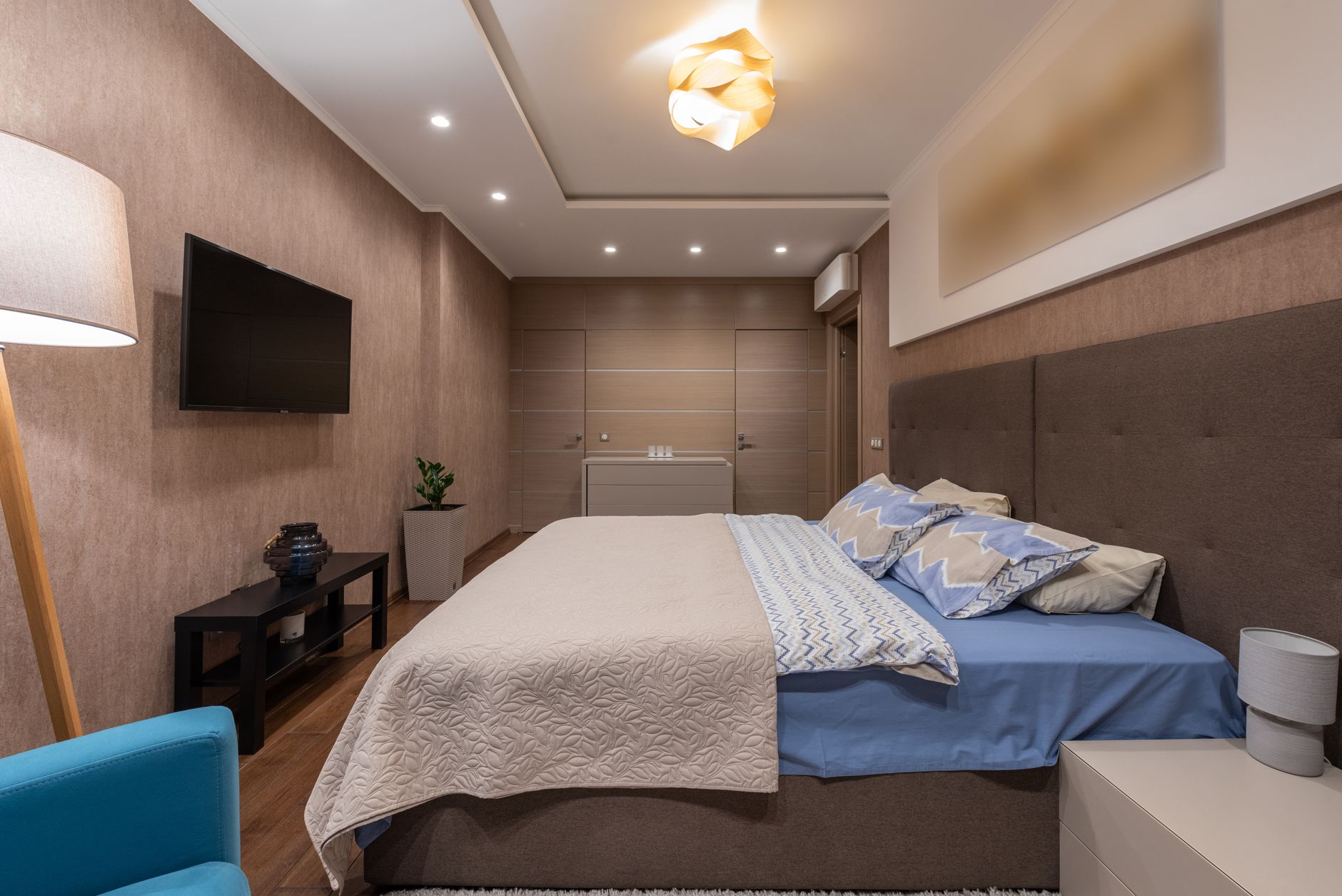
Feng shui treats a guest bedroom the same way it treats any bedroom used for sleep: the bed goes in a position where the sleeper can see the door without lying in line with it, the room stays uncluttered, and anything stored under the bed or hung near it is chosen deliberately. Most guest-room-specific advice comes from the BTB (Black Sect) adaptation, which is explicit about this room being a lower priority than the rooms the household uses daily.
Does feng shui treat a guest bedroom differently from a main bedroom?
Yes, in degree rather than kind. The underlying reasoning — commanding position, minimal clutter, a bed that isn’t jammed against a wall shared with plumbing — applies to any bed. But classical Form School texts, which developed around the layout of a working household, generally give more weight to the rooms occupied by the head of the household than to a room used occasionally by visitors. The BTB adaptation, which is the source of most contemporary Western feng shui advice on guest rooms specifically, makes this explicit: a guest bedroom is worth arranging properly, but it is not treated as carrying the same weight as the main bedroom or the front entrance in shaping the household’s overall chi (qi), the flow of energy the tradition centers on.
Where should the guest bed go in the room?
The same principle used for any bed: positioned so the person lying in it can see the door from the bed, without the foot of the bed lining up directly with the doorway. This is usually called the commanding position.
The practical logic is straightforward and doesn’t require any belief in chi to make sense: a bed facing away from the door means a sleeper is startled by anyone entering, and a bed directly in line with the door puts the sleeper’s feet toward a common walking path, which in Chinese funerary custom is associated with how a body is carried out of a room — which is part of why that alignment is avoided regardless of school. The commanding position is covered in more detail on this site, and the same reasoning shapes advice on where a bed should go in any bedroom.
In a small guest room, the commanding position is often the hardest thing to achieve, because there are fewer wall options. Where it genuinely cannot be arranged — a box room with one usable wall, for instance — the tradition doesn’t offer a workaround beyond suggesting a mirror positioned so the door is visible from the bed without the sleeper facing a mirror directly from the bed itself, which raises its own set of rules covered separately.
Does the guest bed need to be visible from the door on entry, too?
Feng shui also considers how a bedroom door aligns with the bed and with other doors in the home. A guest room whose door faces the main bedroom door, or a bathroom door directly, is treated the same as any other case of two doors facing each other — the tradition holds that this creates competing flows of chi between rooms with different functions. No school claims a health risk from this; it is a design preference, not a safety concern, and readers dealing with an actual sleep or health complaint should speak to a doctor rather than reposition furniture.
What about a guest room that doubles as a study or storage room?
This is the most common real-world version of the guest bedroom, and feng shui addresses it directly: a room with two functions is asked to do two jobs, which the tradition treats as a genuine problem, not a superstition to wave away.
The concern, as usually explained, is that a desk facing the door competes with the bed for the room’s one commanding position, and a home office corner crammed with paperwork sits in a room that is otherwise supposed to support rest. Advice on arranging a study or work corner and on which direction a home office desk should face generally treats a desk as needing its own line of sight to the door — which, in a small guest room, is often physically impossible to give both the bed and the desk at once. Where a room must serve both purposes, the practical compromise most often suggested is a daybed or sofa bed that can be dressed down during the day, screening the sleeping function visually with a folding screen or curtain when the desk is in use, and keeping the desk itself out of direct line with the door if the bed cannot be moved.
Does clutter in a guest room matter more than in other rooms?
Feng shui generally treats a cluttered guest room as a more visible problem than clutter elsewhere, mainly because guest rooms are disproportionately likely to become storage by default — the spare bed becomes a surface, the wardrobe becomes overflow. The tradition’s objection is about stagnant chi accumulating where things sit unused; the practical objection is that a guest, unlike a household member, has no ability to negotiate the room’s layout and simply has to live with whatever has been left in it.
What is kept under a bed matters in the same way it does in any bedroom. Suitcases and off-season linens stored flat, in closed containers, are generally treated as acceptable; boxes of unsorted papers or items connected to unresolved projects are the kind of storage feng shui writers most often flag, on the reasoning that a guest sleeping above unfinished business is a poor match for a room meant to offer rest. This is presented as tradition, not evidence-backed claim.
What role do mirrors and headboards play in a guest bedroom?
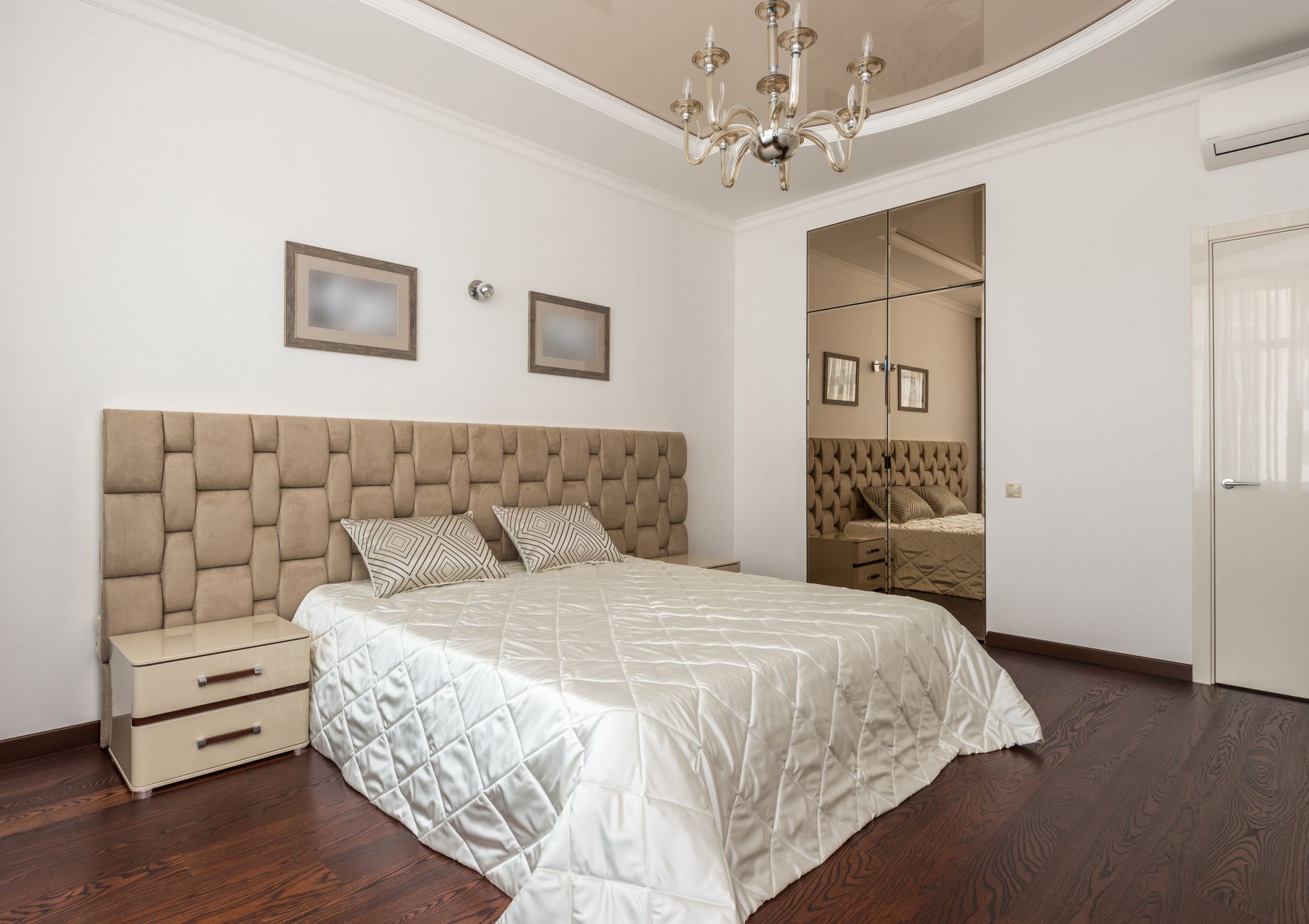
The same rules that apply to mirrors in any bedroom apply here: a mirror facing the bed is the configuration most schools advise against, on the reasoning that it is disruptive to a sleeping body’s chi, though no practical mechanism is given beyond the tradition itself. A mirror on a wardrobe door directly opposite a guest bed is a common accidental version of this in smaller flats, since wardrobes are often the only place to put a mirror in a room with limited wall space.
A guest bed’s headboard is treated the same way as any bed’s: solid, attached to a wall, and not positioned under a window. The reasoning given by most sources on how a headboard should be positioned is about a stable structure behind the sleeper’s head, both as a literal support and, in the tradition’s terms, as a backing that anchors the sleeper’s chi.
Is there a “correct” direction for a guest bedroom?
Classical Compass School (Liqi) feng shui calculates favourable directions from a person’s birth data and the compass orientation of the building, using a system too involved to summarise as a rule of thumb — and Compass School practitioners would say a direction can’t be assigned to a guest bedroom in the abstract at all, because it depends on who occupies it and when. The BTB adaptation instead maps a bagua (pa kua) — a nine-zone grid of life areas — onto the floor plan from the front door, which is a different and incompatible method. This is one of the clearer examples of why feng shui rules contradict each other depending on the school being consulted, and this site’s explainer on Form School versus Compass School covers the split in more depth. Anyone using a compass-based method for a guest room should be clear on what a feng shui compass actually does before applying it.
Does feng shui make any claims about the guest’s sleep or wellbeing?
Some popular sources suggest a poorly arranged guest room affects how well a visitor sleeps or how welcome they feel, framed in terms of chi rather than measurable outcomes. This site does not repeat claims about health, sleep quality or wellbeing as fact — see what evidence exists for feng shui for a plain account of what has and hasn’t been studied. Where a guest’s sleep is genuinely a concern — a medical condition, a mobility issue, an allergy to bedding materials — that is a matter for the people involved and, where relevant, a medical professional, not a layout adjustment.
What is the simplest version of this to actually apply?
Stripped of school-specific detail, the recurring, cross-school points are:
- Put the bed where the door is visible from it, without lining up directly opposite the door.
- Keep a solid headboard against a wall, not under a window.
- Avoid a mirror directly facing the bed.
- Keep under-bed storage closed, tidy, and free of unresolved paperwork or unfinished projects.
- Where the room doubles as a study, screen the two functions from each other rather than letting the desk and the bed compete for the same space.
Anyone furnishing a guest room from first principles rather than retrofitting one may find it useful to start from the general logic covered in the Layout & Furniture section, or to look at how entryways and hallway flow into a guest room are treated in Entrances & Flow, before applying any single school’s specific rule set. The Room by Room archive covers how these same principles are adapted for nurseries, children’s rooms and studies, which share more overlap with a guest bedroom’s dual-purpose problem than a main bedroom does.
About this site. Feng Shui Pack explains what the feng shui tradition holds and which school holds it, from published sources. Feng shui is a tradition of placement and orientation, not a science: nothing here will bring you wealth, health, luck or a relationship, and we never claim otherwise. Where a suggestion has an ordinary practical reason — daylight, airflow, sightlines, less clutter — we say so; where it does not, we say that too. This is not medical, financial, legal or tenancy advice. If a decision matters, talk to a professional in that field.