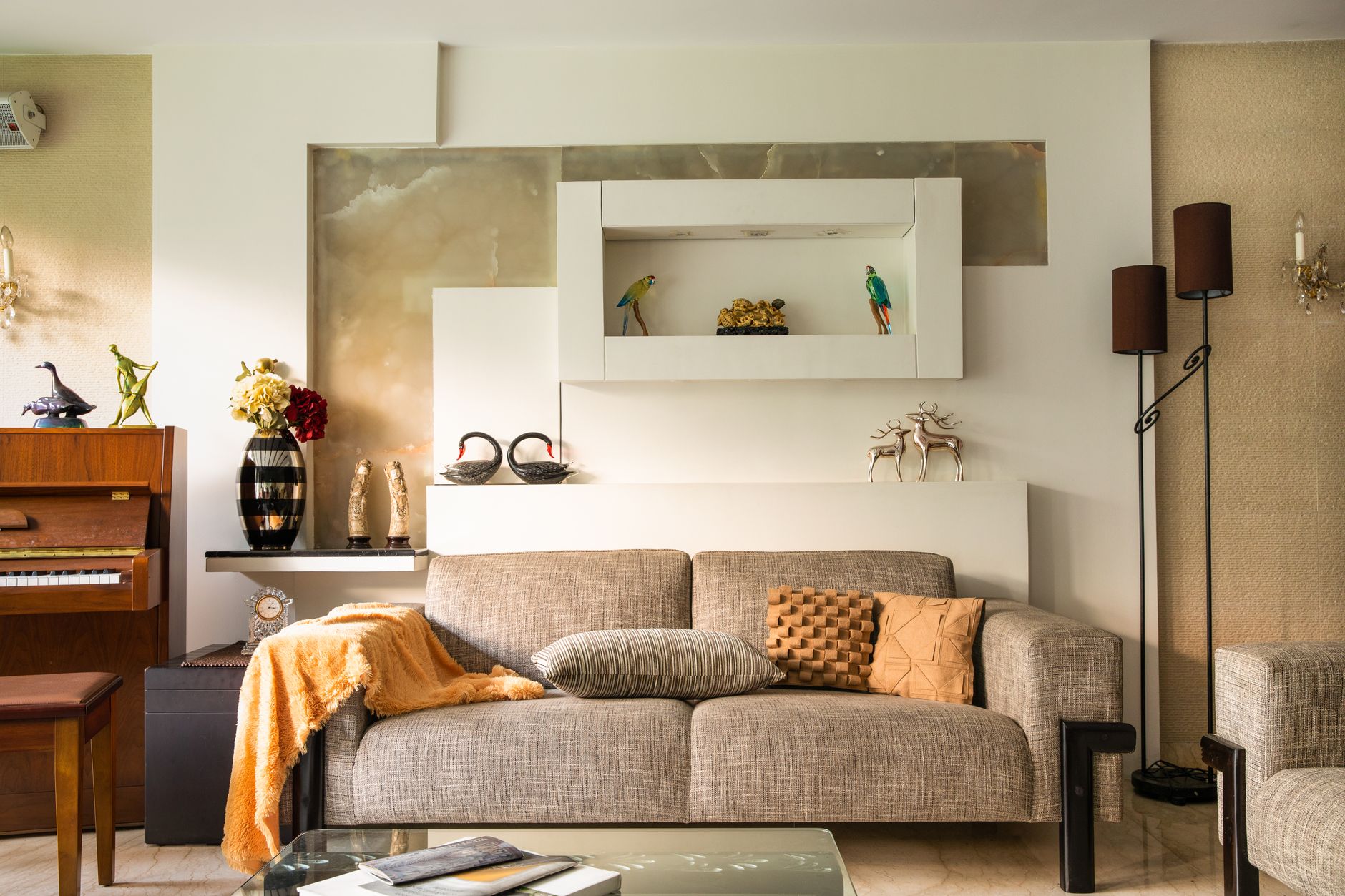
A “command view” describes a seat, desk or bed positioned so the person using it can see the room’s main entrance without being directly in its path. The reasoning given is that a person is more settled when they can see who or what is entering a space, rather than being approached from behind or from the side unseen.
Where does the idea of a command view come from?
The concept comes out of Form School (Xingshi) feng shui, which reasons primarily from landscape and architecture — the shape of hills, the course of water, the layout of a building — rather than from compass directions. Form School’s classical concern is with where a person or a building sits relative to what surrounds it: back to something solid, front open to a view, entrances visible rather than hidden.
Applied indoors, the same logic becomes a rule about furniture. The bed, the desk, the stove, the main seat in a living room — each of these is treated as a place where a person spends sustained time, and Form School holds that such places should not leave a person with their back to the door or blind to it.
How is this different from the “commanding position”?
“Command view” and “commanding position” are largely the same idea described from two angles — one describes what the eye can see, the other describes where the furniture sits in the room. Most English-language sources use them interchangeably, and few name a source for either phrase. A fuller account of the term and its variants is covered in the site’s explainer on what the commanding position is and why it recurs.
The Western Black Sect (BTB) adaptation, developed in the United States from the late 20th century, adopted the same principle and applies it more loosely — treating “command” less as strict Form School geometry and more as a general design instinct: put the important furniture where it has authority over the room. BTB rarely draws the distinction, which is one reason the term gets used inconsistently across the internet.
Which pieces of furniture does the rule apply to?
In practice, the rule is applied to the few pieces of furniture where a person is seated or lying still for an extended period, usually with their attention elsewhere — asleep, reading, working, cooking.
- The bed, discussed at length in the site’s guide to where the bed should go in a bedroom.
- The desk, covered in where a home office desk should face.
- The main sofa or chair, in where a sofa should go in a living room.
- The kitchen stove, which has its own logic covered in the guide to where the kitchen stove should be placed.
Furniture that is used briefly and while upright — a hallway console, a dining chair someone gets up from often — is not usually discussed in these terms, because the underlying concern is about sustained, unguarded time in one spot.
What exactly counts as “seeing the door”?
The rule is not simply “face the door.” Form School distinguishes between seeing the door and being directly in line with it. A bed or desk placed on the same axis as the doorway — so that anything entering the room moves straight toward the person in it — is treated as its own separate problem, closer to what the tradition calls a poison arrow, discussed in what a poison arrow is in feng shui.
A command view is usually described as a diagonal relationship: the door within the field of view, but the furniture set at an angle to it rather than dead ahead. This is also why the rule is frequently applied alongside advice about the headboard, covered in how a headboard should be positioned — a solid surface behind the sleeper, an open sightline in front.
What if the room’s layout won’t allow it?
Most real rooms have one door, one or two windows, and limited wall space, and not every layout permits a diagonal, back-to-a-wall placement. Small bedrooms, box rooms and rooms with a door set in the middle of a short wall are common cases where a “correct” command view and a workable furniture arrangement conflict.
Where BTB writers address this conflict, the most common suggestion is a wall mirror placed so the sleeper or desk user can see the door’s reflection without being able to see it directly — treated as a substitute sightline rather than the real thing. This is a compensatory measure, not a stated equivalent, and the tradition does not claim it works the same way; readers weighing it can see the fuller discussion in what feng shui says about mirrors in a bedroom. Classical Form School texts, by contrast, tend to treat the physical arrangement of the room as the whole of the matter and do not mention mirror substitutes.
Does Compass School use the same idea?
Compass School (Liqi) reasons from compass direction, birth data and the eight trigrams of the bagua rather than from sightlines and room shape. It is much more concerned with which direction a bed or desk faces relative to the occupant’s personal auspicious directions than with whether the door is visible.
The two systems can agree or disagree depending on the room. A bed facing a Compass School-favourable direction might still put the sleeper’s back to the door, and a Form School-correct command view might face a direction Compass School would not recommend for that occupant. Neither school treats the other’s method as decisive, and the disagreement is one of the plainer examples of why the two traditions produce different advice for the same room — a pattern covered more fully in Form School versus Compass School.
Is there a practical reason behind it, or is it only tradition?
Some of the reasoning translates into ordinary, checkable terms. A person facing away from a door, unable to see who or what enters, is more easily startled, and being startled repeatedly while trying to sleep, concentrate or cook is plausibly unsettling in a way that has nothing to do with feng shui specifically. Being able to see an entrance without being directly in its path is also just a common instinct in how people arrange rooms informally, feng shui or not.
Beyond that general observation, no controlled evidence ties furniture placement to sleep quality, work output or any other outcome, and the site’s separate examination of what evidence exists for feng shui claims covers this in more detail. This article is not sleep, health or safety advice; a reader with ongoing sleep or anxiety concerns should raise them with a qualified doctor rather than solve them through furniture layout.
Where in a home does a command view matter most?
Feng shui writers weight it most heavily in the bedroom and the home office, because those are the rooms where a single piece of furniture dominates how the space is used and where a person is least alert — asleep, or absorbed in work.
It carries less weight in rooms built around movement and multiple people, such as a hallway or an entryway, where the relevant concerns are less about a fixed seat and more about circulation and clutter — covered in the guide to how a hallway should be treated and the broader Entrances & Flow section. For furniture arrangement generally across a home, the Layout & Furniture archive collects the room-by-room detail this article only summarises.
What a command view is not
It is not a rule that a bed or desk must directly face a door, and it is not a rule that applies to every piece of furniture in a room. It is also not a claim with a single settled origin — Form School reasoning, Compass School direction-based reasoning, and BTB’s looser adaptation all use overlapping language while meaning slightly different things by it. Readers encountering confident, unqualified “the command position is…” statements online are usually reading one school’s version presented as the whole tradition, a pattern discussed at length in why feng shui rules contradict each other so often.
About this site. Feng Shui Pack explains what the feng shui tradition holds and which school holds it, from published sources. Feng shui is a tradition of placement and orientation, not a science: nothing here will bring you wealth, health, luck or a relationship, and we never claim otherwise. Where a suggestion has an ordinary practical reason — daylight, airflow, sightlines, less clutter — we say so; where it does not, we say that too. This is not medical, financial, legal or tenancy advice. If a decision matters, talk to a professional in that field.